

If you have ever paused mid sentence wondering whether it is seel or seal, here is your quick answer. Seal is the correct spelling for modern English. Seel is an old, almost forgotten word that barely shows up outside dictionaries and old books. Once you get that straight, the rest is easy.
Let’s break down why this mix up happens, where each word actually comes from, and how you can stop second guessing yourself every time you type it.
What Is the Correct Spelling: Seel or Seal?
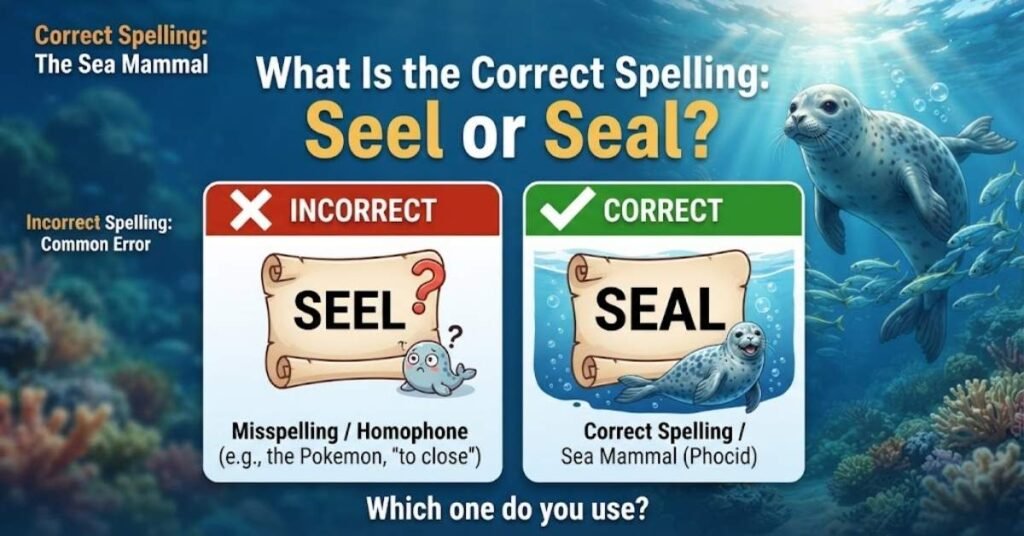
This question pops up more often than you’d think, especially among English learners and fast typists. The short version is simple: use seal in nearly every situation you’ll ever write in.
Seel technically exists, but it is so rare that most native speakers have never seen it in daily life. Think of it as a linguistic fossil rather than an everyday word.
Quick Answer
Seal is your go to spelling. It works as a verb, a noun, and even the name of that adorable marine mammal you see at the zoo. Seel stays tucked away in archaic English and old literary texts.
Understanding the Meaning of “Seal”
Seal carries three main meanings, and knowing them helps you use the word with total confidence. This one small word does a lot of heavy lifting in the English language.
Seal as a Verb
When you seal the envelope, seal the package, or seal a container, you are closing it securely. This usage covers everything from mailing letters to shipping boxes at work.
You’ll also hear it in phrases like seal cracks in a wall or create an airtight seal on a jar. The goal is always the same: to prevent leakage and protect contents inside.
Seal as a Noun
Here, seal refers to an official seal or official stamp, like the one on a legal document or a company seal. It signals authentication and approval on something important.
You’ve probably seen a university seal on a diploma or a king’s seal in a history book. These marks exist purely for document verification and trust.
Seal as an Animal
Of course, there’s the furry version too. A harbor seal lolling around on rocks is a common sight in coastal waters near any decent aquarium.
Baby seals are basically nature’s cutest marketing team for marine life conservation. Spotting one at the beach tends to make everyone’s day a little better.
What Does “Seel” Mean?
Seel is a verb from falconry, an old hunting practice involving trained hawks and falcons. It meant to sew a bird’s eyelids shut temporarily to calm it during training.
Yes, that’s a strange image for a modern reader. It’s a reminder of just how much English has shifted since medieval hunting was a common pastime.
Why You Rarely See “Seel”
You’ll mostly find seel in historical texts, medieval language, or Shakespeare. It belongs to literary English rather than anything you’d type in an email today.
Outside of academic study or archaic English research, this word has zero practical use. It’s an obsolete word that survived only because scholars kept it alive in old manuscripts.
Seel vs Seal: Key Differences
The two words look almost identical, but their meanings couldn’t be further apart. One belongs to your daily vocabulary, and the other belongs in a museum of language history.
Seal is active, common, and flexible. Seel is a rare word tied to a very specific, very outdated practice that most people will never encounter again.
The Easy Rule to Remember
If you’re writing anything modern, from a text message to a business contract, always go with seal. There is genuinely no situation in everyday communication where seel would be expected.
Save seel for trivia nights or literature classes. Everywhere else, seal is your answer, full stop.
Common Situations Where People Misspell Seal
Even confident writers slip up here sometimes. Let’s look at why this spelling confusion happens so often, especially with how we type today.
Fast Typing
When you’re rushing through a message, your fingers sometimes drop or swap letters without you noticing. A quick typo can turn seal into seel in half a second.
This is especially common on phones, where mobile typing and small keyboards make spelling errors more likely. Slow down, and you’ll catch it almost every time.
Autocorrect Doesn’t Catch It
Here’s the tricky part. Predictive keyboards and spell check tools sometimes miss this error because seel is technically a real, dictionary listed word.
Your phone won’t flag it as wrong, even though it’s the wrong word for context. That’s exactly why proofreading still matters, no matter how smart your device claims to be.
Pronunciation Confusion
Both words sound almost the same when spoken aloud. This overlap creates a kind of near-homophones situation that trips up even careful writers.
If you’re learning English as a second language, this pronunciation overlap can be genuinely confusing at first. Repetition and reading help close that gap over time.
Grammar Rule: Why “Seal” Is Correct
Grammar wise, seal fits naturally into modern sentence structures as both a noun and a verb. Seel does not follow current usage patterns and rarely appears in any standard grammar guide.
Modern dictionaries list seel as archaic or obsolete, which tells you everything about its current standing. Seal remains the correct word for everyday English.
Memory Trick
Here’s a simple one: SEA + L = SEAL. Since seals live in the sea, this little formula sticks in your brain almost instantly.
Next time you hesitate, just picture a seal swimming through the ocean. That mental image alone should settle the spelling question for good.
Real-Life Case Study: A Small Typo That Changed the Meaning
A small business owner once typed “please seel the contract” in an email to a client. The client, confused, assumed it was a typo for something else entirely, and the deal stalled for a full day while they cleared it up.
That single letter mix up cost real time and created unnecessary back and forth. It’s a small but honest example of why language accuracy actually matters in professional communication.
Usage Examples in Everyday English
Seeing seal used across different settings makes the correct usage stick faster than any rule ever could.
Business
In the office, you might seal important documents before sending them out, or ask someone to seal the box for shipping. Business writing depends on this kind of precision.
Home
At home, you’ll seal the bottle after use or check that your food containers have a waterproof seal. It’s a small daily habit most people never think twice about.
School
Students often see this word in academic writing, especially in essays discussing symbols, certificates, or contracts. Teachers expect the correct spelling every single time.
Nature
In science class or nature documentaries, kids learn about the harbor seal and other ocean animals. It’s often their first real introduction to marine mammal biology.
Data & Statistics (2025–2026)
Google searches for “seel or seal” and related search intent keywords have quietly grown over the past year, largely thanks to educational websites and language platforms answering the question directly.
Search trend data from major grammar and language learning sites shows that confusion around commonly misspelled words remains one of the most searched grammar topics among English learners and students preparing assignments.
Common Mistakes to Avoid
A few habits tend to cause the most trouble here, so let’s call them out directly.
Mistake 1
Typing seel because it “looks close enough” without double checking. Context always decides the correct word, not visual similarity.
Mistake 2
Trusting autocorrect blindly. As mentioned earlier, it won’t always catch this particular error since both words technically exist.
Mistake 3
Mixing up the noun and verb forms of seal itself, like confusing an official stamp with the act of closing something. Context sorts this out quickly once you’re aware of it.
Tips to Always Remember the Correct Spelling
A few small tricks go a long way toward locking this spelling into memory for good.
Remember the Ocean Trick
Picture the animal. Seals live in the sea, and that visual alone reinforces the correct spelling difference almost instantly.
Think About Closing
Whenever you mean “closing” something, whether it’s an envelope or a deal, seal is your word. This mental shortcut works in nearly every writing scenario.
Proofread Carefully
Build a habit of rereading before you hit send. This one small proofreading habit catches far more errors than any app ever will.
Mini Quiz: Seel or Seal
Test yourself with these quick questions before moving on.
Quiz 1: Which Word Is Correct?
“Please ___ the envelope.” Answer: seal.
Quiz 2: Fill in the Blank
“The ___ swam gracefully near the shore.” Answer: seal.
Quiz 3: True or False
“Seel” is common in modern English. Answer: False.
Quiz 4: What Does “Seal” Mean?
Choose all that apply: verb, noun, animal. Answer: All three.
Quiz 5: Fill in the Blank
“The company ___ appears on every official letter.” Answer: seal.
Quiz 6: Spot the Correct Sentence
“He sealed the box” or “He seeled the box”? Answer: He sealed the box.
Quiz 7: Quick Choice
Falconry term: seel or seal? Answer: seel.
Quiz 8: Fill in the Blank
“Make sure the jar has an airtight ___.” Answer: seal.
Quiz 9: True or False
Autocorrect always catches this mistake. Answer: False.
Quiz 10: Which One Fits?
“The king’s ___ authenticated the document.” Answer: seal.
Quiz 11: Fill in the Blank
“The ___ trick uses SEA plus L.” Answer: memory.
Quiz 12: Final Challenge
Write one sentence correctly using “seal” as a verb and one as a noun.
References
Standard English dictionaries and established grammar resources consistently list seal as the modern, standard spelling, while marking seel as archaic or historical usage tied to falconry and older literary works.
FAQs
Q1: Is “seel” a real English word?
Yes, but it’s archaic and tied specifically to historical falconry practices.
Q2: Is “seal” always the correct spelling?
For virtually all modern writing, yes, whether you mean the verb, noun, or animal.
Q3: Why doesn’t spell check always correct “seel”?
Because it’s technically a valid dictionary word, so most tools won’t flag it as an error.
Q4: Which word should students use?
Always use seal in school assignments and academic writing.
Q5: Can “seal” be both a noun and a verb?
Yes, and it can also refer to the animal, making it a genuinely flexible word.
Q6: Is “seel” acceptable in formal writing?
Not in modern formal writing. It only fits in historical or literary contexts.
Conclusion
At the end of the day, seal is the word you want almost every single time you write. Seel had its moment centuries ago in the world of falconry, but it simply doesn’t belong in modern English anymore.
Keep that ocean trick in your back pocket, proofread before you send anything important, and you’ll never second guess this spelling again.

Henry Parker is an English language writer with several years of experience helping learners understand grammar and improve their writing. He enjoys breaking down confusing grammar rules into simple explanations and practical examples. Through his work at HexoWaves, Henry shares useful tips on grammar, vocabulary, sentence structure, and everyday English.