

Have you ever paused while writing and wondered whether matt, mat, or matte is the correct word? These spellings look nearly identical, but each one carries a completely different meaning. One extra letter can change a person’s name into an object or describe a surface finish. Choosing the wrong spelling can create confusion and make your writing look less polished.
The word matt usually refers to a person’s name and is a short form of Matthew. Mat describes everyday items like floor coverings, yoga mats, and protective pads. Matte refers to a smooth, non-shiny finish used in paint, photography, and beauty products. Once you understand the difference, these words become easy to use correctly in conversations, emails, and professional writing.
Quick Answer
The difference between matt and mat depends on the meaning you want to express. These words look similar, but they serve different purposes in US English.
Mat usually refers to an object. It can mean a floor covering, exercise pad, or protective material placed on a surface.
Examples include:
- Floor mat
- Yoga mat
- Welcome mat
- Bath mat
- Place mat
Matt is mainly a proper noun. It is a male given name and a short form of Matthew.
For example:
“Matt is coming to the gym today.”
“I placed my yoga mat near the door.”
When describing a non-shiny surface, American English usually prefers matte, such as:
- Matte paint
- Matte screen
- Matte lipstick
A simple way to remember it:
- Mat = object or action
- Matt = person’s name
- Matte = dull or non-reflective finish
Why People Confuse Them
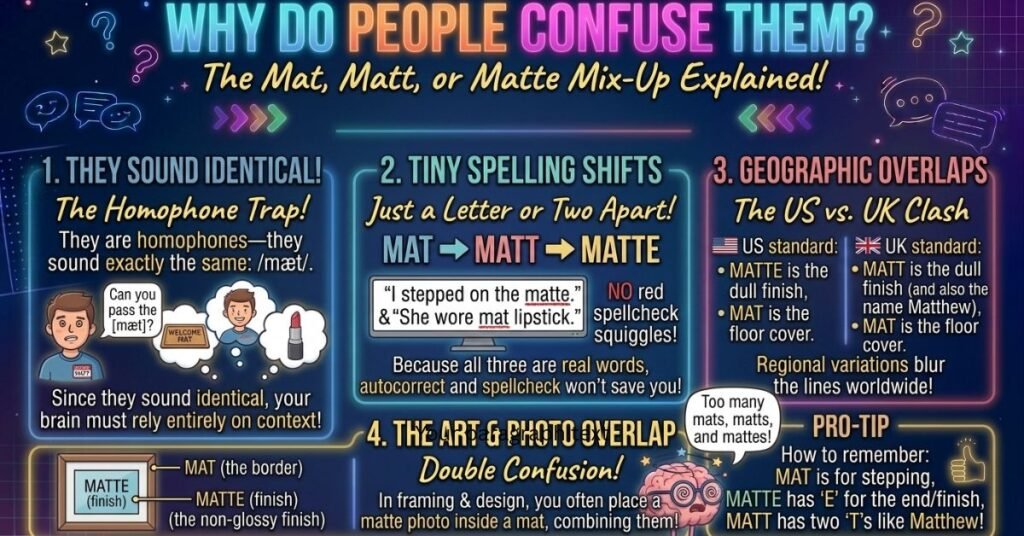
Many people confuse matt and mat because they are homophones. They have the same pronunciation: /mæt/.
When spoken, you cannot hear a difference between them. The meaning comes from the spelling and context.
For example:
“I bought a new mat.”
You know it means a floor covering because of the word “bought.”
However:
“I called Matt.”
Here, Matt clearly refers to a person.
Other reasons for confusion include:
- Similar spelling with only one extra letter
- Autocorrect changing words incorrectly
- Online shopping descriptions using different spellings
- Exposure to British English
British English sometimes uses “matt finish,” while US English usually prefers “matte finish.”
A quick conversation example:
Person 1: “Should I write yoga matt or yoga mat?”
Person 2: “Use yoga mat. The extra ‘t’ changes the meaning.”
Proofreading helps catch these small mistakes. A simple typo can affect professional writing, product descriptions, and academic work.
Key Differences At A Glance
Understanding the basic differences between matt, mat, and matte makes word choice much easier.
| Word | Meaning | Example |
| Mat | A physical object or verb | I cleaned the floor mat. |
| Matt | A male given name | Matt works at the office. |
| Matte | A dull, non-shiny surface | She chose matte paint. |
More differences:
- Mat
- Works as a noun and verb
- Refers to objects, materials, or tangled things
- Has many common uses
- Matt
- Works as a proper noun
- Usually means a person named Matt
- Often comes from Matthew
- Matte
- Works as an adjective
- Describes a flat finish without shine
- Common in beauty, photography, and interior design
Examples:
“I bought a foam mat for my workout.”
“Matt Damon is a famous actor.”
“She selected a matte foundation for a natural look.”
The correct choice depends on context, tone, and meaning.
Matt vs Matte: What’s the Difference?
Although matt and matte look almost identical, they have different meanings.
In American English, Matt usually refers to a person. It is a short form or nickname for Matthew.
Matthew comes from Hebrew origin and means “gift of God.”
For example:
“Matt joined the meeting early.”
On the other hand, matte describes a surface that does not reflect much light.
You will often see this word in:
- Matte paint
- Matte nail polish
- Matte lipstick
- Matte foundation
- Matte background
- Matte screen
A matte finish creates a soft, flat appearance instead of a glossy look.
For example:
“This camera has a matte background to reduce glare.”
“She prefers matte lipstick because it looks less shiny.”
The confusion often happens because British English may use matt finish. However, most US style guides recommend matte finish for American readers.
Meaning and Usage Difference
The meaning of mat changes depending on how you use it. It can work as both a noun and a verb.
As a noun, mat usually means a piece of material used for covering, protecting, or cushioning a surface.
Common examples include:
- Floor mat
- Exercise mat
- Wrestling mat
- Beach mat
- Car mat
- Mouse mat
- Anti-slip mat
- Anti-fatigue mat
You may also see decorative options like a bamboo mat or table mat in home decor.
Example:
“I bought a new bath mat for the bathroom.”
As a verb, mat means to become tangled or form a dense mass.
Examples:
- Matted hair
- Matted fur
- Tangled yarn
- Interwoven fibers
Example:
“The dog’s fur can mat if it is not brushed regularly.”
Meanwhile, Matt mainly works as a proper noun.
It refers to a person, often someone named Matthew.
Example:
“Matt brought his notes to the class.”
The correct word depends on the situation. Good word choice improves clarity, credibility, and professional communication.
Matts or Mats: Which Is Correct?
The correct plural form depends on what you mean. Mats is the standard plural form of mat when you talk about objects.
For example, you would write:
- Yoga mats
- Floor mats
- Bath mats
- Exercise mats
- Welcome mats
The word matts is not the usual plural form for objects. However, it can appear informally when talking about more than one person named Matt.
Example:
“Two Matts joined the meeting today.”
Here, Matts refers to two people with the given name Matt. It is not a common spelling choice.
A simple way to remember:
- Mat → Mats = objects
- Matt → Matts = people named Matt
Conversation example:
Person 1: “Should I write three yoga matts?”
Person 2: “No, write three yoga mats. Add only one ‘t’ before the plural ending.”
Using the correct plural form improves your spelling, clarity, and credibility in everyday and professional writing.
Tone, Context, and Formality
The choice between matt, mat, and matte depends on the situation. Context tells readers what you mean.
Mat feels practical and everyday. You will see it often in home goods, fitness, and workplace settings.
Examples:
- A gym uses anti-slip mats for safety.
- A yoga studio sells comfortable exercise mats.
- A homeowner buys a new welcome mat.
Matt feels personal because it usually refers to someone’s name. Since it is a proper noun, it needs capitalization.
Example:
“Matt helped me move the furniture.”
Meanwhile, matte sounds more professional when describing a surface finish.
It appears in areas like:
- Interior design
- Photography
- Makeup brands
- Product descriptions
Example:
“The camera has a matte background that reduces reflection.”
In formal writing, using the correct word shows attention to detail. A small spelling choice can affect how professional your message appears.
How Do You Spell Matt?
The name Matt is spelled with two “t” letters:
M-A-T-T
It is a common short form or nickname for Matthew. In American English, Matt is usually a male given name and works as a proper noun.
Because it is a name, capitalization matters.
Correct examples:
- Matt arrived early for work.
- I spoke with Matt yesterday.
- Matt Damon is a well-known actor.
Incorrect example:
- I met matt at the office.
The lowercase version looks like a spelling mistake because names require a capital letter.
The full name Matthew has Hebrew origin and carries the meaning “gift of God.” Over time, Matt became a popular shortened version.
Conversation example:
Person 1: “Is matt a common noun?”
Person 2: “No. When you mean the person’s name, write Matt with a capital M.”
Remember:
- Matt = person’s name
- Mat = object or action
- Matte = surface description
Which One Should You Use?
Choosing the correct spelling becomes simple when you check the meaning first.
Ask yourself one question:
Am I talking about a person, an object, or a surface finish?
Use mat when you mean an item used for covering, protecting, or cushioning.
Examples:
- Floor mat
- Car mat
- Wrestling mat
- Beach mat
- Bamboo mat
Use Matt when you mean a person’s name.
Examples:
- Matt is my coworker.
- I called Matt after school.
Use matte when you describe something with a flat, non-shiny appearance.
Examples:
- Matte lipstick
- Matte nail polish
- Matte screen
- Matte paint
A quick conversation:
Person 1: “I need a new matt for my workout.”
Person 2: “For a workout item, the correct spelling is yoga mat.”
The right choice depends on context. Good word choice prevents reader confusion and makes communication clearer.
When One Choice Sounds Wrong
Some spelling choices immediately sound incorrect to American English readers. The reason is simple: the word does not match the meaning.
For example:
❌ “I bought a new yoga matt.”
✅ “I bought a new yoga mat.”
A yoga mat is an object, so it uses one “t.”
Another example:
❌ “Matt paint gives a soft look.”
✅ “Matte paint gives a soft look.”
In US English, matte is the preferred spelling for a non-reflective finish.
Using the wrong form can distract readers.
Common confusing examples:
- “The wrestler stepped onto the Matt.”
- Sounds like the athlete stepped onto a person.
- “My friend mat called me.”
- Looks like a missing capital letter.
- “The makeup brand launched a matt lipstick.”
- Many US readers expect “matte lipstick.”
Correct spelling keeps your writing smooth and professional.
Common Mistakes (and Quick Fixes)
Many mistakes happen because matt, mat, and matte sound exactly the same. Since they are homophones, writers must rely on meaning and spelling rules.
Here are common errors and simple fixes:
| Mistake | Correct Form |
| Yoga matt | Yoga mat |
| Floor matt | Floor mat |
| Matt finish | Matte finish |
| matt as a person’s name | Matt |
Other mistakes include:
- Forgetting capitalization for Matt
- Using matts instead of mats for objects
- Confusing British English and American English styles
- Trusting autocorrect without proofreading
A quick proofreading check helps:
- Is it a person? → Use Matt
- Is it an object? → Use Mat
- Is it a dull surface? → Use Matte
Conversation example:
Person 1: “My product description says car matt.”
Person 2: “Change it to car mat. It describes a vehicle floor covering.”
Small spelling details create stronger writing. Correct word choice improves clarity, consistency, and reader trust.
Everyday Examples
Seeing matt, mat, and matte in real situations makes the difference easier to understand. These words appear in homes, workplaces, shopping sites, and everyday conversations.
The word mat usually describes a physical item. You may find it in fitness, home decor, or workplace safety.
Common examples include:
- “I bought a new yoga mat for my morning workouts.”
- “The welcome mat looks great near the front door.”
- “The gym replaced old wrestling mats.”
- “She cleaned the car mat after a muddy trip.”
The name Matt appears when talking about a person.
Examples:
- “Matt joined the meeting this morning.”
- “I asked Matt for help with the project.”
The word matte describes a surface without shine.
Examples:
- “The photographer used a matte background.”
- “She prefers matte lipstick over glossy colors.”
Conversation example:
Person 1: “Is this a matt screen?”
Person 2: “In American English, write matte screen because it describes a non-reflective surface.”
Understanding these everyday examples helps you choose the right spelling quickly.
Dictionary-Style Word Details
A dictionary explains mat, matt, and matte by looking at their meaning, grammar, and part of speech.
Each word has a different role in American English.
Mat
- Part of speech: Noun and verb
- Meaning: A piece of material used for protection, covering, or cushioning
- Another meaning: To become tangled or form a dense mass
Examples:
- Floor mat
- Bath mat
- Exercise mat
- Anti-fatigue mat
As a verb, mat describes hair, fur, yarn, or fibers becoming tangled.
Example:
“Humidity can cause hair to mat quickly.”
Matt
- Part of speech: Proper noun
- Meaning: A male given name
- Origin: Short form of Matthew
The name Matthew has Hebrew origin and means “gift of God.”
Because Matt is a name, capitalization matters.
Correct:
“Matt works in marketing.”
Incorrect:
“matt works in marketing.”
Matte
- Part of speech: Adjective
- Meaning: A flat, non-shiny, non-reflective surface
Common uses include:
- Matte paint
- Matte foundation
- Matte nail polish
- Matte lipstick
- Matte screen
A style guide for US English usually recommends “matte” instead of “matt” for finishes.
Verb
The word mat can work as a verb when something becomes tangled, packed together, or stuck into a dense mass.
This meaning often applies to hair, fur, fabric, or fibers.
Examples:
- “The dog’s fur started to mat without regular brushing.”
- “Wet yarn can mat together during storage.”
- “The fibers became matted after heavy use.”
Related forms include:
- Matted hair
- Matted fur
- Interwoven fibers
- Tangled fabric
The verb mat does not relate to the name Matt.
A simple comparison:
Mat: “The wool began to mat after washing.”
Matt: “Matt washed the wool.”
The pronunciation stays the same, but the meaning changes completely.
When writing, always check the context before choosing the spelling.
Noun
As a noun, mat refers to a physical object or a thick tangled layer of material.
The most common meaning is a flat piece of protective material placed on a surface.
Examples include:
- Floor mat
- Welcome mat
- Doormat
- Yoga mat
- Wrestling mat
- Beach mat
- Car mat
- Mouse mat
Mats can provide:
- Cushioning
- Protection
- Comfort
- Safety
For example:
- A gym uses foam mats to protect athletes.
- A workplace uses anti-slip mats to prevent accidents.
- A home may use a bamboo mat for decoration.
The word Matt does not work as a common noun because it usually identifies a person.
Example:
“Matt bought a new mat.”
Here, the first word names a person and the second names an object.
Synonyms
The synonyms for mat depend on the meaning and context.
For a floor covering or protective item, similar words include:
- Rug
- Pad
- Floor covering
- Cushion
- Protective material
However, these words do not always mean exactly the same thing.
For example:
A rug usually covers a larger floor area. A mat is often smaller and more functional.
For exercise, you may use:
- Workout pad
- Exercise pad
For tangled materials, similar words include:
- Tangle
- Clump
- Knot
- Dense mass
For a matte surface, related descriptions include:
- Flat finish
- Dull surface
- Non-shiny
- Non-reflective
Antonyms can also change based on meaning:
- Matte ↔ Glossy
- Dull ↔ Shiny
- Tangled ↔ Smooth
Choosing the closest synonym depends on the exact message you want to communicate.
Example Sentences
Correct examples help you understand how matt, mat, and matte work in real writing.
Mat examples:
- “Please wipe your shoes on the doormat before entering.”
- “The yoga studio bought new exercise mats.”
- “The wrestling team cleaned the foam mats after practice.”
- “The car mat was covered with dirt after the road trip.”
Matt examples:
- “Matt called me after the business meeting.”
- “I asked Matt to review my report.”
- “Matt Damon is a popular actor.”
Matte examples:
- “The designer selected matte paint for the bedroom walls.”
- “This camera has a matte screen that reduces reflection.”
- “She bought matte foundation for a natural look.”
Conversation example:
Person 1: “I wrote that the room has a matt finish.”
Person 2: “For US English, use matte finish when describing a dull surface.”
Correct examples make spelling choices feel natural instead of confusing.
Word History
The history behind these words explains why they look so similar today.
The word mat comes from older languages connected with woven materials. People used woven mats for flooring, sleeping areas, and protection for centuries.
The name Matt developed from Matthew, a traditional name with Hebrew origin. Over time, Matt became a common short form and nickname.
The word matte came through European languages and became associated with surfaces that lack shine.
Today, American English separates these meanings clearly:
- Mat = object or action
- Matt = person’s name
- Matte = surface appearance
Regional preferences can create confusion. British English may use “matt finish,” while US English commonly uses “matte finish.”
Knowing the word history helps explain why these spellings exist side by side.
Phrases Containing
Many common phrases use mat because it connects to everyday objects and activities.
Popular examples include:
- Welcome mat
- Yoga mat
- Bath mat
- Floor mat
- Place mat
- Table mat
- Car mat
- Wrestling mat
- Mouse mat
- Anti-slip mat
- Anti-fatigue mat
Examples:
- “Put out the welcome mat before the guests arrive.”
- “She carries her yoga mat to the studio.”
- “The mechanic replaced the old car mat.”
The word Matt appears mostly in personal references.
Examples:
- “Hey Matt!”
- “Matt’s office”
- “Matt’s project”
There are fewer fixed phrases with the name because it identifies a person rather than an object.
Using the right phrase improves clarity in professional writing, social media posts, product descriptions, and everyday communication.
FAQs
Is it spelled Matt or Mat?
Matt refers to a person’s name, while mat describes an object or material.
Both spellings are correct, but their meanings differ.
What does Matt mean?
Matt is a male given name and short form of Matthew.
It commonly appears as a nickname in American English.
What does mat mean?
Mat means a floor covering, pad, or protective material.
It can also work as a verb for tangled hair or fibers.
Is Matt a correct spelling of Matthew?
Yes, Matt is the accepted short form of Matthew.
It is a common nickname used in US English.
Can Mat be a person’s name?
Yes, Mat can sometimes appear as a person’s name.
However, Matt is the more common spelling.
What is the difference between Matt and mat?
Matt is a proper noun for a person’s name.
Mat is a common noun or verb related to objects and actions.
Should Matt be capitalized?
Yes, Matt should always have capitalization when naming someone.
It is a proper noun, like other personal names.
Is “mat” or “matt” correct for a floor covering?
Mat is correct for a floor covering, not matt.
Examples include floor mat, yoga mat, and welcome mat.
Is it “Matts” or “mats”?
Mats is the correct plural form for multiple objects.
Matts usually refers to several people named Matt.
Is Matt the same as matte?
No, Matt and matte have different meanings and uses.
Matte describes a dull, non-shiny surface finish.
What is the plural of mat?
The plural form of mat is mats.
You can say yoga mats, floor mats, or bath mats.
How do you use Matt and mat in a sentence?
Matt joined the meeting, while the mat stayed near the door.
The words differ based
Conclusion
Understanding matt, mat, and matte becomes simple when you focus on their meanings. Matt is mainly a person’s name and a short form of Matthew. Mat refers to objects like a yoga mat, floor mat, or welcome mat. Matte describes a dull, non-shiny surface.
Choosing the correct word helps your writing stay clear and professional. Whether you use matt in a name, mat for an object, or matte for a finish, context matters. Small spelling details can prevent confusion and improve communication. Once you understand how matt works, you can easily choose the right spelling in everyday writing, messages, and professional content.

Henry Parker is an English language writer with several years of experience helping learners understand grammar and improve their writing. He enjoys breaking down confusing grammar rules into simple explanations and practical examples. Through his work at HexoWaves, Henry shares useful tips on grammar, vocabulary, sentence structure, and everyday English.

