

Have you ever seen PS at the end of a message and wondered why someone added it? This small abbreviation appears in texts, emails, letters, and social media captions. It often catches attention because it comes after the main message. Many people use it to add one last thought, reminder, or personal comment.
ps means postscript, which refers to something written after the main message. Although it started in traditional letters, PS still has a place in today’s digital communication. You may see it in friendly chats, funny posts, or even casual work emails. Knowing how to use PS helps you understand messages better and add extra details naturally. It is a simple tool that can make your words feel more personal and engaging.
Quick Answer
PS means “postscript.” It refers to an extra note, thought, or reminder added after the main message is already finished.
People use PS in texting, emails, letters, and social media captions when they remember something after writing the main message.
For example:
I’ll meet you at 6 PM. PS: Bring the tickets.
The first sentence shares the main message. The PS adds a small additional note.
You can think of PS as a little “one more thing” at the end of a conversation.
It often adds a friendly, casual, or personal touch. However, it can also appear in a business message or personal email when the extra detail feels separate from the main point.
TL;DR
PS means “postscript,” which means “written after.” It adds an extra thought after the main message.
Here are the key points:
- PS is an abbreviation, not usually slang.
- It comes from the Latin phrase Post scriptum.
- It means an additional note added at the end.
- People use it in texting, emails, captions, and online chat.
- PS can introduce a reminder, joke, or personal comment.
- You may see it written as PS, P.S., or P.S.:.
Example:
Great photo from the beach! PS: We should visit again soon. 😂
The meaning stays the same, but the tone can change depending on the situation.
A friendly message may feel warm, while a business message may sound more formal.
What Does PS Mean in Text?
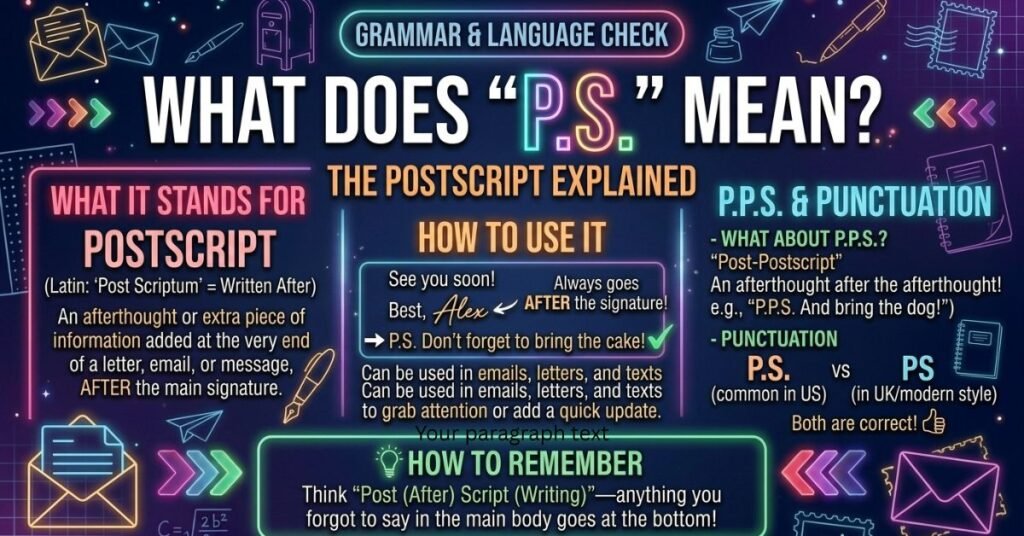
PS means “postscript,” which is an extra message placed after the main message. It helps you add something you forgot or want to mention separately.
The word comes from Post scriptum (Latin), which means “written after.” Long before texting existed, people used postscripts in letters.
Today, PS works naturally in digital communication. You can see it in:
- Text messages
- Emails
- Online chat
- Social media captions
- Personal notes
For example:
Hey Alex, thanks for helping me today. PS: Don’t forget your charger.
The first sentence delivers the main message. The PS adds an extra thought.
People often use PS for:
- A quick reminder
- A funny comment
- A personal feeling
- A final note
- An additional note
It works like a small message attached at the end.
Conversation Example
Jordan: I sent you the photos from yesterday.
Alex: Thanks!
Jordan: PS: Check the last picture. It’s my favorite.
What does “postscript” mean?
A postscript means something added after the main writing is complete.
The word literally connects to the idea of something being “written after.”
In old letters, writers used a postscript when they finished writing but remembered one more detail.
For example:
Dear Sam,
I hope you are doing well.
PS: Please bring my book tomorrow.
The postscript appears after the main message.
Today, the same idea applies to modern conversations. A PS can be a short extra thought that does not fit smoothly into the original message.
It is not a replacement for the main message. Instead, it works like a small addition at the end.
Is PS Slang?
No, PS is not usually considered slang. It is a standard abbreviation that has been used in writing for many years.
Some people think PS is texting slang because they see it in casual conversations. However, the meaning does not come from internet culture.
It simply stands for postscript.
For example:
Movie starts at 8. PS: I’m bringing popcorn. 😂
The message sounds casual because of the words and emoji. The PS itself is still a traditional writing abbreviation.
PS can appear in different tones:
- Friendly tone in casual conversation
- Playful tone in social media captions
- Formal tone in some emails
- Personal tone in letters
A PS is more about message structure than slang.
How Do You Pronounce PS?
When you read PS aloud, you usually pronounce the letters separately:
“pee ess”
The full word, postscript, is pronounced:
“POHST-script”
Most people say “pee ess” when reading a text message or email.
Example:
Written:
PS: Call me when you arrive.
Spoken:
“Pee ess, call me when you arrive.”
The pronunciation stays the same in American English, whether you use it in texting, email, or a social media caption.
The full term “postscript” sounds more formal. You may hear it in writing discussions, grammar lessons, or professional settings.
What Part of Speech Is PS?
PS is an abbreviation that works as a noun.
A noun names a person, place, thing, or idea. In this case, PS names an extra note added after a message.
Example:
She added a PS to her email.
Here, PS refers to the additional note itself.
The part of speech remains connected to the idea of a postscript. It does not usually work as a verb, adjective, or adverb.
In language studies, understanding the part of speech helps explain how words function in a sentence.
PS is mainly used as:
- A noun
- A writing abbreviation
- A label for an extra message
Example:
The PS included important details about the documents.
The sentence treats PS as a thing being added.
How to Use PS in a Message
Using PS is simple. Add it after your main message when you want to include one more thought.
A common structure looks like this:
Main message → PS → Extra thought
Example:
I’ll send the documents tonight.
PS: Please check your email.
The PS should usually stay short. If the information becomes too important or too long, place it inside the main message instead.
You can use PS in:
- Text messages
- Personal email
- Social media captions
- Online chat
- Business messages
Examples:
Reminder message:
Don’t forget our meeting tomorrow. PS: Bring your ID.
Friendly message:
Thanks for coming over. PS: I had a great time.
Funny message:
Your package arrived. PS: I checked it first. 😂
Romantic message:
Sleep well tonight. PS: I miss you.
For punctuation, many writers use a colon after PS:
PS: Remember your keys.
You may also see P.S. or P.S.:. The Chicago Manual of Style prefers PS without periods, but the best choice depends on your house style and consistency.
Should you use a colon after PS?
Using a colon after PS is a common and clear writing choice. It helps separate the extra note from the abbreviation.
For example:
PS: Don’t forget your umbrella.
The colon tells readers that a new thought is coming next. It makes the message easier to scan.
However, you may also see different styles, such as:
- PS
- P.S.
- P.S.:
All versions are understandable. The choice often depends on personal preference, punctuation rules, or a specific house style.
In modern American English, many writers prefer PS: because it looks simple and natural in digital communication.
The Chicago Manual of Style recommends PS without periods. Still, consistency matters more than choosing one specific style.
Examples:
With colon:
PS: I saved your seat.
Without colon:
PS I saved your seat.
Both communicate the same idea.
When should you use PS?
PS means an extra thought added after the main message. Use it when you remember something after finishing your original point.
It works best when the added information feels separate but still connected.
You can use PS for:
- A quick reminder
- A final note
- A personal comment
- A small joke
- An emotional message
For example:
I’ll meet you near the café at 5. PS: Bring your charger.
The main message gives the plan. The PS adds a useful reminder.
However, avoid using PS when the information is important. If the detail changes the meaning of your message, include it in the main message instead.
A good PS feels like a little extra at the end, not a second full message.
Common Contexts for PS
PS means “postscript,” and people use it in many types of communication. The meaning stays the same, but the tone can change depending on where you use it.
In older letters, writers added a postscript after signing their name. Today, people use PS in digital communication because it feels personal and easy.
Common places where you may see PS include:
- Text messages
- Emails
- Social media captions
- Online chats
- Personal notes
- Some business messages
The style can be:
- Friendly
- Casual
- Playful
- Formal
For example, a friend may use PS to add a joke. A coworker may use it to mention one final detail.
Text messages
Texting is one of the most common places where people use PS today.
A text message is usually quick and informal. PS helps you add something after you already finished your main thought.
Example:
I’m leaving work now. PS: Can you pick up the keys?
The first sentence shares the update. The PS adds a reminder.
People often use PS in texting for:
- Reminders
- Funny comments
- Last-minute details
- Personal thoughts
Conversation Example:
Jordan: I’ll see you tonight at 7.
Alex: Perfect.
Jordan: PS: Don’t forget the tickets.
Here, PS makes the reminder stand out without interrupting the original message.
Emails
PS has a long history with letters, so it also fits naturally in emails.
People often place a PS after the sign-off in a personal email.
Example:
Thanks for your help.
Best,
Alex
PS: I’ll send the photos tomorrow.
A PS can make an email feel warmer and more personal.
It works well for:
- Personal emails
- Friendly business messages
- Follow-up notes
However, a formal report usually does not need a PS. Important details should appear in the main content.
A business message should stay clear and organized. Use PS only when the extra note feels like a small addition.
Social media captions
Social media captions often use PS to add personality.
A caption may already explain a photo or moment. The PS adds a final thought that feels more personal.
Example:
Amazing day at the beach with friends. PS: I still can’t believe how sunny it was. 🌊
People use PS in captions for:
- Humor
- Emotions
- Extra details
- Personal reactions
It can also create a playful ending.
Example:
Best vacation ever! PS: I ate way too much popcorn. 😂
The PS gives the caption a conversational feeling, almost like talking directly with followers
Online chats
Online chats use PS in a similar way to texting.
Whether it happens in a group chat, messaging app, or online community, PS helps someone add one final point.
Example:
I finished the project. PS: Check the last page.
It works well because online conversations move quickly. People often remember details after sending their main message.
Common uses include:
- Adding forgotten information
- Sharing quick updates
- Making a conversation more friendly
Conversation Example:
Sam: I uploaded the files.
Taylor: Got them.
Sam: PS: The second folder has the updated documents.
The PS adds information without making the original message confusing.
PS Examples in Real Messages
Real examples make it easier to understand how PS works in everyday communication.
PS means a final addition after the main message. It can change the feeling of a message depending on the situation.
Here are different examples:
Reminder message
I’ll meet you outside the restaurant at 8. PS: Bring your ID.
The PS adds a helpful reminder.
Friendly message
Thanks for helping me move today. PS: I really appreciate you.
The extra note adds warmth and gratitude.
Funny message
Your package finally arrived. PS: I wanted to open it first. 😂
The PS creates a playful moment.
Work message
I finished the document review. PS: I fixed the formatting issue too.
This works in a casual workplace setting.
Romantic message
Sleep well tonight. PS: I miss you already.
The PS adds an emotional touch.
Social media caption
Weekend memories with my favorite people. PS: We need another trip soon.
The PS makes the caption feel more personal.
A good PS feels like a small surprise at the end of a message. It adds personality without taking attention away from the main idea.
Reminder
A reminder message is one of the most common ways people use PS. It helps you add a small detail after sharing the main information.
PS means a final note added after the main message. In a reminder, it works like a quick tap on the shoulder.
For example:
I’ll see you at the event tomorrow. PS: Bring your ID.
The meeting detail comes first. The PS adds the thing you should not forget.
People often use PS for reminders about:
- Tickets
- Keys
- Charger
- Documents
- Appointments
- Plans
Conversation Example:
Jordan: I’ll pick you up at 7.
Alex: Sounds good.
Jordan: PS: Don’t forget the tickets.
A reminder PS keeps the message short while making the extra detail easy to notice.
Friendly message
A PS can make a friendly message feel warmer and more personal.
Instead of ending a conversation suddenly, you can add a small extra thought that shows care or appreciation.
For example:
Thanks for spending time with me today. PS: I had a great time.
The main message shares gratitude. The PS adds a personal touch.
Friendly PS messages often include:
- Kind words
- Small memories
- Extra appreciation
- Personal thoughts
They work well in:
- Text messages
- Personal emails
- Online chats
- Letters
Conversation Example:
Mia: Thanks for helping me with the project.
Chris: No problem!
Mia: PS: I really appreciate your support.
The extra note makes the conversation feel more genuine and thoughtful.
Funny message
People often use PS to add humor after finishing a message.
A funny PS feels like a small joke at the end. It gives the reader a little surprise.
For example:
Your package arrived today. PS: I almost opened it first. 😂
The first sentence gives information. The PS adds a playful comment.
Funny PS messages usually appear in:
- Casual conversation
- Texting
- Social media posts
- Group chats
They can include:
- Jokes
- Funny reactions
- Light teasing
- Emojis
Conversation Example:
Sam: I saved you some popcorn.
Taylor: Thanks!
Sam: PS: I didn’t eat all of it. 😂
The PS adds personality and makes the message more entertaining.
Work message
PS can also appear in a work message when the tone is relaxed.
In professional communication, the extra note should stay short and useful.
For example:
I finished reviewing the report. PS: I updated the final section.
The main message explains the task. The PS adds one more detail.
PS works best in:
- Friendly workplace emails
- Team messages
- Casual professional conversations
However, avoid adding important information through PS in a formal report. Important details belong in the main content.
Conversation Example:
Jordan: I sent the updated documents.
Manager: Thanks.
Jordan: PS: I also corrected the formatting issues.
A work PS should improve clarity, not create confusion.
Social media caption
Social media captions often use PS to add a personal ending.
A caption may describe a photo or event. The PS adds an extra feeling, joke, or detail.
For example:
Perfect day at the beach with friends. PS: I definitely got too much sun. ☀️
The PS makes the caption sound more like a conversation.
People use PS in captions for:
- Funny comments
- Personal thoughts
- Extra memories
- Emotional messages
It works well on platforms like:
- TikTok
- Other social media posts
Example:
Best weekend ever! PS: We need to do this again soon. 😂
The final note gives followers a more personal connection.
Romantic message
A PS can add emotion to a romantic message.
Many people use it to share a sweet thought after the main message.
For example:
I hope you have a peaceful night. PS: I miss you.
The first sentence is caring. The PS adds a deeper feeling.
Romantic PS messages often include:
- Love
- Appreciation
- Missing someone
- Sweet memories
- Personal feelings
Conversation Example:
Alex: Goodnight. Sleep well.
Jordan: Thank you ❤️
Alex: PS: I can’t wait to see you tomorrow.
Because the PS comes at the end, it feels like a final heartfelt note.
Common Mistakes With PS
Although PS looks simple, people sometimes use it incorrectly. Understanding these mistakes helps you use it naturally.
PS means an extra note after the main message. It should support your message, not replace it.
Common mistakes include:
1. Treating PS as secret slang
Some people think PS has a hidden texting meaning.
However, PS is usually an abbreviation for postscript, not internet slang.
2. Placing PS before the main message
A postscript comes after the main message.
Incorrect:
PS: Bring your charger. I’ll see you at 6.
Better:
I’ll see you at 6. PS: Bring your charger.
3. Writing an overly long PS
A PS should feel like a small addition.
If your PS becomes several paragraphs, move the information into the main message.
4. Confusing PS versus P.S.
Both forms are understood.
You may see:
- PS
- P.S.
- P.S.:
The important thing is choosing one style and using it consistently.
5. Overusing PS
Not every extra sentence needs a PS.
Use it when the thought feels like a final note or afterthought. If it connects naturally with your message, simply write it normally.
A well-used PS adds charm. Too many can make a message feel messy.
Mistake 1: Treating PS as secret slang
One common mistake is assuming PS has a hidden texting meaning. Some people think it is a modern internet phrase or secret code.
However, ps means “postscript.” It is a traditional abbreviation that has been used in letters, emails, and digital communication for years.
PS is not usually slang. It simply introduces an extra note after the main message.
For example:
I’ll call you tonight. PS: I found your book.
The PS adds another detail. It does not change the meaning of the conversation.
People may use PS in a casual tone, but the abbreviation itself remains standard.
Remember:
- PS = Postscript
- It means an added note
- It is not a secret chat word
Understanding this helps you avoid confusion when reading texts or online messages.
Mistake 2: Putting PS before the main message
A postscript belongs after the main message. That is the whole idea behind the word “postscript.”
The prefix “post” means after, so PS should appear at the end, not the beginning.
Incorrect example:
PS: Bring your keys. I’ll meet you outside at 7.
This placement makes PS look like the main message.
Better example:
I’ll meet you outside at 7. PS: Bring your keys.
The first sentence delivers the important information. The PS adds a final reminder.
Use PS when you remember something after writing your message.
A simple format works best:
- Main message
- Sign-off (if needed)
- PS with extra thought
Conversation Example:
Alex: I’ll send the photos tonight.
Jordan: Great.
Alex: PS: I’ll include the beach pictures too.
The order feels natural because the extra note comes last.
Mistake 3: Making the PS too long
A PS works best when it stays short. It should feel like a small addition, not a second message.
A common mistake is turning a PS into a long explanation.
For example:
PS: I also wanted to explain the entire situation, share every detail, and discuss what happened yesterday…
This makes the reader wonder why the information was not included in the main message.
A better PS is brief:
PS: I’ll send the full details tomorrow.
Use PS for:
- A quick reminder
- A final thought
- A small update
- A personal comment
If the information needs several sentences or paragraphs, add it before the PS instead.
A good postscript feels like a little bonus at the end. It should not take over the conversation.
Mistake 4: Worrying too much about PS versus P.S.
Many writers spend too much time deciding between PS and P.S. Both forms are widely understood.
The difference mostly comes from punctuation style and personal preference.
You may see these versions:
- PS
- P.S.
- P.S.:
All of them communicate the same idea.
In modern American English, many writers choose PS because it looks cleaner in digital communication.
The Chicago Manual of Style prefers PS without periods.
However, the most important thing is consistency. If you choose one style, use it throughout your writing.
For example:
PS: Don’t forget your charger.
or
P.S.: Don’t forget your charger.
Both are clear.
Your choice may depend on:
- Personal style
- Company guidelines
- House style
- Type of writing
Mistake 5: Using PS for every extra sentence
Not every additional sentence needs a PS.
Some people add PS after every small detail. This can make messages look cluttered and less natural.
Remember, ps means a final note after the main message. It should feel like something added at the end.
Good use:
Thanks for meeting me today. PS: I enjoyed our conversation.
The extra thought feels separate.
Poor use:
I arrived. PS: I parked outside. PS: I brought coffee. PS: I saw your friend.
Too many PS notes make the message harder to follow.
Use PS when:
- You remember something late
- You want to add a personal touch
- The extra detail feels like an afterthought
If the sentence connects directly to your main idea, simply include it normally
Synonyms and Related Terms
Although PS has a specific meaning, several words describe similar ideas. These terms can help you understand how a postscript works.
The closest related term is postscript itself. It means an extra note added after the main message.
Other similar expressions include:
- Afterthought — an idea remembered later
- Additional note — extra information added separately
- Final note — a last message or comment
- Extra thought — another idea shared at the end
- Reminder — information that helps someone remember something
For example:
I’ll send the file tomorrow. PS: Don’t forget the meeting.
Here, the PS acts as a reminder and an additional note.
Related writing terms include:
- Sign-off — the closing part of an email or letter
- Main message — the primary information before PS
- Abbreviation — a shortened form of a word or phrase
You may also see PPS, which means a second postscript.
Example:
PS: Bring your charger. PPS: Bring your headphones too.
A PPS adds another note after the first PS. However, people use it much less often today.
Understanding these related terms makes it easier to recognize PS in different types of writing.
FAQs
What does PS mean in text?
PS means postscript, an extra note added after the main message. It shares reminders, thoughts, or final details.
What does PS stand for?
PS stands for postscript. The term comes from Post scriptum, meaning written after in Latin language.
Is PS slang?
No, PS is not slang. PS means postscript, a common abbreviation used in writing and messages.
What does PS mean in chat?
In chat, PS means an extra thought added later. People use it for reminders, jokes, or personal notes.
How do you use PS in a text?
Add PS after your main message to share one more detail. Example: PS: Bring your charger.
Is it PS or P.S.?
Both PS and P.S. are correct. Modern American English often uses PS for a cleaner style.
Where should PS go in an email?
PS usually goes after the sign-off in an email. It adds a final note, reminder, or extra thought.
Conclusion
PS means postscript, a simple way to add an extra note after the main message. Whether you see it in a text, email, or social media caption, PS means the writer has one more thing to share. It can add a reminder, funny thought, personal feeling, or final detail.
Using PS correctly keeps your message clear and natural. Remember, PS means an additional note, not secret slang. You can use PS means as a helpful reminder when writing messages, but keep it short. Choose PS or P.S. based on your style and stay consistent. In modern digital communication, PS means a small extra touch that makes conversations feel more friendly and personal.

Henry Parker is an English language writer with several years of experience helping learners understand grammar and improve their writing. He enjoys breaking down confusing grammar rules into simple explanations and practical examples. Through his work at HexoWaves, Henry shares useful tips on grammar, vocabulary, sentence structure, and everyday English.

