

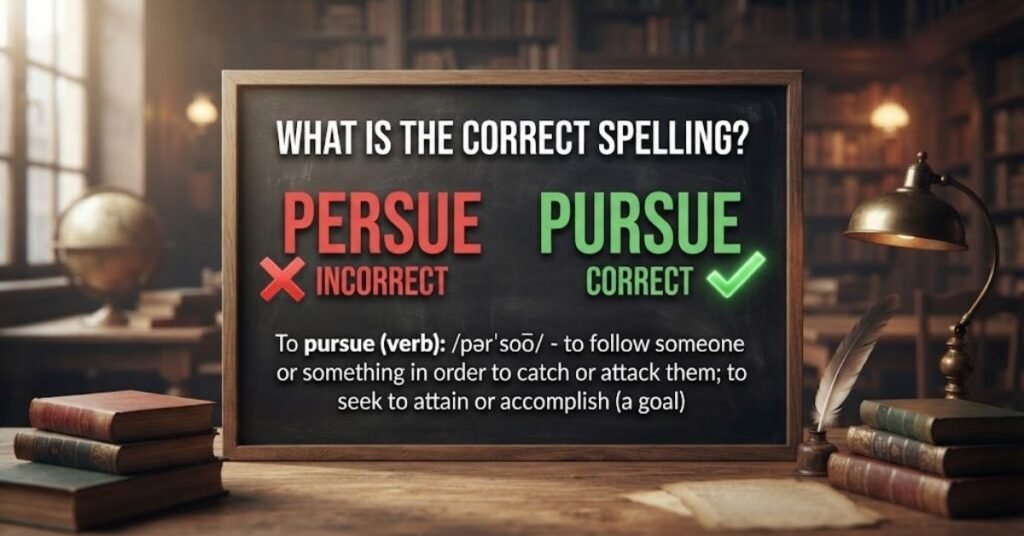
If you’ve typed “persue” and then paused, wondering if that looks right, you’re not alone.The correct spelling is pursue, not persue.
That one small mix up trips up students, professionals, and even careful writers every single day.This guide clears up the confusion for good, and by the end, you won’t second guess this word again.
What Is the Correct Spelling: Persue or Pursue?
Let’s settle this right away so you can stop scrolling and get your answer.
Pursue is the only correct spelling recognized in every major dictionary entry, including Merriam-Webster.
“Persue” is simply an incorrect spelling, a common typo that sneaks in because of how the word sounds when spoken.
Quick Answer
Pursue: correct.
Persue: incorrect, always.
Remember it this way: pursue has that “u” right after the “p,” and that little letter makes all the difference between correct usage and a spelling mistake.
Why Do People Misspell Pursue as Persue?
Honestly, this spelling error makes a lot of sense once you break it down.
English spelling doesn’t always match pronunciation, and pursue is a textbook example of that gap.
People hear the word, try to spell it phonetically, and end up with the wrong version without even realizing it.
The Pronunciation Confusion
Say pursue out loud. You’ll notice the first syllable sounds a bit like “per.”
That’s exactly where the trouble starts, because your ear tells you “per” while your eyes need to see “pur.”
This sound similarity between “per” and “pur” is the root cause of most word confusion around this term.
Common Situations Where Mistakes Occur
Fast typing is a big culprit here. When you’re rushing through an email, your fingers move faster than your brain checks spelling.
Autocorrect sometimes misses it too, especially on mobile keyboards where “persue” doesn’t always get flagged.
Non native English learners also mix it up more often, since phonetic instinct naturally leans toward “per” instead of “pur.”
Meaning of Pursue in English
Now that spelling is sorted, let’s talk about what pursue actually means, because context makes the word stick better in memory.
At its core, pursue means to follow a goal, chase after something, or continue an activity with real intention.
It’s a word packed with energy. It suggests effort, direction, and commitment, not just casual interest.
Pursue a Goal
When someone says they want to pursue a goal, they mean they’re actively working toward something, not just dreaming about it.
Think of a student who wants to pursue higher education. That’s not a passive wish, it’s a deliberate plan with steps attached.
This usage shows up constantly in conversations about ambitions, success, and achievement.
Pursue Someone or Something
Pursue also means to follow or chase, whether that’s literal or figurative.
Police might pursue a suspect. A company might pursue a partnership. A writer might pursue an idea until it becomes a full story.
In every case, there’s motion involved, someone or something is being actively followed.
Pursue an Activity
You can also engage in an activity by saying you pursue it, like photography, painting, or research.
Someone who loves capturing sunsets might say, “I pursue photography on weekends.”
It’s a natural way to describe a hobby you take seriously, not something you just dabble in occasionally.
Persue vs Pursue: Side-by-Side Comparison
Let’s put these two side by side so the difference sticks visually, which honestly helps more than any explanation.
| Word | Status | Example |
| Pursue | Correct | She wants to pursue a career in medicine. |
| Persue | Incorrect | She wants to persue a career in medicine. (wrong) |
Key Takeaway
Only one spelling exists in standard English, and that’s pursue.
If you ever see “persue” in a document, it’s a grammar mistake waiting to be fixed, plain and simple.
Keep that table in your back pocket next time doubt creeps in while you’re writing.
How to Remember the Correct Spelling of Pursue
Memory tricks work wonders here, and you don’t need to be a grammar expert to use them.
These four tricks are simple enough to remember on the spot, even mid sentence when you’re typing fast.
Pick whichever one clicks for you and stick with it. Consistency beats perfection.
Trick 1: Think of “Pure Success”
Pursue starts with “pur,” just like “pure.” Connect the two words in your head.
When you pursue success, you’re chasing something “pure” and meaningful, so let that connection anchor the spelling.
It’s a small mental shortcut, but it works surprisingly well under pressure.
Trick 2: Remember the “U”
Pursue has two u’s. Say it slowly: p-u-r-s-u-e.
Persue only has one, and that missing letter is exactly what makes it wrong.
Whenever you’re unsure, count the u’s. Two means you’re correct.
Trick 3: Visual Memory Method
Picture the word written out in bold letters, with the “u” highlighted in a different color in your mind.
This visual memory method helps your brain recognize the correct shape of the word faster over time.
Repetition paired with a strong image builds retention better than reading the rule ten times.
Trick 4: Use It in Sentences
Write three sentences using pursue right now. Seriously, try it.
Spelling practice through actual sentence writing beats passive memorization every time.
The more you use a word correctly, the less your brain reaches for the wrong version later.
Real-Life Example: How One Misspelling Cost a Job Applicant
Here’s a story that drives the point home better than any rule ever could.
A job applicant once submitted a strong resume, great experience, solid communication skills, everything looked promising.
But the cover letter had one line that read, “I want to persue a management position at your company.”
The recruiter noticed it immediately. Small errors like this signal a lack of attention to detail, especially in a document meant to represent your best work.
That single typo didn’t sink the application on its own, but it planted doubt. And in a competitive hiring process, doubt is expensive.
The lesson here isn’t to panic over every typo. It’s to double check the words that matter most, especially in professional documents.
Pursue in Different Contexts
Pursue shows up everywhere, from classrooms to boardrooms, and the meaning shifts slightly depending on where you use it.
Understanding these contexts helps you use the word naturally instead of forcing it into sentences where it doesn’t quite fit.
Let’s walk through four common areas where this word does a lot of heavy lifting.
Education
Students across the world pursue higher education every year, chasing advanced degrees and graduate studies to build stronger futures.
Researchers and scientists also pursue specific questions for years, sometimes decades, before publishing their findings in academic papers.
This kind of pursuit reflects learning as an ongoing journey, not a destination with a fixed endpoint.
Career Development
In the workplace, people pursue career opportunities, leadership opportunities, and professional growth constantly.
Someone eyeing a management position might spend months building skills before they formally pursue the role.
This word fits naturally into resume language, cover letter phrasing, and everyday workplace writing.
Business
Companies pursue strategic growth, step into new markets, and pursue partnerships that align with long term vision.
Investors often look for organizations that pursue long-term growth rather than quick, short lived wins.
This kind of language appears often in business proposal documents and internal strategy memos.
Personal Goals
On a personal level, people pursue happiness, financial freedom, and their own version of self-improvement.
Maybe you pursue a passion project on weekends, or you’re working quietly toward a dream you haven’t told anyone about yet.
Either way, personal development is really just a long, steady pursuit of becoming who you want to be.
Common Examples of Correct Usage
Seeing the word in action helps more than any dry definition, so here are real examples across different settings.
Notice how the tone shifts slightly depending on whether it’s casual, academic, or professional writing.
In Everyday Conversation
“I’ve decided to pursue painting more seriously this year.”
“She’s going to pursue that job lead she mentioned last week.”
In Academic Writing
“The researchers chose to pursue a longitudinal study to track results over time.”
“Students who pursue interdisciplinary studies often develop broader problem solving skills.”
In Business Writing
“Our company plans to pursue expansion into three new regions by next year.”
“We recommend the board pursue this partnership given the projected returns.”
Language Trends and Spelling Accuracy Statistics (2025 to 2026)
Google Trends data shows a steady rise in grammar related searches, especially around commonly confused words like pursue.
Spelling searches for terms like “is persue a word” spike regularly, which tells us this confusion isn’t going away anytime soon.
Interestingly, digital communication trends point to more people relying on spell checker tools than ever, yet mistakes still slip through in casual texting and social posts.
Online language behavior research also shows that error rates tend to rise on mobile devices, where autocorrect sometimes hides rather than fixes the problem.
This growing gap between spoken instinct and written accuracy is exactly why language accuracy content, like this guide, keeps gaining search interest year after year.
Step-by-Step Guide to Avoid Spelling Mistakes
Fixing one word is great, but building better writing habits protects you from dozens of future errors.
Here’s a simple five step process that takes less time than you’d think.
Step 1: Write Naturally
Don’t overthink your first draft. Let the words flow, even if a few come out wrong.
Perfection during drafting slows you down and rarely improves the final result anyway.
Step 2: Run a Spell Check
Use Grammarly or your built in spell check before finalizing anything important.
These writing tools catch obvious mistakes fast, though they’re not flawless, so don’t rely on them blindly.
Step 3: Read Aloud
Reading your work out loud forces your brain to slow down and actually notice odd looking words.
You’ll catch things your eyes glossed over during silent reading, almost every single time.
Step 4: Verify Uncertain Words
If a word feels off, check it. A quick dictionary search takes seconds and saves embarrassment later.
This is especially true for words that sound one way but are spelled another, exactly like pursue.
Step 5: Create a Personal Error List
Keep a running personal error list of words you personally struggle with.
Review it occasionally. Over time, that list shrinks, and your proofreading gets noticeably faster.
Commonly Confused Words Similar to Pursue
Pursue isn’t alone in causing trouble. English is full of these tricky pairs.
Here are a few more that trip people up just as often, and honestly, they’re worth bookmarking.
Accept vs Except
Accept means to receive. Except means excluding something. “I accept your offer, except for the last clause.”
Advice vs Advise
Advice is the noun, advise is the verb. “She gave advice.” “She advised me carefully.”
Loose vs Lose
Loose describes something not tight. Lose means to misplace or fail to win. Easy to mix up when typing fast.
Affect vs Effect
Affect is usually a verb, effect is usually a noun. “It affected me.” “The effect was clear.”
Persue vs Pursue
And of course, the pair we’ve covered in depth. Pursue wins, always. Persue simply isn’t a real word.
Other tricky ones worth knowing include definitely, separate, necessary, accommodation, transferred vs transfered, you too vs you to, lable vs label, and even goodmorning vs good morning.
Mini Quiz: Persue or Pursue
Test yourself with these quick questions. No pressure, just a fun way to lock in what you’ve learned.
Quiz 1: Choose the Correct Spelling
A) Persue B) Pursue
Quiz 2: Fill in the Blank
“I plan to ______ my dream job.” (pursue)
Quiz 3: True or False?
“Persue is an accepted alternate spelling.” (False)
Quiz 4: Meaning Check
Does pursue mean to give up or to chase after? (Chase after)
Quiz 5: Spot the Correct Sentence
A) “He wants to persue law.” B) “He wants to pursue law.” (B)
Quiz 6: One-Letter Challenge
Which letter is missing in “persue” that makes it wrong? (u)
Quiz 7: Workplace Writing Test
Fix this line: “We will persue this opportunity.” (pursue)
Quiz 8: Quick Grammar Check
Is pursue a noun or a verb? (Verb)
Quiz 9: Find the Mistake
“She decided to persue her passion.” (persue should be pursue)
Quiz 10: Dream Chaser Test
“To chase your dreams, you must ______ them daily.” (pursue)
Quiz 11: Dictionary Check
Which spelling appears in Merriam-Webster? (Pursue)
Quiz 12: Correct or Incorrect?
“Persue your goals.” (Incorrect)
Quiz 13: Multiple Choice
Pursue means: A) Ignore B) Follow C) Forget (B)
Quiz 14: Finish the Word
P U R S _ E (u)
Quiz 15: Final Challenge
Write one sentence using pursue correctly, right now, before moving on.
Conclusion
At the end of the day, this comes down to one simple rule worth remembering forever.Pursue is correct. Persue is not, and it never will be, no matter how many people type it.Whether you’re writing a resume, a business proposal, an essay, or just texting a friend about your ambitions, getting this word right shows care and professional credibility.
Small details like this build trust with readers, recruiters, and anyone judging your writing quality.So the next time your fingers start typing “per,” pause, picture that second “u,” and write pursue with confidence.
FAQs
Q1: Is persue a real word?
No. Persue is not a recognized word in any standard dictionary entry. The correct spelling is always pursue.
Q2: What does pursue mean?
Pursue means to follow a goal, chase after someone or something, or continue an activity with clear intention and effort.
Q3: Why do people write persue instead of pursue?
Mostly because of pronunciation confusion. The word sounds like “per-sue” when spoken, which misleads the spelling in writing.
Q4: How do you spell pursue correctly?
P U R S U E. Two u’s, no exceptions. That’s the only accepted spelling in standard English.
Q5: Is pursue a verb?
Yes, pursue is a verb. It describes an action, whether that’s chasing a goal, a person, or an interest.
Q6: Can I use pursue in formal writing?
Absolutely. Pursue fits naturally into formal writing, academic writing, and business communication without sounding out of place.
Q7: What is a sentence with pursue?
“She worked hard to pursue her dream of becoming a doctor.” Simple, clear, and grammatically correct.

Henry Parker is an English language writer with several years of experience helping learners understand grammar and improve their writing. He enjoys breaking down confusing grammar rules into simple explanations and practical examples. Through his work at HexoWaves, Henry shares useful tips on grammar, vocabulary, sentence structure, and everyday English.