

Breath is the noun, the thing you take in and let out. Breathe is the verb, the action of pulling air into your lungs and pushing it back out. Mix them up and your sentence still makes sense to your brain, but it looks wrong on paper. That one letter at the end changes everything.
If you have ever typed “just breath” in a text and then stared at it wondering why it looks off, you are not alone. This mix up trips up native speakers and English learners alike, and it shows up in emails, school essays, and even professional writing. Let’s clear it up for good.
Breath or Breathe: What Is the Difference?
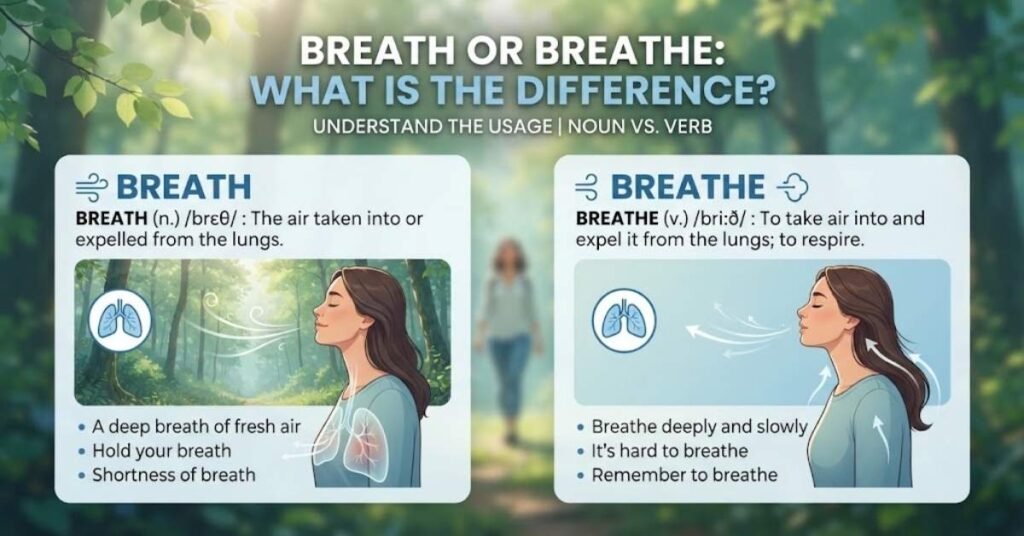
The short answer is this. Breath names a thing, and breathe describes an action. You take a breath, but you breathe air. One is a noun you can count, and the other is a verb you perform every second of your life without even thinking about it.
Once you see them side by side, the pattern becomes obvious. Think of breath as the noun form, something you hold or catch. Think of breathe as the verb form, something you do right now or plan to do later.
Breath Is a Noun
Breath refers to the air that moves in and out of your lungs. You can have a breath, breaths in the plural, or a deep breath before a big moment. It is a singular noun most of the time, though it can be made plural too.
Say this out loud: “I took a deep breath before speaking.” Notice how breath sits right after “a,” which is one of the biggest grammar clues you will use in this article.
Breathe Is a Verb
Breathe is the action word. It describes the actual act of breathing, the physical motion of your lungs expanding and contracting. You breathe in, you breathe out, and you do it roughly twenty thousand times a day without noticing.
Here is a simple example. “Remember to breathe during your workout.” That sentence needs an action, and breathe delivers it. Swap in breath there and the sentence falls apart instantly.
The One Second Rule
Here is a trick that works almost every time. Say the sentence out loud and ask yourself if something is happening or if something exists. If it is happening, like inhaling or exhaling, you need breathe. If it exists as a thing, like the air itself, you need breath.
This “one second rule” saves you from overthinking. Most word confusion happens because people rush through writing without pausing to check. Slow down for one second, and the answer usually clicks into place.
Breath vs Breathe: Grammar Rules You Need to Know
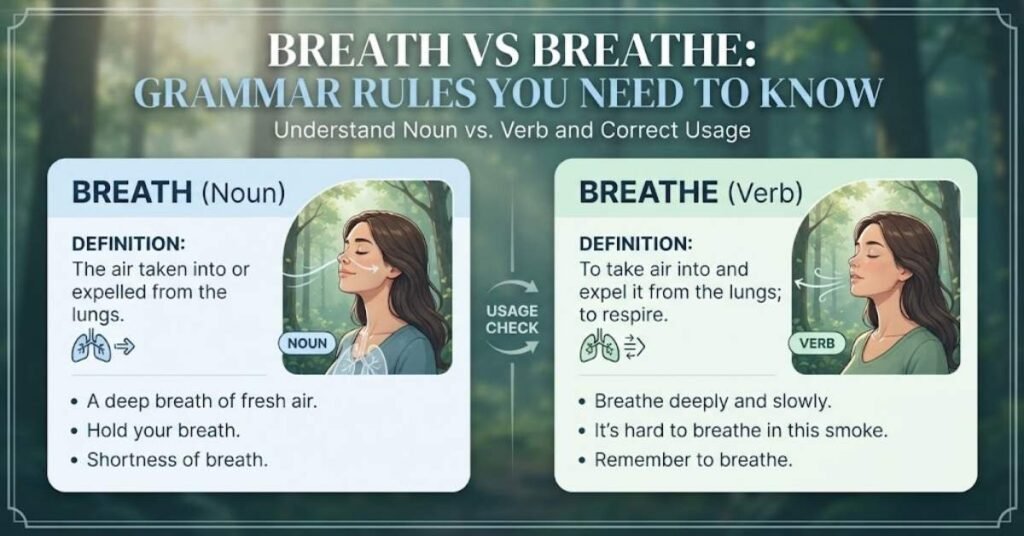
Grammar rules around parts of speech can feel dry, but this one is genuinely simple once it clicks. Breath behaves like any other noun, and breathe behaves like any other verb. The trick is spotting the small words around them that give the game away.
Once you train your eye to catch these sentence clues, this mistake basically disappears from your writing. Let’s break down exactly what to look for.
Use Breath After Articles and Determiners
Any time you see “a,” “the,” “his,” “her,” or “your” sitting right before the word, you almost always need breath. Articles and determiners point to a noun, not a verb, so the pattern is reliable.
Examples: “take a breath,” “hold your breath,” “catch your breath.” In every one of these, breath is naming a thing, not performing an action.
Use Breathe After To
The word “to” almost always signals a verb is coming next. “I need to breathe” and “try to breathe” both follow this exact structure. This is one of the most reliable usage rules in the entire language.
If you see “to” right before the word, skip the second guessing. Breathe is your answer nearly every single time.
Watch the Verb Forms
Breathe changes shape depending on tense. The base verb is breathe, the past tense is breathed, and the present continuous form is breathing. Breath, on the other hand, mostly just adds an “s” for the plural noun form, becoming breaths.
Knowing these verb forms helps you catch mistakes fast. If you see something like “breathes” or “breathing,” you are dealing with the verb family, not the noun.
A Helpful Grammar Test
Try replacing the word with “air” in your sentence. If “air” fits naturally, you likely need breath. If replacing it with “inhale and exhale” makes more sense, you need breathe.
“I took a deep air” sounds odd but confirms breath is correct in that spot. “I need to inhale and exhale” confirms breathe fits the second sentence. This little grammar test works surprisingly well under pressure.
How to Pronounce Breath and Breathe
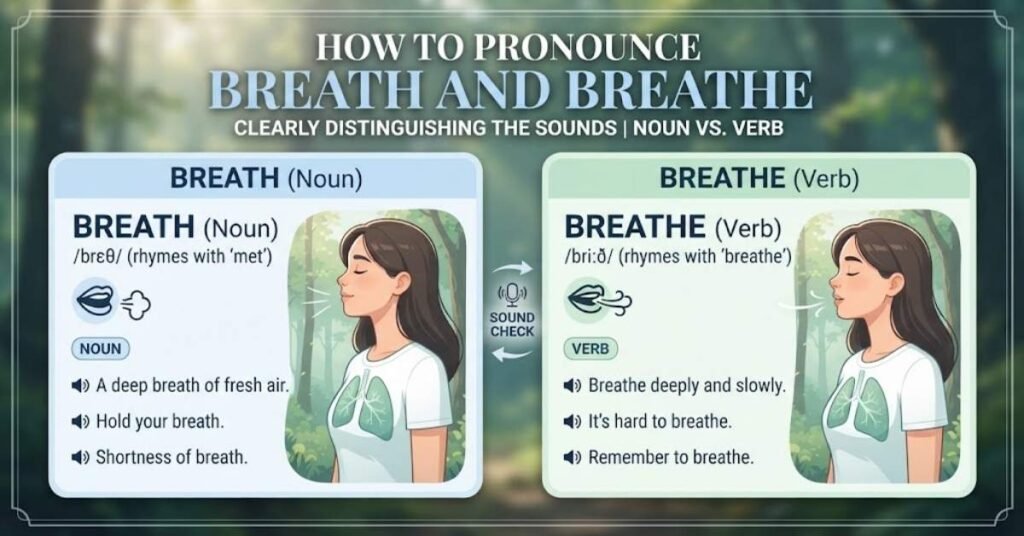
Pronunciation is actually where a lot of the confusion starts. These two words look almost identical but sound quite different once you say them slowly. Getting the sound right also helps you remember the spelling.
Let’s break down the phonetic difference so you never second guess yourself in conversation again.
Breath Short e Sound
Breath is pronounced /brɛθ/, using a short e sound similar to the vowel in “bed,” “red,” or “head.” The ending uses a voiceless th sound, the soft version you hear in “think” or “bath.”
Say “bed” and then say “breth.” Notice how the vowel sound matches up almost exactly.
Breathe Long ee Sound
Breathe is pronounced /briːð/, with a long ee sound like the vowel in “see,” “tree,” or “free.” The ending also uses a voiced th sound, the buzzier version found in “this” or “mother.”
Try saying “free” and then “breeth.” That stretched out vowel is your clue you are saying the verb correctly.
The TH Difference
Here is the part most people miss entirely. The final “th” in breath is soft and quiet, almost like a whisper. The final “th” in breathe has a slight buzz or vibration in your throat.
Place two fingers gently on your throat and say both words slowly. You should feel a small vibration on breathe that is absent on breath. This tiny sound difference is the whole secret.
Common Expressions With Breath and Breathe
English is full of idioms built around these two words, and they show up constantly in everyday English. Knowing them helps you sound natural and also reinforces which word goes where.
Let’s look at the most common ones you will actually run into.
Common Expressions With Breath
You will hear phrases like “hold your breath,” “catch your breath,” “out of breath,” and “under your breath” all the time. There is also “a breath of fresh air,” used when something feels refreshing or new, and “last breath,” used for a final moment.
These expressions are fixed, meaning you cannot swap in breathe without sounding wrong. “Hold your breathe” is a mistake you will now be able to spot instantly.
Common Expressions With Breathe
On the verb side, you have “breathe easily,” “breathe life into something,” and simply “breathe deeply” or “breathe slowly.” These describe ongoing actions or a shift in how someone feels.
“She breathed a sigh of relief” is another classic example, using the past tense form. Notice the pattern holds steady across every single one of these phrases.
Breath or Breathe: Examples You Can Copy
Sometimes the fastest way to learn is by seeing correct and incorrect versions side by side. Let’s run through a batch of clean examples you can literally reuse in your own writing.
Correct Breath Examples
- Take a deep breath before your presentation.
- She held her breath underwater for a full minute.
- His breath smelled like coffee after the meeting.
- I could see my breath in the cold morning air.
- He caught his breath after running up the stairs.
Correct Breathe Examples
- Breathe deeply and try to relax your shoulders.
- Meditation teaches you to breathe slowly and with purpose.
- I need to breathe for a second before answering.
- Remember to breathe through your nose during yoga.
- She breathes heavily after every workout session.
Incorrect vs Correct
| Incorrect | Correct |
| Take a deep breathe | Take a deep breath |
| I can’t breath | I can’t breathe |
| Hold your breathe | Hold your breath |
| I need to breath | I need to breathe |
| Out of breathe | Out of breath |
A Real Life Example: Why the Difference Matters
Picture this. A job applicant sends a cover letter that says “I need a moment to catch my breathe before the interview.” Small mistake, sure, but a hiring manager scanning fifty resumes might notice it and quietly judge the applicant’s attention to detail.
This kind of thing happens more often than people admit. Writing mistakes like this one do not usually ruin your chances alone, but they chip away at credibility in workplace communication, school assignments, and even casual social media posts where people still expect basic accuracy.
2025 2026 English Learning Data: Why Word Accuracy Still Matters
According to the EF English Proficiency Index, millions of English learners worldwide continue to study grammar basics like noun versus verb distinctions well into intermediate and advanced levels. Confused word pairs remain one of the most searched grammar topics online year after year.
This tells us something important. Even people who speak English fluently in conversation still stumble over written English when a pair of words looks this close. Brushing up on small distinctions like breath and breathe difference genuinely improves your communication skills across reading, writing, speaking, and listening.
A Simple Step by Step Method to Choose the Right Word
If the rules above still feel like a lot to hold in your head, here is a shortcut you can run through in seconds.
Step 1 Look at the Sentence
Read the full sentence first instead of just staring at the tricky word. Context almost always gives away the answer before you even reach the grammar rule.
Step 2 Ask Thing or Action
Ask yourself plainly, is this a thing or an action? A thing needs breath, and an action needs breathe. This is the thing vs action rule in its simplest form.
Step 3 Look for Clue Words
Check what comes right before the word. An article like “a” or “the” points to breath, while “to” points to breathe. These sentence clues rarely lie.
Step 4 Read It Aloud
Say the sentence out loud one more time. Your ear often catches what your eyes miss, especially with a pronunciation difference this clear.
The Easiest Memory Trick for Breath vs Breathe
Here is one that sticks. Breath is short, just like its vowel sound, and it names a short simple thing. Breathe is longer, has that extra “e,” and stretches out just like its long ee sound does when you say it.
Another trick some learners swear by. The extra “e” in breathe is like extra effort, since a verb involves doing something. A noun just sits there, quiet and short, exactly like breath itself.
Mini Quiz: Breath or Breathe
Test yourself with these quick questions before checking your answers below.
Quiz 1 Quick Pick Breath or Breathe
I took a deep ______ before diving in.
Quiz 2 Fill in the Blank
Try to ______ slowly during the exam.
Quiz 3 Which One Sounds Right
His ______ smelled like mint gum.
Quiz 4 Noun or Verb
“She breathes quietly at night.” Is “breathes” a noun or a verb?
Quiz 5 Fill in the Blank
I need to catch my ______ after that run.
Quiz 6 Can You Spot the Mistake
“He held his breathe for ten seconds.” What is wrong here?
Quiz 7 The Action Test
Choose the correct word. “Remember to ______ before you speak.”
Quiz 8 Fill in the Blank
The room was silent, and I could hear every ______.
Quiz 9 Choose the Correct Phrase
Which is correct, “a breath of fresh air” or “a breathe of fresh air”?
Quiz 10 Pronunciation Challenge
Which word rhymes with “free,” breath or breathe?
Quiz 11 Fill in the Blank
She ______ a sigh of relief when the results came in.
Quiz 12 Grammar Check
“I can’t breath right now.” Fix the sentence.
Quiz 13 One Second Challenge
“Take a moment to breath.” True or false, this is correct.
Quiz 14 Final Boss Can You Get It Right
Write one original sentence using breath and one using breathe correctly.
Answers: 1. breath, 2. breathe, 3. breath, 4. verb, 5. breath, 6. should be “breath” not “breathe,” 7. breathe, 8. breath, 9. a breath of fresh air, 10. breathe, 11. breathed, 12. “I can’t breathe right now,” 13. false, it should be “breathe.”
References
- Cambridge Dictionary, entries for “breath” and “breathe”
- Merriam-Webster, entries for “breath” and “breathe”
- EF Education First, EF English Proficiency Index reports
Final Takeaway
Breath is the noun, the air itself. Breathe is the verb, the act of moving that air in and out. Check for articles like “a” or “the” for breath, and check for “to” right before the verb for breathe.This is one of those common grammar errors that looks small but says a lot about your writing when you get it right.
Practice with the quiz above a few times, and this word choice will stop tripping you up for good.Got a favorite trick for remembering breath vs breathe? Drop it in the comments and share this with a friend who still mixes them up.
FAQs
Q1 Is take a breathe correct
No. The correct phrase is “take a breath,” since “a” signals a noun is coming next.
Q2 Is it I can’t breath or I can’t breathe
“I can’t breathe” is correct. This describes an action, so the verb form is needed here.
Q3 What is the difference between breath and breathe
Breath is a noun meaning the air you take in, while breathe is a verb meaning the act of inhaling and exhaling.
Q4 Is hold your breath correct
Yes. “Hold your breath” is correct and commonly used before diving underwater or in moments of suspense.
Q5 Is breathe deeply correct
Yes. “Breathe deeply” is correct, using the verb form to describe the action of slow, deep breathing.
Q6 How do you pronounce breath and breathe
Breath uses a short e sound and ends in a soft “th,” while breathe uses a long ee sound and ends in a buzzing “th.”
Q7 What is the past tense of breathe
The past tense of breathe is breathed, as in “She breathed slowly after the run.”

Henry Parker is an English language writer with several years of experience helping learners understand grammar and improve their writing. He enjoys breaking down confusing grammar rules into simple explanations and practical examples. Through his work at HexoWaves, Henry shares useful tips on grammar, vocabulary, sentence structure, and everyday English.