

You typed “recurring” into an email, then paused. Was it supposed to be “reoccurring”? You’re not alone. Thousands of writers hit this exact wall every week, and most spellcheckers won’t save you because both words are technically real.Here’s the short answer: recurring describes something that happens again and again on a predictable pattern or schedule, like a recurring payment or a recurring meeting.
Reoccurring describes something that comes back once, without any set timing, like a reoccurring symptom or a reoccurring software bug. Same family of meaning, different flavor of repetition.That single distinction changes how professional, technical, and everyday writing reads. Let’s break it down properly so you never second guess it again.
What Is the Difference Between Recurring and Reoccurring?
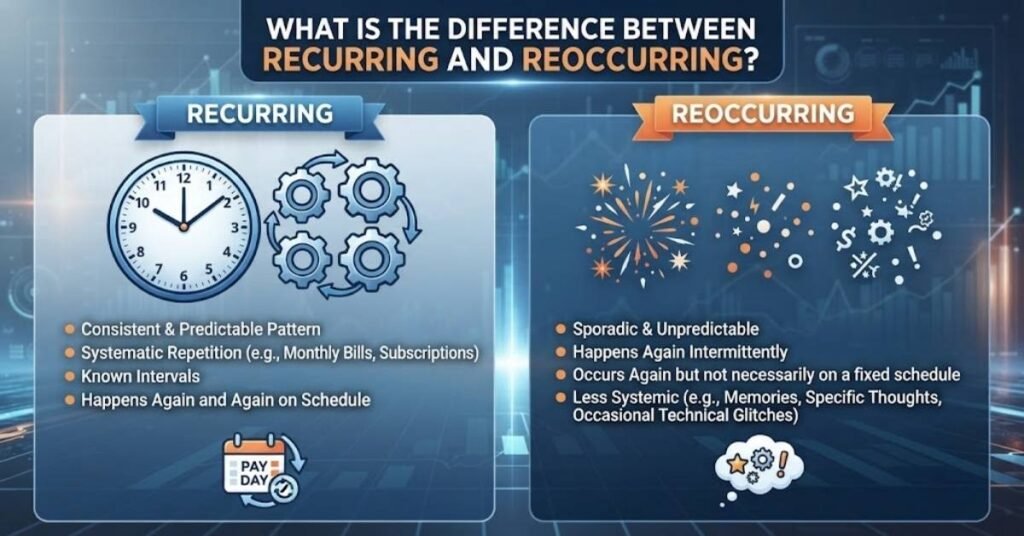
Both words trace back to the idea of something happening more than once. But repetition isn’t a one size fits all concept, and that’s exactly where these two terms split.
Recurring carries a sense of rhythm. It implies a regular interval, a plan, or a routine repetition you can set your watch to.
Quick Definition of Recurring
Recurring means happening repeatedly in a consistent, expected way. Think recurring subscription charges, recurring appointments, or a recurring theme in a novel.
Quick Definition of Reoccurring
Reoccurring means happening again after a gap, with no fixed schedule attached. A reoccurring migraine doesn’t follow a calendar. It just shows up.
Featured Snippet Answer
Recurring refers to something that happens on a regular, predictable basis, while reoccurring refers to something that simply happens again, once, without a set pattern.
Why Is Recurring More Common Than Reoccurring?
Open any style guide, any SaaS dashboard, any business report, and you’ll see recurring winning by a landslide. There’s a real reason behind that gap.
Language Evolution Favors Simplicity
Modern English tends to favor shorter, cleaner forms over time. Recurring rolls off the tongue faster, and native speakers naturally gravitate toward it in casual and formal speech alike.
Business and Technology Industries Prefer Recurring
Business terminology leans hard on recurring because so much of commerce runs on schedules. Recurring revenue, recurring billing, and recurring invoices describe income that arrives like clockwork, which is exactly what SaaS providers and subscription-based software products want investors to see.
Major Dictionaries Recognize Both
Don’t assume reoccurring is slang or a typo. Merriam-Webster Dictionary and Cambridge Dictionary both list it as a legitimate word. It’s just used far less often in professional writing.
Recurring vs Reoccurring: Meaning Breakdown
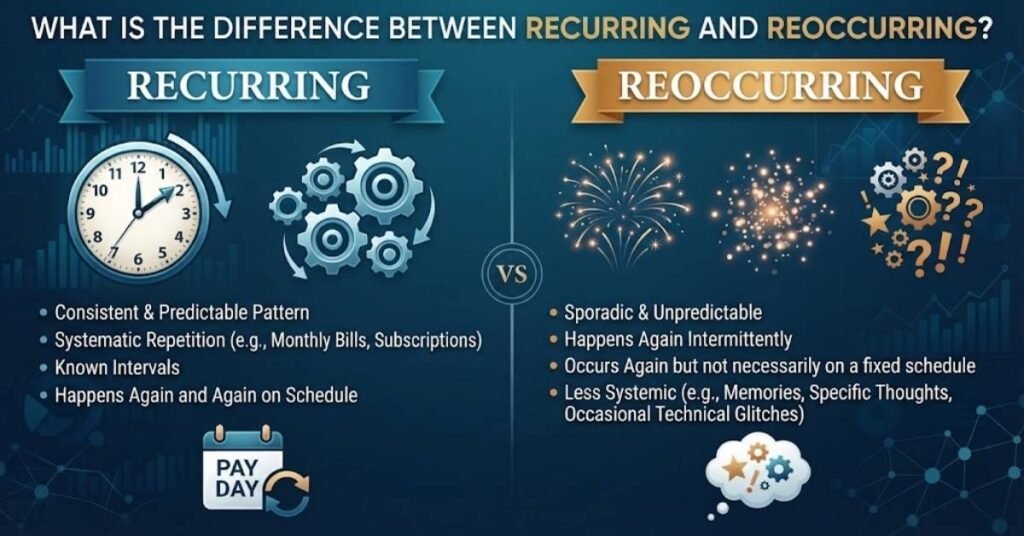
Understanding where each word came from makes the word choice feel a lot less arbitrary.
The Origin of Recurring
Recurring comes from the Latin “recurrere,” meaning to run back. Over centuries, English shaped it into a word tied to cycles and occurrence patterns you can predict.
The Origin of Reoccurring
Reoccurring is simply “occur” with the prefix “re” attached, meaning to occur again. It’s more literal and less tied to any built in rhythm.
The Key Distinction
Recurring assumes structure. Reoccurring assumes a previous occurrence just happened to repeat. One word plans ahead, the other reacts.
When Should You Use Recurring?
If you can attach a calendar, a schedule, or a cycle to the situation, recurring is almost always your word.
Recurring in Business
Think recurring monthly payment plans, recurring reminder notifications, and recurring calendar events for team standups. Finance teams track recurring expenses and recurring charges because they repeat on a fixed timeline.
Recurring in Personal Life
A recurring family tradition, like Sunday dinners, fits perfectly here. So does a recurring dream you keep having on a strange but noticeable pattern.
Recurring in Literature and Writing
Authors build a recurring character or a recurring motif on purpose. It’s intentional repetition, woven in for effect, not an accident.
When Should You Use Reoccurring?
Reoccurring fits situations that lack a rhythm. Something just happens, disappears, and comes back later with no warning.
Reoccurring Medical Symptoms
Healthcare professionals describe reoccurring infections or reoccurring pain this way because a patient’s body doesn’t run on a spreadsheet. Symptoms returning isn’t scheduled behavior.
Reoccurring Technical Problems
Engineers and technical teams deal with reoccurring software bugs, reoccurring network failures, and reoccurring server problems constantly. These issues pop up, get patched, then reappear later without a fixed cause.
Reoccurring Events Without a Schedule
A reoccurring weather phenomenon, like an unusual storm pattern, or a reoccurring conflict between two departments, both lack the predictability that recurring implies.
Real-Life Case Study: How a Marketing Team Improved Communication
A digital marketing agency kept mixing up these two words across client reports and dashboards. Their recurring revenue streams section accidentally read “reoccurring revenue,” which made a client question whether the numbers were even stable.
After a quick style audit, the team standardized their client presentations and templates, using recurring for anything scheduled and reoccurring only for genuine one off repeats, like a reoccurring security concern flagged twice in one quarter. Client confusion dropped, and their industry standards for internal documentation actually improved. Small word, real business impact.
The lead account manager later said the fix took under an hour, but it changed how the whole team approached professional terminology going forward. They even added a quick note to their client communication checklist, reminding new hires to check for this exact mix up before sending anything out. It’s a tiny habit, but it saved them from repeating the same awkward correction email more than once.
Usage Statistics and Language Trends (2025–2026)
Search trends and word frequency data consistently show recurring used far more often across financial publications, professional publications, and everyday web content.
What Current Trends Reveal
Language analysis tools report recurring appearing roughly ten times more often than reoccurring in written English today. That gap keeps widening as more content shifts toward business communication and tech.
Why This Matters for Writers
If your reader familiarity with a term matters, and it usually does, leaning on recurring in content writing and SEO writing keeps your message instantly clear.
Trusted References
Authoritative sources like Merriam-Webster Dictionary confirm both words remain valid English mistakes and spelling mistakes aside, this isn’t a case of one being wrong.
Reference sites and language references used by editors and students alike still list reoccurring under standard entries, not as slang or an error. It’s simply a quieter word living in a busier neighborhood, sitting right beside a much louder cousin.
Recurring vs Reoccurring Comparison Table
| Feature | Recurring | Reoccurring |
| Pattern | Follows a schedule | No fixed pattern |
| Predictability | High | Low |
| Common Field | Business, tech, finance | Medical, technical issues |
| Example | Recurring subscription fee | Reoccurring migraines |
| Frequency of Use | Very common | Rare |
Easy Memory Trick
Recurring sounds like “occurring” with rhythm baked in, so picture a repeating song on loop. Reoccurring sounds heavier, like something knocking on your door unannounced. That mental picture sticks.
Common Mistakes Writers Make
Even experienced editors slip up here, so don’t feel bad if you’ve made these errors before.
Mistake 1: Using Reoccurring for Scheduled Events
Calling a recurring appointment “reoccurring” undersells the fact that it’s planned, not random.
Mistake 2: Mixing Both Terms in One Document
Switching between the two mid document confuses readers and looks careless in academic writing or report writing.
Mistake 3: Assuming One Word Is Incorrect
Neither word is wrong. This isn’t like Transferred vs Transfered or Striping vs Stripping, where one spelling is simply a common writing error. Here, context decides the correct word choice.
Recurring vs Reoccurring in Everyday Conversation
You don’t need a finance degree or a medical license to bump into this choice. It shows up in texts, group chats, and casual emails just as often as it does in formal reports.
Say your friend keeps rescheduling the same weekly game night. That’s a recurring event, since it’s tied to a set day. But if your car makes a weird noise every few months for no clear reason, that’s a reoccurring pattern, not a scheduled one.
Getting this right in casual writing matters more than people think. It signals writing clarity, and it shows you actually thought about what you’re describing instead of grabbing whichever word felt familiar.
How Style Guides and Editors Handle the Choice
Most style guides quietly favor recurring, and for good reason. It reads cleaner, it’s shorter, and it matches how most readers already talk.
Editors working on internal documentation, training materials, or client facing content usually flag reoccurring only when the context genuinely calls for it, like describing a reoccurring security concern in a systems audit. Outside of that, they’ll swap it for recurring almost automatically.
If you’re building documentation for a team, it helps to set a simple internal rule: recurring for anything scheduled, reoccurring for anything that just happens to repeat. That one line saves hours of back and forth during edits.
Mini Quiz: Recurring vs Reoccurring
Test yourself. Answers are listed after question 11.
Quiz 1: Which Word Fits Best?
“We set up a ___ payment for the software.” (recurring)
Quiz 2: Spot the Better Choice
“Her ___ back pain flares up randomly.” (reoccurring)
Quiz 3: True or False?
Recurring always implies a schedule. (True)
Quiz 4: Fill in the Blank
“The team scheduled a ___ meeting every Monday.” (recurring)
Quiz 5: Quick Pick
Which word fits a subscription service? (recurring)
Quiz 6: What’s the Meaning?
Reoccurring means: happening again without a fixed pattern.
Quiz 7: Business English Challenge
“Our SaaS platform reports strong ___ revenue this quarter.” (recurring)
Quiz 8: True or False?
Reoccurring is a made up word. (False, it’s dictionary recognized)
Quiz 9: Choose the Correct Phrase
“Reoccurring network failure” or “Recurring network failure” for an unpredictable outage? (Reoccurring)
Quiz 10: Grammar Check
Fix this sentence: “The recurring infection surprised the doctor.” (Should be reoccurring, since infections aren’t scheduled)
Quiz 11: Final Test
Pick the better word for a weekly newsletter reminder. (recurring)
Conclusion
Recurring and reoccurring both describe repeated events, but the timing behind each one tells a different story. Recurring belongs to schedules, routines, and anything with a predictable pattern. Reoccurring belongs to the unexpected, the medical, the technical hiccup that just won’t stay gone.
Next time you’re drafting an email, a report, or even a text to a friend, ask yourself one question: is this thing showing up on a plan, or just showing up again? That answer picks your word for you.
FAQs
Q1: Is recurring or reoccurring more correct?
Neither is more correct grammatically. Recurring is simply used far more often, especially in business documents.
Q2: Can recurring and reoccurring be used interchangeably?
Not really. Swapping them changes the meaning slightly, since one implies a schedule and the other doesn’t.
Q3: Why do businesses use recurring instead of reoccurring?
Because recurring revenue and recurring billing describe predictable income, which matters for financial planning and investor confidence.
Q4: Is recurring revenue the correct term?
Yes. It’s the standard, correct term across SaaS, accounting, and finance industries.
Q5: Are recurring and reoccurring synonyms?
They’re near-synonyms, close in meaning but not identical in usage.
Q6: Which word should I use in professional writing?
Default to recurring unless you’re specifically describing an unpredictable repeat, like a reoccurring issue in a bug report.
Q7: Is reoccurring outdated?
No, it’s not outdated, just less common. It still holds a clear, valid place in modern English.

Henry Parker is an English language writer with several years of experience helping learners understand grammar and improve their writing. He enjoys breaking down confusing grammar rules into simple explanations and practical examples. Through his work at HexoWaves, Henry shares useful tips on grammar, vocabulary, sentence structure, and everyday English.