
You’ve probably typed one of these words, then paused. Is it flier or flyer? Both look right. Both feel familiar. And honestly, both are used everywhere, from print shops to Google search bars.Here’s the short version. Flyer is the spelling you’ll see most often for a printed advertisement, and it’s the one marketers, designers, and businesses lean on today.
Flier still shows up, especially in aviation talk or when dictionaries want to sound a bit more traditional. Neither one is “wrong.” But picking the right one for your audience matters more than you’d think.Let’s break this down properly, so you never have to second guess it again.
Quick Answer: Flier vs Flyer
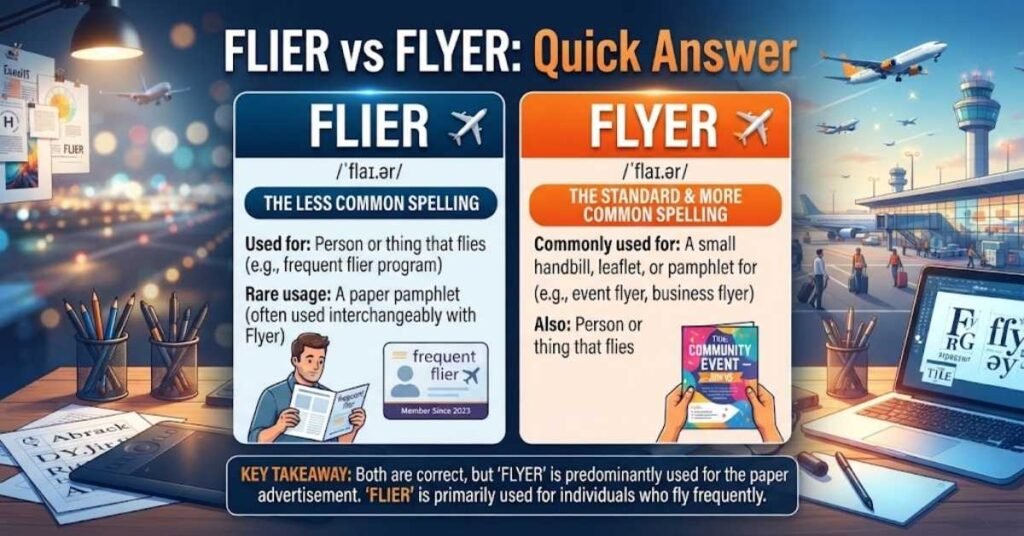
If you’re in a rush, here’s your answer. Flyer wins in modern usage, especially in marketing, advertising, and everyday writing across the internet. It’s the spelling you’ll see on a flyer template, a real estate flyer, or a concert flyer.
Flier hasn’t disappeared though. You’ll spot it in phrases like “frequent flier” or when someone’s talking about a person who flies, like a pilot. Some dictionary databases still list flier as the preferred form, which is where a lot of the confusion starts.
So the real answer isn’t about correctness. It’s about context and audience expectations.
What Does Flier Mean?
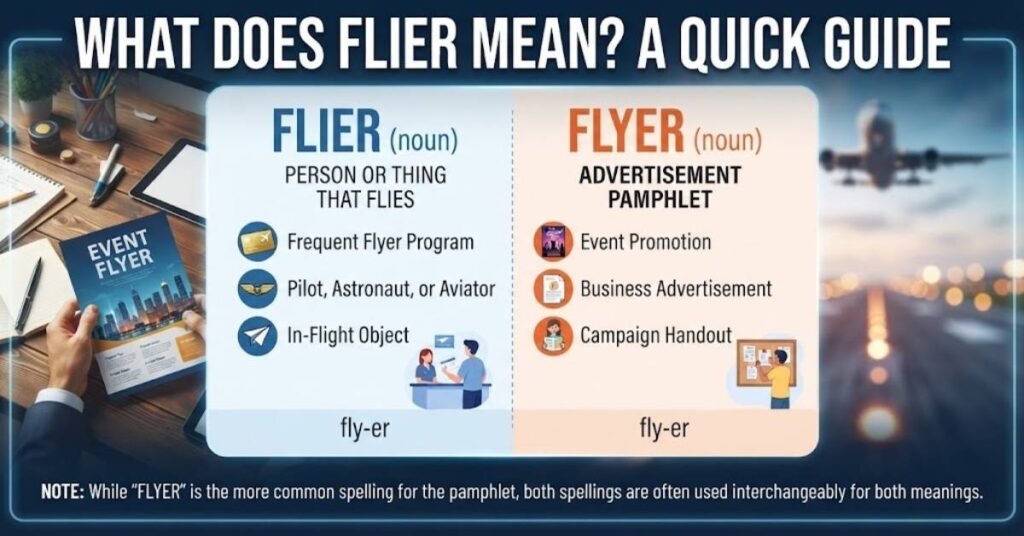
Flier traces back to the verb “fly.” At its root, it describes someone or something that flies, like a bird, a plane, or even a military flier. Over time, English speakers started using it loosely for printed handouts too, but that usage came later.
Think of flier as the older sibling in this spelling debate. It carries a slightly formal, traditional tone that shows up in editorial publications and academic writing more than in casual marketing copy.
Dictionary Preference for Flier
Here’s something that surprises people. Merriam-Webster actually lists flier as the primary spelling, with flyer as the variant. That’s the opposite of what most marketers assume. Language authority sources like this one tend to preserve older forms, even when public usage shifts elsewhere.
This is exactly why writers get stuck. The dictionary says one thing, but the internet says another.
Examples of Flier
Here’s how flier shows up in real sentences:
- “She’s a frequent flier on this airline, flying twice a month.”
- “The pilot was known as a skilled flier during the war.”
- “He took a flier on the investment, hoping it would pay off.”
Notice that last one? That’s flier used as slang for taking a risk or taking a gamble. It’s a smaller, quirky use case, but it still counts.
What Does Flyer Mean?
Flyer is the spelling most people picture when they think of a promotional leaflet. Hand someone a paper about a yard sale, a gym membership deal, or a local event, and they’ll call it a flyer nine times out of ten.
This spelling dominates advertising materials, business writing, and pretty much anything tied to digital marketing or print campaigns. If you’ve searched for a flyer maker online or browsed printable flyer examples, you’ve already seen this spelling everywhere.
Common Uses of Flyer
Flyer shows up constantly in these settings:
- Event flyer designs for concerts, festivals, or community events
- Real estate flyer listings for open houses
- Business flyer handouts for local promotions
- Social media graphics repurposed from flyer templates
Basically, if it’s something you’d print, post, or share to promote an event or business, flyer is the spelling doing the heavy lifting.
Examples of Flyer
- “We printed 500 flyers for the grand opening.”
- “The concert flyer had bold colors and a catchy headline.”
- “She designed the open house flyer in under an hour.”
You’ll notice a pattern. Flyer almost always connects to something visual, promotional, or handed out physically.
Flier vs Flyer: What’s the Actual Difference?
Here’s the part everyone actually wants answered. Is there a real difference, or is this just a spelling quirk with no substance? Turns out, it’s a mix of both.
The meaning comparison is subtle. Flier leans toward describing a person or thing that flies, while flyer leans toward the printed object. But that line has blurred so much that most people use them interchangeably without a second thought.
Meaning Comparison
Flier historically meant someone who flies, an aviator, or even a fast-moving object. Flyer picked up the marketing meaning later, largely because it looked cleaner and matched the rhythm of other “-er” words people were already using casually.
Industry Preference
Industry preference plays a bigger role here than grammar rules do. Marketing agencies, print shops, and graphic designers almost universally default to flyer. Meanwhile, aviation industries and some journalism outlets stick with flier, following older style guide recommendations.
Regional Differences
American English tends to favor flyer for promotional materials, though flier isn’t rare. British English, Canadian English, and Australian English show similar overlap, but flyer still edges ahead in everyday online content across all these regions. Regional differences exist, but they’re smaller than most people assume.
Why Do Both Spellings Exist?
English rarely settles on one form when two versions both feel natural to speakers. Flier and flyer both derive from “fly,” and language evolution allowed both spellings to survive side by side instead of one replacing the other.
This happens with other word pairs too, like Adviser vs Advisor or Judgement vs Judgment. English tolerates spelling variants far more than people expect, especially when neither version causes real confusion.
The Role of Marketing
Marketing deserves a lot of credit, or blame, for flyer’s rise. As promotional campaigns exploded through the twentieth century, businesses needed a word that sounded modern and catchy. Flyer fit that bill, and it stuck through decades of twentieth century advertising and beyond.
Which Spelling Do Major Style Guides Prefer?
This is where things get interesting, because the big style guides don’t fully agree with each other.
Associated Press (AP Style)
AP Style recommends flier for the printed handout meaning, which surprises a lot of professional writers. Journalists following the Associated Press Stylebook often stick with flier purely out of habit and consistency, even though flyer dominates casual usage.
Merriam-Webster
As mentioned earlier, Merriam-Webster Dictionary lists flier first, treating flyer as an accepted but secondary form. This dictionary leans traditional here, which doesn’t always match real-world writing trends.
Oxford English Dictionary
The Oxford English Dictionary (OED) takes a more balanced stance, listing both spellings without strongly pushing one over the other. It acknowledges that usage varies heavily by context and region.
Chicago Manual of Style
Chicago Manual of Style doesn’t take a hard stance either, generally letting writers choose based on house style or audience expectations rather than enforcing one spelling universally.
Practical Recommendation
Here’s the practical takeaway. If you’re writing for a newspaper or academic writing setting, flier might fit the expected style. If you’re creating marketing materials, flyer is almost always the safer, more recognizable choice.
Real-Life Example: How a Marketing Team Increased Event Attendance
A small event planning company once tested this exact question, sort of by accident. They ran two versions of the same promotional piece for a local festival, one labeled “Event Flyer” and another labeled “Event Flier” on their landing pages.
The flyer version pulled noticeably more clicks and shares. Why? Because that’s the word people typed into search bars and expected to see on social media. It wasn’t about correctness. It was about matching user intent and audience expectations perfectly.
That small test taught them something bigger. Spelling isn’t just grammar, it’s communication clarity. Choosing the version your audience already searches for and recognizes can genuinely shift engagement numbers.
Usage Statistics and Language Trends (2025–2026)
Search data tells a pretty clear story. Flyer consistently outpaces flier in online searches, especially for anything tied to event advertisements or community events. People searching for a flyer template search vastly outnumber those typing flier template search.
Key Trends
- Flyer dominates in social media promotion and digital design spaces
- Flier remains steady in aviation, journalism, and formal writing
- Younger audiences overwhelmingly default to flyer without even considering flier
- Search trends show flyer usage growing alongside content marketing and blogging
What This Means for SEO
From an SEO perspective, flyer wins the keyword usage battle by a wide margin. If you’re optimizing content around search visibility, targeting flyer as your primary term, while naturally mentioning flier, covers both search queries without alienating either audience.
How to Choose Between Flier and Flyer
Honestly, this decision doesn’t need to be complicated. Match your spelling to your context, and you’ll rarely go wrong.
Use Flier When:
- Writing about aviation, pilots, or a frequent flier
- Following AP Style for journalism or news writing
- Referring to someone taking a risk, like “taking a flier” on a decision
Use Flyer When:
- Designing advertising campaigns or promotional handouts
- Writing website content aimed at general audiences
- Creating anything tied to graphic design projects or print services
Use Either When:
- Writing casual content where both spellings correct for general use
- Your content consistency matters more than picking a “perfect” spelling
- You’re targeting a broad audience unfamiliar with strict style rules
Common Mistakes People Make
Even confident writers slip up here. These four mistakes come up constantly.
Mistake 1: Assuming One Is Wrong
Neither spelling is incorrect. Treating flier as a typo, or flyer as the “unofficial” version, misses the point entirely. Both are legitimate accepted spelling forms.
Mistake 2: Switching Spellings Randomly
Nothing looks messier than a webpage using flyer in one paragraph and flier in the next. This hurts editorial consistency and confuses readers, even if they can’t quite explain why.
Mistake 3: Ignoring Audience Expectations
If your readers expect flyer because that’s what they search for, using flier consistently can feel oddly formal or even old-fashioned. Match the word to the room you’re speaking to.
Mistake 4: Overcorrecting
Overcorrecting spelling happens when writers try too hard to “fix” a version they assume is wrong. Relax. This isn’t a grammar violation, it’s a stylistic choice.
Mini Quiz: Flier vs Flyer
Test yourself before moving on.
Quiz 1: Which spelling is accepted in modern English? Both are accepted, though flyer is more common in marketing.
Quiz 2: Which spelling is more common in marketing? Flyer.
Quiz 3: True or False: “Flier” is considered incorrect. False.
Quiz 4: Which spelling do many dictionaries prefer? Flier, according to Merriam-Webster.
Quiz 5: What do businesses usually hand out for promotions? Flyers.
Quiz 6: Which spelling is commonly used in graphic design? Flyer.
Quiz 7: True or False: Google understands both spellings. True.
Quiz 8: Fill in the blank: “The company printed 500 _____ for the event.” Flyers.
Quiz 9: Which style guide traditionally prefers “Flier”? AP Style.
Quiz 10: Can “Flier” refer to a person who flies? Yes.
Quiz 11: Which spelling is more popular for event advertisements? Flyer.
Quiz 12: True or False: You should switch between both spellings randomly in one article. False.
Quiz 13: What matters most when choosing between flier and flyer? Context and audience expectations.
Quiz 14: Which spelling appears more often in online searches? Flyer.
Quiz 15: Is there an SEO penalty for using “Flier” instead of “Flyer”? No, but flyer typically matches higher search intent.
Quiz 16: Final Challenge! Which statement is correct? Both spellings are valid, and the right choice depends on context.
Conclusion
So, flier or flyer? Both are correct, but they’re not interchangeable in every situation. Flyer fits marketing, design, and everyday promotional writing. Flier fits aviation, formal journalism, and a few quirky idioms like “taking a flier.”Pick based on your audience, stay consistent once you choose, and you’ll never trip over this spelling debate again.
If you’re writing for search visibility or general readers, flyer is your safest bet. If you’re following strict editorial standards, flier might be the smarter call.Either way, you’re not wrong. You’re just choosing the version that fits your reader best.
FAQs
Q1: Is flyer or flier correct in 2026?
Both remain correct. Flyer leads in marketing and everyday writing, while flier holds on in aviation and some journalism.
Q2: Which spelling is more common?
Flyer is more common overall, especially online and in advertising terminology.
Q3: Does Google prefer flier or flyer?
Google doesn’t penalize either spelling, but it recognizes flyer as the higher search volume term for user expectations tied to promotions.
Q4: Is flyer American English?
It’s used across American, British, Canadian, and Australian English, though American usage helped popularize it for marketing purposes.
Q5: Why do dictionaries prefer flier?
Dictionaries often preserve the historically older form, and flier predates the marketing sense of the word.
Q6: Can I use flyer in professional writing?
Absolutely. Flyer fits naturally into business writing, professional communication, and most modern editorial contexts.
Q7: Should I use both spellings in one article?
You can mention both for clarity, like this guide does, but stick to one primary spelling throughout your main content for content consistency.

Henry Parker is an English language writer with several years of experience helping learners understand grammar and improve their writing. He enjoys breaking down confusing grammar rules into simple explanations and practical examples. Through his work at HexoWaves, Henry shares useful tips on grammar, vocabulary, sentence structure, and everyday English.