
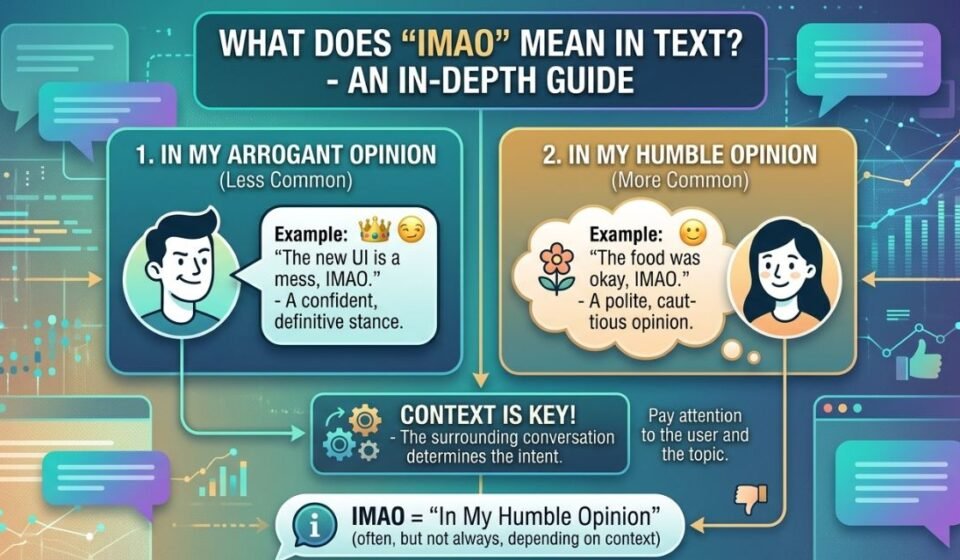
IMAO Meaning in Text: Hidden Meaning & Chat Uses 2026
Have you ever spotted IMAO in a message and paused because you had no idea what it meant? You’re not alone. Internet slang can turn a simple chat into a guessing game. IMAO often appears in texts, group chats, comments, and social media posts. It can add humor, confidence, or a playful edge to someone’s opinion. The exact tone may change based on the conversation and the people involved.
The imao meaning in text is usually In My Arrogant Opinion. It’s an informal abbreviation used to introduce a personal view. You might see it before a bold statement or after someone shares an opinion. Among friends, IMAO can sound funny and confident. In serious conversations, though, it may seem sarcastic or rude. Knowing its meaning also helps you tell it apart from similar slang like IMO, IMHO, and LMAO.
What Does IMAO Mean in Text & Chat?
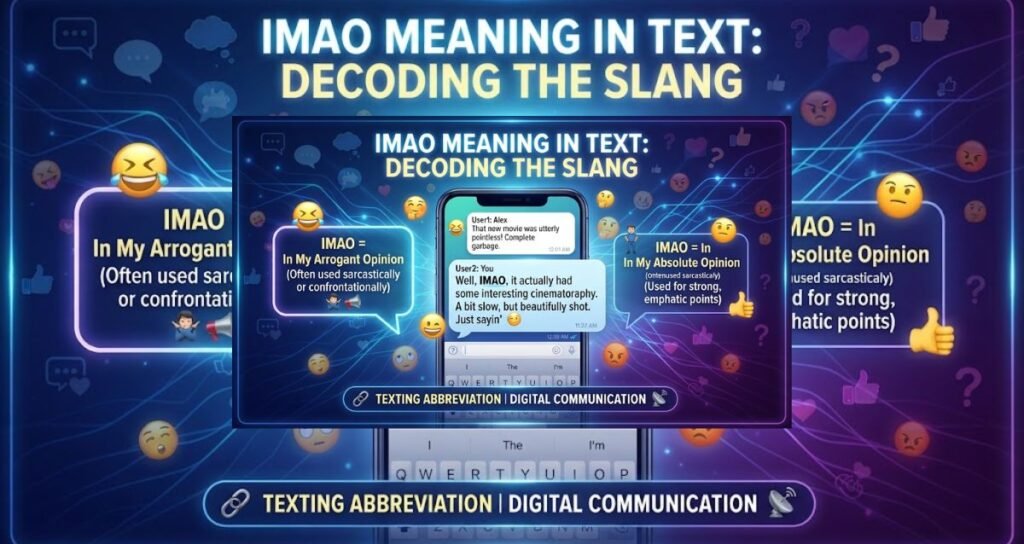
IMAO usually means In My Arrogant Opinion. It is an internet abbreviation used when someone wants to share a personal opinion in a playful, bold, or self-aware way.
The imao meaning in text can sound humorous because the word “arrogant” makes the opinion feel intentionally exaggerated. It often shows that the writer knows they sound very confident.
You may see IMAO at the beginning or end of a message.
- IMAO, this is the best pizza here.
- That show is overrated, IMAO.
- IMAO, nobody does it better.
The term belongs to informal online slang. It works best in texting, comments, group chats, gaming conversations, and social media.
Quick Meaning of IMAO
The simple IMAO meaning in text is “In My Arrogant Opinion.” It tells the reader that the following statement represents the writer’s personal view.
Unlike a serious formal phrase, IMAO often carries a joking or sarcastic tone. The writer may use it to make a strong opinion sound lighter.
For example:
Friend: Which movie should we watch?
You: IMAO, the older one is much better.
Here, the speaker is not necessarily being genuinely arrogant. They may simply be joking about how strongly they feel.
IMAO can therefore suggest confidence, humor, sarcasm, or playful exaggeration.
- I = In
- M = My
- A = Arrogant
- O = Opinion
Simple Chat Examples
Seeing IMAO in a conversation becomes easier when you look at how people place it around an opinion.
Example 1:
Alex: Who has the best voice in the group?
Sam: IMAO, Maya easily wins.
Example 2:
Nina: Is this outfit too simple?
Lena: IMAO, simple looks better here.
Example 3:
Tom: Which game should we play tonight?
Ben: IMAO, the racing game is the only good choice.
Example 4:
Sara: That restaurant is expensive.
Mike: True, but IMAO, the food is worth it.
These examples show that IMAO usually introduces or emphasizes an opinion. The surrounding sentence helps reveal whether the tone is serious, playful, or sarcastic.
Why People Use IMAO
People use IMAO because short internet slang can add personality to ordinary messages. Instead of simply saying “in my opinion,” the writer adds a humorous twist.
It can make a strong statement feel more playful.
Common reasons include:
- Showing confidence in an opinion
- Making a bold statement sound humorous
- Adding sarcasm or self-awareness
- Playing with the familiar IMHO expression
- Making casual conversations more entertaining
For example, “IMAO, my cooking is unbeatable” may sound deliberately overconfident.
The phrase does not always mean the person truly considers themselves arrogant. Often, the exaggeration is the joke.
Is IMAO Different From IMHO?
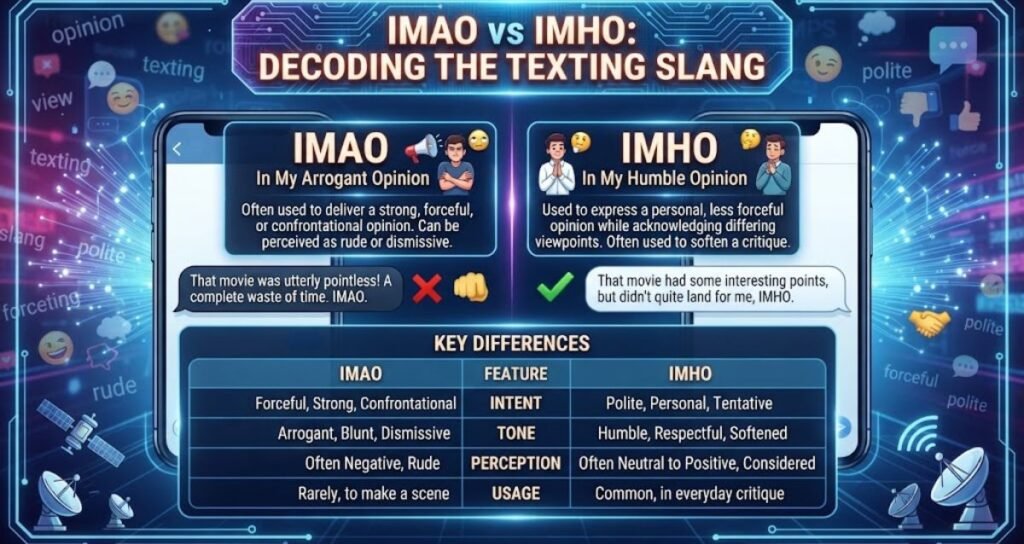
Yes. IMAO and IMHO look similar, but they create different tones.
IMHO means In My Humble Opinion. It traditionally presents an opinion in a modest or respectful way.
IMAO means In My Arrogant Opinion. It deliberately changes “humble” to “arrogant,” creating a humorous contrast.
Compare these:
- IMHO: This is probably the better option.
- IMAO: This is obviously the better option.
The first sounds modest. The second can sound confidently exaggerated.
IMAO is essentially a playful variation of IMHO. Dictionary.com describes it as an ironic or self-deprecating internet acronym, while Collins lists it as an abbreviation used in messaging and social media.
So, IMHO softens an opinion, while IMAO plays up confidence for humor.
Can IMAO Be Used in Formal Writing?
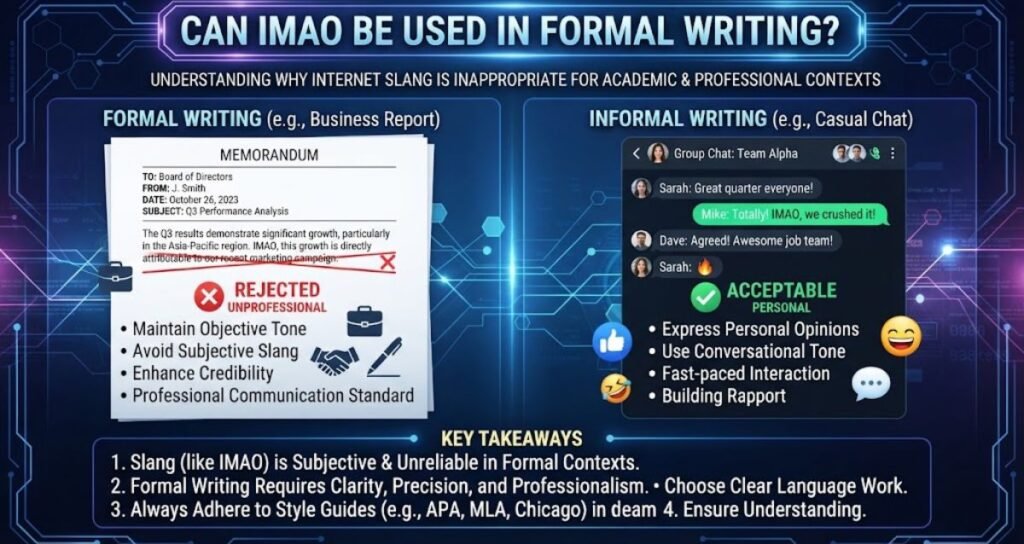
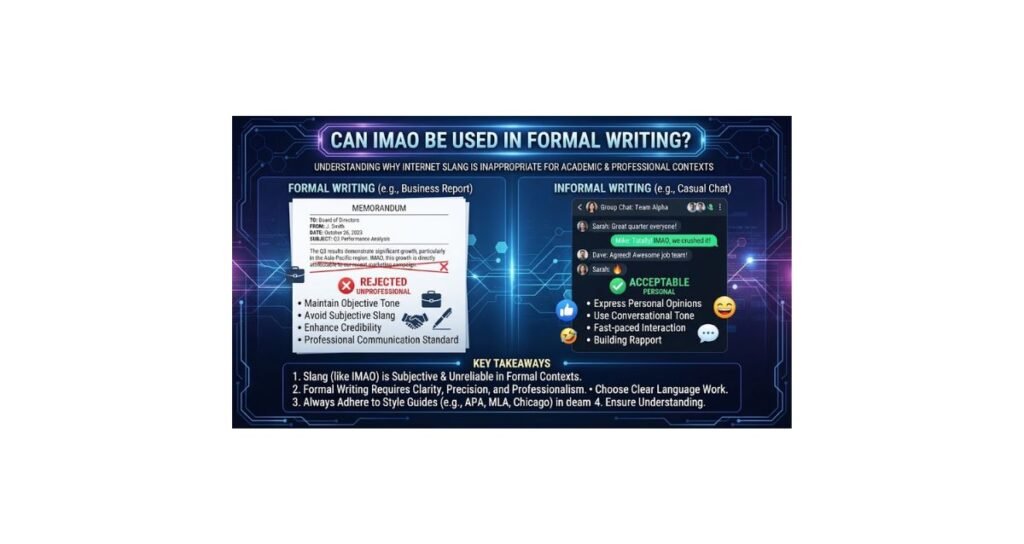
Generally, no. IMAO belongs to informal online communication rather than formal writing.
You may see it in texts, social media comments, forums, gaming chats, and casual emails between friends. It can help create a relaxed conversational tone.
Formal situations usually need clearer language.
Instead of writing:
IMAO, this proposal needs changes.
A professional writer could say:
In my opinion, this proposal needs several changes.
Avoid IMAO in:
- Academic essays
- Business reports
- Job applications
- Official letters
- Professional presentations
- Legal or technical documents
The abbreviation may confuse readers who are unfamiliar with internet slang.
For casual communication, though, IMAO can work naturally. Always consider your audience before using it.
Full Form, Stands For & Short Meaning of IMAO
The IMAO full form is In My Arrogant Opinion.
The phrase works as an abbreviation for introducing a personal view. Collins specifically defines IMAO as the messaging and social-media abbreviation for “in my arrogant opinion.”
Here is the basic breakdown:
- IMAO stands for: In My Arrogant Opinion
- IMAO meaning: A personal opinion expressed with exaggerated confidence
- IMAO slang: Informal internet language
- IMAO meaning in chat: A playful way to introduce or emphasize an opinion
- Tone: Often humorous, sarcastic, or self-aware
For example:
“IMAO, this is the best song on the album.”
The writer is basically saying, “This is my opinion, and I’m proudly confident about it.”
The word “arrogant” often adds the humorous effect.
Difference Between IMO and IMAO
IMO means In My Opinion. It is straightforward and neutral.
IMAO means In My Arrogant Opinion. It adds a stronger and more playful personality to the statement.
Consider these examples:
IMO, this phone looks better.
This simply identifies a personal opinion.
IMAO, this phone is clearly the best one.
This sounds more confident and exaggerated.
The key difference is the extra A in IMAO.
- IMO: Neutral personal viewpoint
- IMAO: Bold or joking personal viewpoint
- IMHO: Humble or modest personal viewpoint
IMAO is therefore not just a longer version of IMO. It changes the tone.
The speaker may use it when they want to sound cheeky rather than serious.
Short Meaning of IMAO
The short meaning of IMAO is “my very confident opinion.”
It normally signals that the following statement belongs to the speaker. The “arrogant” part often creates humor instead of genuine rudeness.
For instance:
“IMAO, this is the only café worth visiting.”
The person is expressing a strong preference. They may know that their wording sounds dramatic, which is exactly what makes the expression funny.
You can think of IMAO as:
“Here comes my confidently stated opinion.”
It is usually more playful than aggressive.
The context still matters. A friendly conversation may make IMAO sound funny, while a heated argument could make the same abbreviation seem dismissive.
That is why readers should consider the whole message rather than focusing only on the abbreviation.
When It Sounds Friendly
IMAO can sound friendly when people already share a casual relationship.
Friends often use exaggerated language while joking with each other. In that setting, IMAO can add personality without creating tension.
Example:
Ali: Which dessert should we order?
Hamza: IMAO, chocolate cake wins every time.
The statement sounds confident, but the situation is harmless and playful.
Another example:
Mia: Who is the funniest person here?
Zoey: IMAO, obviously me 😂
The emoji and casual wording make the joke clearer.
IMAO often feels friendly when:
- The conversation is relaxed
- People know each other
- The opinion is harmless
- Humor is already part of the discussion
- The wording is obviously exaggerated
The surrounding tone usually matters more than the abbreviation itself.
When to Be Careful
Although IMAO is often playful, it can sound rude when used in a serious disagreement.
Words such as “arrogant” and “obviously” can make a message feel dismissive. A reader may not recognize the joke, especially without facial expressions or vocal tone.
For example:
“IMAO, you clearly know nothing about this.”
That message can sound insulting rather than funny.
Be careful when:
- Discussing sensitive subjects
- Talking with strangers
- Responding to criticism
- Writing to teachers or employers
- Having a serious disagreement
A safer choice may be IMO or a normal phrase such as “I think.”
Digital communication removes many tone cues. Because of that, playful slang can sometimes be misunderstood.
Use IMAO when the context clearly supports a lighthearted tone.
Origin, History & First Known Use of IMAO
IMAO developed as a playful variation of IMHO, meaning “In My Humble Opinion.” Instead of presenting an opinion as humble, IMAO humorously replaces “humble” with “arrogant.”
Its history reaches back further than modern social media. Dictionary.com identifies an early documented example from a May 1989 Usenet discussion. The writer used IMAO while giving an opinion about The Grateful Dead and explained the abbreviation in the post. Dictionary.com also reports several uses during 1989.
This means the abbreviation was already appearing in early online discussion culture decades before today’s messaging apps.
Early Internet Culture
Early internet communities relied heavily on text. Usenet groups, message boards, and other discussion spaces encouraged users to create short expressions for opinions and emotions.
Abbreviations helped people communicate quickly within these text-based communities.
IMHO was already useful for marking a personal viewpoint. IMAO offered a humorous alternative by pretending the writer was being deliberately “arrogant.”
One documented 1989 Usenet example shows IMAO being used in a discussion and explicitly explained by its writer.
That early use is important because it shows IMAO was not simply a recent TikTok, Instagram, or texting invention.
Its roots belong to older internet communication, where users regularly experimented with abbreviations and playful language.
Why It Became Popular
IMAO became useful because it follows a familiar abbreviation pattern.
Internet users already understood expressions such as IMO and IMHO. Changing one word created a new meaning while keeping the same basic structure.
That made IMAO easy to recognize for people familiar with online slang.
It can also communicate several things at once:
- A personal opinion
- Strong confidence
- Humor
- Sarcasm
- Self-awareness
For example:
“IMAO, my playlist is better than yours.”
The statement sounds confident, but the wording suggests the writer may be joking about their own certainty.
Its continued appearance in messaging and social media fits the broader habit of shortening expressions online. Collins now classifies IMAO specifically under messaging and social media.
Common Typing Confusion
One reason IMAO can confuse readers is its visual similarity to LMAO, which means “Laughing My Ass Off.”
When written in lowercase, imao and lmao can look surprisingly similar, especially in a fast-moving chat.
For example:
“That video was imao 😂”
A reader might wonder whether the person intended:
IMAO: In My Arrogant Opinion
or
LMAO: Laughing My Ass Off
Look at the context to decide.
If the sentence expresses an opinion, IMAO may be intentional.
If the message reacts to something funny, LMAO may have been intended.
Typing quickly, font styles, autocorrect, and simple keyboard mistakes can also create confusion. When the meaning seems strange, reading the entire conversation usually gives the clearest answer.
Modern Usage
IMAO is still used in casual online conversations when someone wants to share a strong opinion with a playful twist.
The imao meaning in text is usually In My Arrogant Opinion. It adds a little confidence, humor, or sarcasm to an ordinary statement.
People may write IMAO before an opinion, after it, or sometimes as part of a funny comment.
- IMAO, that was the best performance.
- This is the best pizza here, IMAO.
- IMAO, nobody can beat her style.
Its meaning depends heavily on context.
In a friendly chat, it often feels humorous. In a disagreement, however, it may sound slightly arrogant or dismissive.
Modern users also type abbreviations in lowercase, such as “imao,” because casual texting rarely requires perfect capitalization.
That makes the term look even more relaxed and informal.
How People Use IMAO in Daily Conversations
People generally use IMAO when they want to make an opinion sound bold, funny, or intentionally overconfident.
The expression works especially well when friends are already joking with each other.
Someone might say, “IMAO, my playlist is better than everyone’s,” without seriously claiming superiority.
The imao meaning in text becomes clearer when you look at the words around it.
It can introduce an opinion, add humor to a statement, or make a friendly argument more entertaining.
Common Ways People Use IMAO
There are several common situations where IMAO fits naturally.
People often use it for opinions, jokes, playful debates, and exaggerated claims.
Common uses include:
- Sharing a personal preference
- Making a confident joke
- Defending a favorite choice
- Playfully disagreeing with someone
- Adding personality to a comment
The same abbreviation can sound different depending on the relationship between the speakers.
Example:
A: Which phone looks better?
B: IMAO, the black one wins easily.
1. Sharing Opinions
The most common use of IMAO is giving a personal opinion.
It tells readers that the statement reflects the speaker’s own view rather than an established fact.
For example:
Sara: Which movie should we watch?
Mia: IMAO, the comedy is much better.
The speaker is simply expressing a preference.
The word “arrogant” makes the statement more playful than saying “In My Opinion.”
You can use it when discussing:
- Movies
- Music
- Food
- Fashion
- Games
- Sports
- Daily choices
Example:
Dan: Who has the best burger in town?
Leo: IMAO, that little café near us does.
The tone stays casual and conversational.
2. Making Jokes
IMAO can make a joke sound more exaggerated.
Instead of directly saying something funny, the speaker pretends to be extremely confident about a silly opinion.
Example:
Ali: Who is the best dancer here?
Hamza: IMAO, obviously me.
The humor comes from acting overly confident.
Another example:
Maya: Who makes the best coffee?
Nora: IMAO, I should probably open a café.
This use is usually playful rather than genuinely arrogant.
IMAO works especially well when the subject is harmless and the people involved understand each other’s humor.
It can make ordinary messages feel more personal.
3. Friendly Arguments
Friends sometimes use IMAO during light arguments.
It helps them defend their views without making the conversation feel too serious.
For example:
Tom: Vanilla is boring.
Jake: IMAO, chocolate is way too predictable.
Neither person necessarily feels offended.
They are simply exaggerating their preferences for fun.
IMAO can soften a disagreement by making it humorous.
Still, the topic matters.
A friendly debate about food is very different from a serious argument about personal issues.
Use the abbreviation carefully when emotions are already high.
In a casual setting, it can add personality. In a tense conversation, it might be misunderstood.
Tone Matters
Tone is one of the most important parts of understanding IMAO.
The phrase can sound funny, confident, sarcastic, playful, or even rude depending on the message around it.
Consider:
“IMAO, my cake is better than yours 😂”
This probably sounds playful.
Now consider:
“IMAO, you clearly know nothing.”
That version may feel insulting.
Signs of a friendly tone include:
- Laughing emojis
- Playful wording
- Familiar relationships
- Harmless topics
- Obvious exaggeration
The imao meaning in text does not automatically tell you the speaker’s exact attitude.
You need to read the whole conversation.
Digital messages do not include voice tone or facial expressions, so even a joke can sometimes be misunderstood.
Best Places to Use It
IMAO works best in informal spaces where slang and abbreviations are normal.
It feels natural when you are chatting with friends or posting casual opinions online.
Good places include:
- WhatsApp chats
- Instagram comments
- TikTok discussions
- Snapchat messages
- Gaming chats
- Online forums
- Casual group conversations
Avoid it in situations that require professional language.
That includes formal reports, academic assignments, official letters, and serious workplace communication.
For example, writing “IMAO” to a close friend is normal.
Writing the same abbreviation in a job application could make the message look too casual.
The right setting makes a big difference.
IMAO Meaning Across WhatsApp, Instagram, TikTok & Snapchat
The basic meaning of IMAO stays the same across major social platforms.
It generally means In My Arrogant Opinion, but users may express that idea in slightly different ways depending on the platform.
The imao meaning in text remains connected to opinions, confidence, jokes, and playful disagreement.
On messaging apps, it often appears in direct conversations.
On social media, it can appear in captions, replies, comments, or discussions.
People may also combine it with emojis, slang, abbreviations, and informal spelling.
For example:
“IMAO this trend is overrated 😂”
The exact meaning remains the same, but the tone can change according to the audience.
IMAO on WhatsApp
WhatsApp is one of the easiest places to see informal abbreviations.
Friends often use short slang terms because conversations move quickly.
Someone might write:
“IMAO, you picked the worst movie 😭.”
The statement may be teasing rather than genuinely insulting.
IMAO can appear in:
- Private chats
- Family group chats
- Friend groups
- Community groups
- Status replies
Because WhatsApp conversations are usually personal, the relationship between users helps explain the tone.
Close friends may use IMAO jokingly.
A stranger may interpret it more seriously.
Users also write “imao” in lowercase. This does not normally create a different meaning.
It simply reflects casual typing habits.
IMAO on Instagram
On Instagram, IMAO can appear in comments, DMs, captions, or replies.
Users may add it when reacting strongly to a photo, trend, outfit, song, or opinion.
For example:
“IMAO, this outfit is the best one in the entire post.”
The phrase can make the comment sound more confident and humorous.
Instagram also encourages short messages.
Because of that, abbreviations can save typing time while adding personality.
You may see IMAO next to:
- Emojis
- Hashtags
- Short comments
- Reaction phrases
- Casual captions
However, not every reader knows every slang term.
Context helps people understand what the abbreviation means.
IMAO on TikTok
TikTok conversations often move quickly through comments and replies.
People use short internet expressions to react to videos, trends, jokes, and opinions.
IMAO can work well when someone wants to make a playful judgment.
Example:
User 1: This is the best dance trend.
User 2: IMAO, the old one was better 😂.
Here, the abbreviation signals a personal opinion.
TikTok users may also combine IMAO with other casual expressions.
The meaning usually stays connected to confidence and humor.
Because comment sections can contain strangers, tone becomes especially important.
A phrase intended as a joke may be read differently by someone who does not know the writer.
IMAO on Snapchat
Snapchat focuses heavily on quick, casual communication.
Users often send short messages rather than long explanations.
That makes abbreviations such as IMAO useful in everyday chats.
For example:
“IMAO you actually wore that? 😂”
Between friends, this may simply be playful teasing.
Snapchat messages often rely on:
- Short slang
- Emojis
- Inside jokes
- Informal spelling
- Fast replies
All of these can affect how IMAO feels.
The abbreviation itself does not change meaning across the app.
What changes is the tone created by the surrounding conversation.
If the topic is light, IMAO usually feels casual.
If the conversation is serious, the same phrase can appear sarcastic or dismissive.
Social Media Trends
Internet slang changes as online communities create, reuse, shorten, and remix expressions.
IMAO belongs to a family of abbreviations that became popular through text-based internet communication.
Users often adapt older expressions to create humorous versions.
For example, changing “humble” into “arrogant” creates a playful contrast with IMHO.
Social media also spreads slang quickly.
A phrase may start in one online community and later appear in messaging apps, comments, and forums.
However, popularity does not always mean universal understanding.
Some users know IMAO immediately, while others may confuse it with LMAO or IMO.
That is why context remains important when reading short internet abbreviations.
Different Meanings of IMAO in Other Fields
In everyday online conversation, IMAO most commonly refers to In My Arrogant Opinion.
However, abbreviations can sometimes appear in unrelated fields, workplaces, communities, or specialized documents.
A reader should not automatically assume that every use has the same meaning.
The imao meaning in text is mainly associated with internet slang, but context determines whether that interpretation makes sense.
When IMAO appears in a casual message, it is usually slang.
When it appears in a technical document or organization-specific conversation, it may represent something else.
Always consider the topic, audience, and surrounding words.
Possible Alternate Meanings
Some abbreviations have different meanings outside everyday texting.
IMAO is not as universally recognized outside internet slang as more common abbreviations like IMO or FAQ.
That means a specialized group could assign its own meaning to the letters.
Possible interpretations may depend on:
- A company
- An organization
- A technical field
- A private group
- A personal shorthand system
Still, in normal texting, In My Arrogant Opinion remains the interpretation most readers expect.
If an abbreviation seems strange in context, do not force a slang definition onto it.
Look at the sentence first.
Why Multiple Meanings Happen
Abbreviations are created because people want to communicate quickly.
Different communities can independently choose the same letters for different phrases.
That naturally creates overlap.
For example, an abbreviation used in business may mean one thing while the same letters carry internet slang meaning elsewhere.
Short forms are especially vulnerable to this problem because they contain very few characters.
This is why the same three or four letters can appear unrelated in different conversations.
The best way to interpret an abbreviation is to consider where it appears and what people are discussing.
Context Is Important
Context often solves abbreviation confusion faster than a dictionary.
Look at the words before and after IMAO.
Ask yourself whether the person is:
- Giving an opinion
- Laughing at something
- Discussing a technical subject
- Talking about work
- Referring to a specific organization
For example:
“IMAO, that movie was amazing.”
Here, the slang meaning clearly fits.
But if IMAO appears inside a technical report, another definition may be possible.
The imao meaning in text should therefore be understood from the complete message rather than the letters alone.
Internet Slang Evolves Fast
Online slang changes much faster than traditional language.
New abbreviations appear constantly, while older expressions can become less common.
A term may also change tone over time.
IMAO began in older internet culture but can still be understood in modern casual conversations.
Users may shorten, remix, or combine slang in creative ways.
For example, lowercase writing, emojis, and additional abbreviations can change how a phrase feels without changing its core meaning.
This constant evolution explains why one user may know an abbreviation immediately while another has never seen it.
Language online is flexible, fast-moving, and highly dependent on community habits.
Common Confusions, Mistakes & Wrong Interpretations
IMAO is short, so mistakes are easy.
One of the biggest problems comes from confusing it with other abbreviations that look almost identical.
The most common example is LMAO.
Both terms contain similar letters, especially when users type in lowercase.
A person unfamiliar with online slang may also assume IMAO is simply another spelling of IMO.
That is not correct.
IMAO usually means In My Arrogant Opinion, while IMO means In My Opinion.
The tone also differs.
The imao meaning in text generally adds humor or exaggerated confidence.
Understanding these differences can prevent awkward replies and incorrect interpretations.
Most Common Confusion: IMAO vs LMAO
LMAO means Laughing My Ass Off.
It is normally used to show that something is extremely funny.
IMAO means In My Arrogant Opinion.
It usually introduces or emphasizes an opinion.
Compare them:
“IMAO, this is the best show ever.”
This expresses a viewpoint.
“LMAO, that video was hilarious.”
This expresses laughter.
The two abbreviations may look similar when typed quickly.
That is why readers sometimes misread one for the other.
When you see IMAO, check whether the sentence contains an opinion.
When you see LMAO, check whether the person is reacting to something funny.
Example of Confusion
Imagine this conversation:
Sam: Which restaurant should we try?
Alex: IMAO, the new one downtown is better.
Now imagine Alex accidentally types LMAO.
Alex: LMAO, the new one downtown is better.
The meaning becomes unclear because LMAO does not naturally introduce a restaurant preference.
Another example:
“IMAO, you really said that 😂.”
The reader might initially mistake IMAO for LMAO.
Once they look at the sentence, the intended meaning becomes easier to understand.
Context can repair many typing mistakes.
Why the Mistake Happens
There are several reasons people confuse IMAO and LMAO.
First, the two abbreviations look almost identical.
Second, users often type quickly on phones.
Third, lowercase text can make individual letters harder to notice.
Fourth, autocorrect and predictive typing can introduce accidental changes.
There is also another reason: some users simply have not learned what IMAO means.
For someone familiar with LMAO but unfamiliar with IMAO, the brain may automatically interpret the letters as LMAO.
That is why clear context matters.
Other Misunderstandings
IMAO can also be confused with IMO or IMHO.
IMO means In My Opinion.
IMHO means In My Humble Opinion.
IMAO means In My Arrogant Opinion.
The difference mainly comes from the middle word.
- IMO: Neutral
- IMHO: Humble or modest
- IMAO: Playfully arrogant
Some readers may also assume that IMAO literally means the writer thinks they are arrogant.
Usually, that is not the point.
The expression often works as humor or self-aware exaggeration.
How to Avoid Confusion
Use IMAO when the meaning is easy to understand from the surrounding words.
Avoid using it as a stand-alone response if your reader may not know the abbreviation.
For clearer communication:
- Add enough context
- Avoid mixing too many abbreviations
- Use emojis when appropriate
- Use normal wording with unfamiliar audiences
- Check your typing before sending
For example:
“IMAO, I think this is the better choice.”
The sentence makes the intended meaning much clearer.
Helpful Tip
When you see IMAO in a message, do not immediately assume it means laughter.
Read the sentence first.
Ask what the person is doing with the abbreviation.
If they are giving a preference, opinion, judgment, or playful claim, In My Arrogant Opinion probably fits.
For example:
“IMAO, summer is better than winter.”
That clearly sounds like an opinion.
If the message describes something funny, the writer may have meant LMAO instead.
A little context checking can prevent unnecessary confusion.
Similar Terms, Alternatives & Related Slang
IMAO belongs to a larger family of internet abbreviations.
Many of these terms help users express opinions, reactions, laughter, or personal feelings without typing full sentences.
Understanding related slang can make online conversations much easier to follow.
The imao meaning in text becomes even clearer when you compare it with similar expressions.
The most useful comparisons include IMO and IMHO, but other slang can also appear in the same conversations.
Knowing the tone of each term helps you choose the right one.
Popular Alternatives to IMAO
Several expressions can replace IMAO depending on the tone you want.
Common alternatives include:
- IMO — In My Opinion
- IMHO — In My Humble Opinion
- TBH — To Be Honest
- Honestly — A direct way to state a view
- Personally — A clea
Modern Usage
IMAO appears in casual online conversations when someone wants to give an opinion with a confident or joking tone.
The imao meaning in text is generally In My Arrogant Opinion. The word “arrogant” adds an intentionally bold twist.
People may use IMAO before an opinion or place it at the end of a sentence.
- IMAO, this is the best option.
- That movie was better, IMAO.
- IMAO, nobody makes burgers like this place.
It can sound playful when used between friends.
However, tone depends on the whole conversation. A serious topic can make the same phrase sound rude or dismissive.
Dictionary.com describes IMAO as an ironic or self-deprecating expression and notes that it has also been used online as a mistaken form of LMAO.
Gaming Chat
Gaming chats are full of short words and abbreviations. Players often type quickly while focusing on the game.
IMAO can appear when someone gives a strong opinion about a player, weapon, map, character, or strategy.
For example:
Player 1: Which character should I use?
Player 2: IMAO, the sniper is the best choice.
Here, IMAO introduces a personal opinion.
Players may also use it during friendly competition.
Player 1: Who is carrying this team?
Player 2: IMAO, obviously me 😂.
In this setting, the phrase is usually playful.
Common gaming topics include:
- Best characters
- Game strategies
- Weapons
- Maps
- Team choices
- New updates
Because gaming chats move quickly, people may also type IMAO in lowercase. The lowercase form normally does not change its meaning.
Social Media Comments
IMAO can be used in social media comments when someone wants to share a strong personal reaction.
It may appear under posts about fashion, food, music, movies, sports, memes, or everyday opinions.
For example:
Commenter 1: This is the best outfit in the whole post.
Commenter 2: IMAO, the second one wins easily.
The phrase adds a confident tone without requiring a long explanation.
People may also pair it with emojis.
“IMAO, this trend needs to come back 😂.”
The imao meaning in text usually becomes obvious when the sentence clearly expresses an opinion.
Still, some readers may confuse it with LMAO.
That is especially possible when “imao” is typed in lowercase.
Reading the surrounding comments often helps reveal what the person intended.
Group Chat Examples
Group chats create a relaxed environment where IMAO can fit naturally.
Friends may use it while discussing food, movies, games, school activities, travel plans, or funny disagreements.
A: Where should we eat tonight?
B: IMAO, the burger place.
C: You say that every time.
B: Because I’m always right 😂.
Another example:
A: Which movie should we watch?
B: IMAO, the comedy.
C: Horror is better.
B: That opinion needs some work.
Here, IMAO keeps the disagreement light.
Common group-chat uses include:
- Choosing between options
- Defending a favorite
- Teasing friends
- Sharing strong opinions
- Starting playful debates
The expression can make short messages feel more humorous and personal.
Funny Reactions
IMAO can create a funny reaction when someone intentionally sounds too confident.
The humor usually comes from exaggeration.
For example:
Friend: Who makes the best tea?
You: IMAO, me. Nobody comes close.
The speaker probably does not mean that seriously.
Another example:
Friend: Who is the smartest person here?
You: IMAO, I thought we already settled that. 😂
The joke works because the speaker acts proudly confident.
IMAO can be especially funny when the subject is something small or unimportant.
- Best snack
- Best song
- Funniest friend
- Best gaming skill
- Best movie choice
The phrase gives ordinary statements a dramatic tone.
That is why users may choose IMAO instead of simply saying “I think.”
Quick Scanning Examples
When you are reading a fast-moving chat, short examples can help you identify IMAO quickly.
Look for an opinion immediately after the abbreviation.
IMAO, blue is the better color.
This suggests In My Arrogant Opinion.
Another example:
IMAO, she won that debate easily.
Again, the person is giving an opinion.
Now compare:
LMAO, that video was crazy.
That message is about laughter, not an opinion.
Try these quick checks:
- IMAO + opinion: likely “In My Arrogant Opinion”
- LMAO + funny event: likely “Laughing My Ass Off”
- IMO + viewpoint: “In My Opinion”
- IMHO + viewpoint: “In My Humble Opinion”
The imao meaning in text is usually easier to identify when you focus on the sentence instead of the abbreviation alone.
How to Reply When Someone Says IMAO
Replying to IMAO is usually simple.
You do not need to repeat the abbreviation unless it fits your own style.
The right response depends on whether you agree, disagree, joke back, or need clarification.
For example:
Friend: IMAO, this is the best burger.
You: I agree. It’s seriously good.
Or:
Friend: IMAO, that team is unbeatable.
You: I’m not convinced 😂.
The casual tone usually gives you room to be playful.
Common responses include:
- Agreeing naturally
- Joking back
- Starting a friendly debate
- Asking what they mean
- Giving your own opinion
There is no special rule for replying to IMAO.
Just respond to the actual point the person is making.
Friendly Replies
Friendly replies work well when the message is clearly casual.
You can agree with the opinion or play along with the speaker’s exaggerated confidence.
A: IMAO, my cooking is unbeatable.
B: Honestly, the pasta was pretty good.
Or:
A: IMAO, I picked the best movie.
B: Okay, I’ll give you that one 😂.
You can also use similar slang.
- IMO, I agree.
- TBH, that’s fair.
- NGL, you might be right.
- Same here.
- I can’t argue with that.
A friendly reply does not need to copy the exact language.
The important part is matching the conversation’s tone.
If the speaker is joking, a light response usually keeps the exchange comfortable.
Playful Debate Replies
IMAO often appears in friendly arguments, so a playful disagreement can be a natural response.
For example:
A: IMAO, cats are obviously better than dogs.
B: Absolutely not. Dogs win this one.
Another example:
A: IMAO, that movie is perfect.
B: Perfect? You need to watch better movies. 😂
These replies keep the disagreement focused on the topic.
You can use phrases such as:
- I strongly disagree.
- No chance.
- That’s a bold opinion.
- You really believe that?
- IMAO, my choice is better.
Avoid turning playful disagreement into a personal attack.
The expression is often humorous, but the topic and relationship still matter.
Agreeing Responses
When you agree with someone, a simple response is enough.
You can say:
“Exactly.”
“I completely agree.”
“That’s what I was thinking too.”
Or:
A: IMAO, the old version was better.
B: Honestly, same.
Another example:
A: IMAO, this restaurant has the best fries.
B: Facts. I’d order them again.
You can also use another opinion abbreviation:
A: IMAO, this is the best song.
B: IMO, you’re right.
These replies show that you understood the message.
The imao meaning in text does not require a special response.
React naturally to the opinion that follows it.
When You Don’t Understand
Sometimes you may see IMAO and have no idea what the sender means.
That is completely normal, especially when online slang changes quickly.
Instead of guessing, ask.
You could say:
“What does IMAO mean here?”
Or:
“Do you mean In My Arrogant Opinion?”
This is especially useful when “imao” could be a typo for LMAO.
For example:
A: IMAO, that was hilarious.
B: Did you mean LMAO?
The second message makes sense because the sentence focuses on something funny.
Asking a simple question is better than replying based on the wrong meaning.
Context usually helps, but clarification is useful when the message remains unclear.
Tips for Responding
You can usually respond to IMAO by focusing on the opinion itself.
Do not spend too much time analyzing the abbreviation.
First, ask:
What is this person actually saying?
Then choose a matching reply.
Useful approaches include:
- Agree naturally
- Disagree politely
- Joke back
- Ask for clarification
- Add your own opinion
For example:
A: IMAO, this is the best game ever.
B: I’ve played better ones, but it’s definitely fun.
This response acknowledges the opinion without creating unnecessary conflict.
Also remember that online tone can be difficult to read.
An IMAO message may be serious, playful, or sarcastic depending on the context.
Avoid Overusing It
IMAO works best when it feels natural.
Using the abbreviation in every sentence can make your writing feel forced.
For example, this looks excessive:
“IMAO, this is good. IMAO, that song is great. IMAO, this movie wins.”
One use is usually enough.
You can vary your language with:
- IMO
- TBH
- Honestly
- Personally
- I think
- In my view
Using different expressions keeps conversations more natural.
IMAO is especially effective when you want a small touch of humor or exaggerated confidence.
It loses that effect when it appears everywhere.
Use slang as a conversational tool, not as a replacement for every normal phrase.
Is IMAO Still Popular? Trends & Online Usage
IMAO is still recognized as an internet abbreviation, particularly in discussions about texting and social media.
However, it does not appear to have the same broad visibility as more common expressions such as IMO, IMHO, or LMAO.
Dictionary.com notes that IMAO never became as widely adopted as IMHO and says that contemporary online uses can also be misspellings of LMAO.
Collins currently lists IMAO under messaging and social media, defining it as “in my arrogant opinion.”
So, the term remains part of online slang, but its use can be niche.
There is no reliable public statistic showing how often IMAO is used across all social platforms today.
Current Popularity
IMAO is recognizable, but it appears less established in everyday online language than some better-known abbreviations.
Its dictionary presence shows that the term remains recognized in messaging and social media contexts.
At the same time, Dictionary.com reports that IMAO did not reach the popularity of IMHO and that people sometimes type it when they intended LMAO.
That suggests a mixed modern picture.
The abbreviation still exists, but not every user will recognize it immediately.
You may see it more often in communities that enjoy older internet slang, irony, sarcasm, or abbreviation-based humor.
For casual readers, context remains the best guide.
Why It Still Exists
IMAO has several features that help it remain understandable.
It follows the same structure as familiar expressions such as IMO and IMHO.
That gives readers a built-in clue about its purpose.
The phrase also creates an amusing contrast.
Instead of saying “humble opinion,” it says “arrogant opinion.”
That small change can make a message sound cheeky and self-aware.
For example:
“IMAO, my playlist is flawless.”
The humor comes from the exaggerated confidence.
IMAO can therefore survive as a niche expression because it offers something ordinary wording does not.
It is short, recognizable to some internet users, and useful for playful opinions.
Its meaning is also easy to explain once someone learns the abbreviation.
Why It Is Less Common Today
One reason IMAO may feel uncommon is that its full phrase is unusual.
“In My Arrogant Opinion” is not a standard phrase people normally say in everyday speech.
IMHO, by contrast, follows a more familiar expression involving humility.
Dictionary.com specifically notes that IMAO never became as popular as IMHO. It also points out that the phrase is not a standard English expression and may be less natural in debate.
Another issue is visual confusion.
Lowercase “imao” looks very similar to “lmao.”
That can cause accidental typing or misunderstanding.
As a result, users may choose clearer and more familiar abbreviations instead.
Slang Trends Keep Changing
Internet slang changes as online communities adopt new words and stop using older ones.
Some abbreviations become mainstream.
Others remain inside smaller groups.
Users also create new variations from older slang.
This makes online language flexible and sometimes unpredictable.
A term can become popular through memes, comments, gaming communities, or social media trends.
Later, a newer expression may take its place.
The imao meaning in text has remained relatively stable, but the frequency of use can vary from one community to another.
That is why one person may see IMAO regularly while another rarely encounters it.
Online slang is shaped by culture, platform, age group, and personal habits.
Will IMAO Disappear?
It is impossible to know exactly whether IMAO will disappear.
Slang does not always follow a predictable path.
Some old internet abbreviations continue to appear years after their peak.
Others become rare but remain understandable because dictionaries and online communities preserve them.
IMAO could continue as a niche expression for playful or ironic opinions.
It could also become less common as newer slang becomes more popular.
Dictionary sources continue to recognize the term, but Dictionary.com already describes it as less successful than IMHO and notes its frequent confusion with LMAO.
For now, the safest view is simple: IMAO still exists, but its use is more limited and context-dependent than many mainstream internet abbreviations.
FAQs About IMAO Meaning in Text
What does IMAO stand for in texting?
IMAO stands for In My Arrogant Opinion, showing a playful,
confident view. This is the imao meaning in text today.
Is IMAO the same as LMAO?
No, IMAO means In My Arrogant Opinion, while LMAO means
Laughing My Ass Off. Their uses differ in casual conversations.
Is IMAO rude?
IMAO is usually playful, not rude, but context matters greatly.
It can sound arrogant or dismissive during serious online disagreements.
Where is IMAO commonly used?
IMAO is commonly used in casual texts, group chats, and
social media comments, gaming conversations, and informal online discussions today.
Can I use IMAO in professional messages?
Avoid IMAO in professional messages because slang may seem casual.
Use clear phrases when expressing personal opinions at work settings.
Conclusion
Understanding imao meaning in text makes online conversations easier. IMAO usually means In My Arrogant Opinion. People use it to share a strong opinion with a playful tone. The imao meaning in text can sound funny, confident, or slightly sarcastic. Context helps you understand the speaker’s intention. IMAO is common in casual chats, comments, gaming talks, and social media posts. It is not usually suitable for formal writing.
When you see IMAO, read the full message before replying. The imao meaning in text differs from LMAO, which relates to laughter. IMO and IMHO also have different tones. Knowing these differences helps you avoid confusion. The imao meaning in text can vary slightly with context, but the main idea stays the same. Use IMAO naturally with friends, and remember that clear words are better when the situation is serious and professional.

Henry Parker is an English language writer with several years of experience helping learners understand grammar and improve their writing. He enjoys breaking down confusing grammar rules into simple explanations and practical examples. Through his work at HexoWaves, Henry shares useful tips on grammar, vocabulary, sentence structure, and everyday English.