
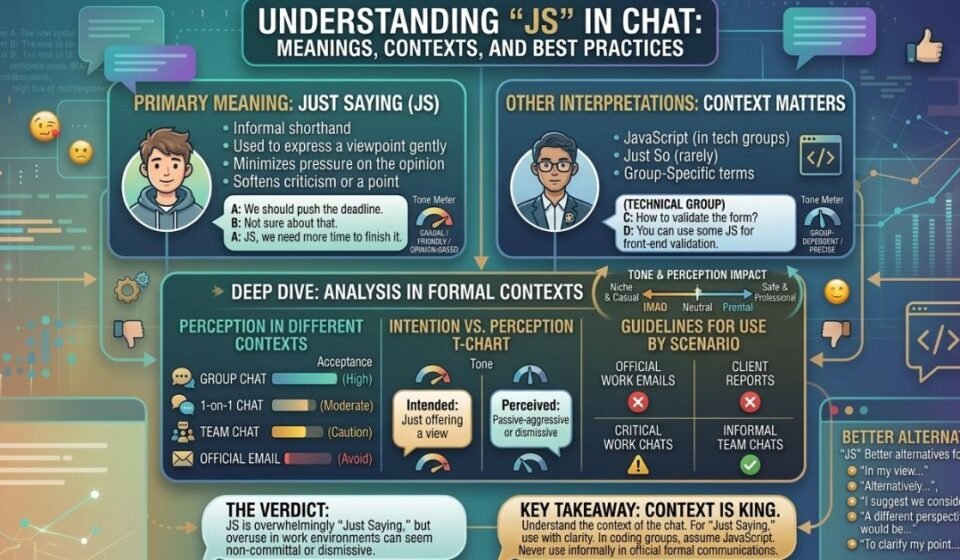
Have you ever seen JS in a message and wondered what it actually means? Many people use short forms while chatting, but some abbreviations can be confusing. The js meaning in chat usually stands for Just Saying, a simple phrase people use to share opinions, advice, or personal thoughts without sounding too serious.
From WhatsApp conversations to Instagram comments and TikTok replies, JS has become a popular part of online communication. It makes messages shorter, faster, and more casual. However, JS can have different meanings depending on the situation. In technology, it often means JavaScript, while in everyday chats, it usually has a completely different purpose. Understanding JS helps you communicate better and avoid misunderstandings online.
What Does JS Mean in Text & Chat?
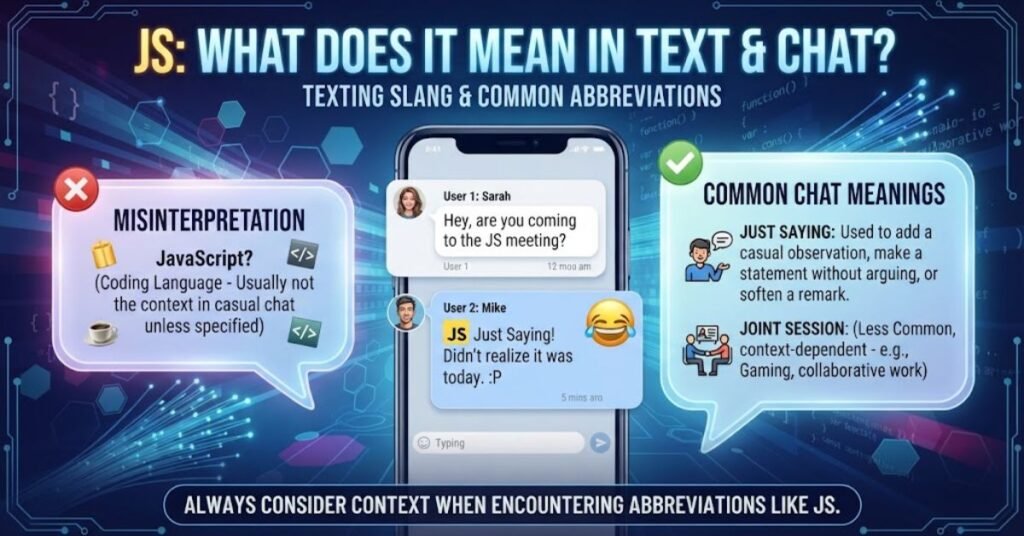
The js meaning in chat usually stands for “Just Saying.” People use this abbreviation to share an opinion without sounding too serious. It is one of the most common pieces of texting slang and internet slang used on WhatsApp, Instagram, TikTok, Snapchat, and other social media platforms. You’ll also see it in SMS, direct messages (DMs), comments, and instant messaging apps.
Adding “JS” at the end of a sentence acts like a polite disclaimer. It can soften a message, make casual advice feel friendlier, or add a personal thought without sounding pushy or confrontational. Even though it’s a short abbreviation, the context, relationship, and tone decide how readers understand it. In most daily conversations, JS simply means, “This is only my opinion.”
Quick examples:
- Friend: “That pizza place is much better downtown, JS.”
- Coworker: “You may want to send the email again, JS.”
- Friend: “That movie wasn’t worth the ticket price, JS.”
- Sibling: “You should get more sleep before exams, JS.”
- Chat: “Blue looks better on you, JS.”
When Should You Use JS in a Text?
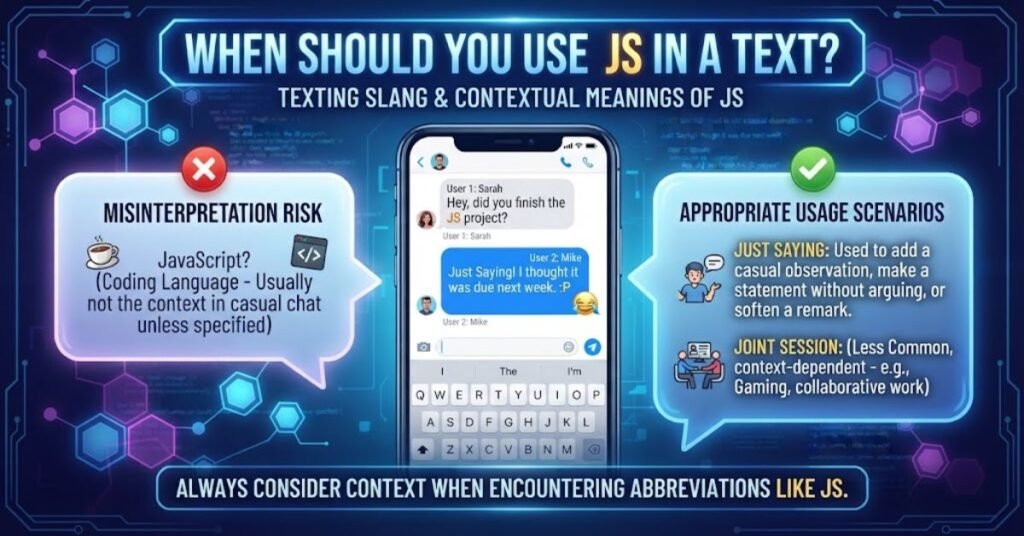
Knowing the js meaning in chat helps you use it naturally. JS works best when you want to share an opinion, recommendation, observation, or casual advice without sounding rude. It creates a friendly tone and serves as a helpful buffer in conversation. That’s why people often add it after giving advice or expressing a personal thought.
You can use JS in text messages, WhatsApp, Instagram comments, Snapchat chats, or TikTok replies. However, think about your audience first. In professional conversations, writing the full sentence is often clearer. Tone matters too. Without emojis or friendly wording, JS may sound dismissive or even sarcastic. Matching the relationship and tone helps avoid misunderstandings.
Common times to use JS:
- Giving casual advice.
- Sharing opinions.
- Making a recommendation.
- Pointing out an observation.
- Offering a personal thought.
- Ending a lighthearted comment.
Conversation example:
Alex: “You should book your tickets today, JS.”
Taylor: “Good idea. I’ll do it now.”
How to Tell What JS Means From Context
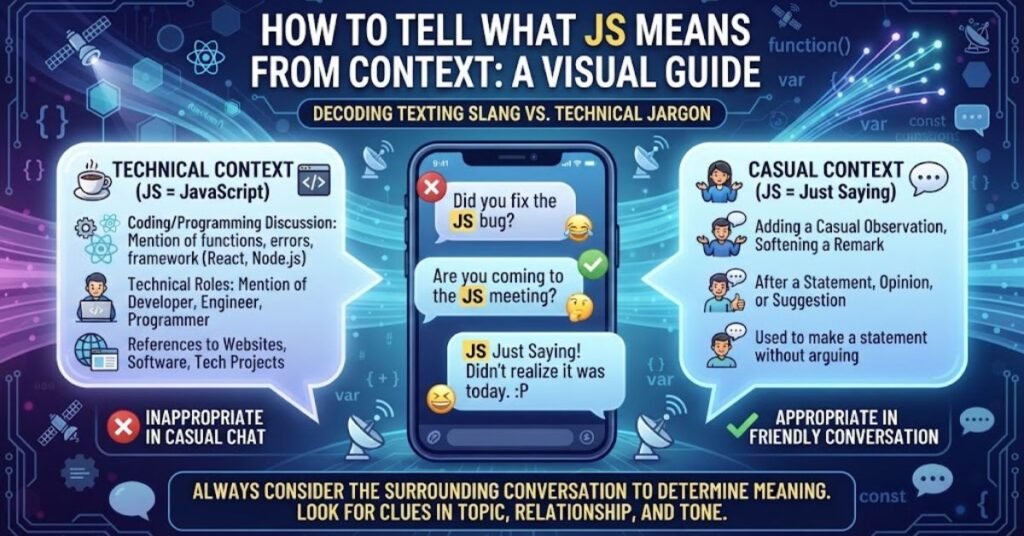
The easiest way to understand the js meaning in chat is by looking at the entire conversation. Most of the time, JS means Just Saying, especially when someone shares advice, an opinion, or a casual comment. Reading only the abbreviation can lead to misinterpretation, so always check the surrounding words first.
Pay attention to the tone, wording, sentence structure, punctuation, and emojis. A smiling emoji often creates a lighthearted or friendly tone, while a short message with a period might sound more serious. Also, think about the sender’s texting style. If you’re discussing coding, software, websites, or apps, JS could mean JavaScript instead. The topic usually gives you the answer.
Things to check:
- What is the conversation about?
- Is the sender giving advice?
- Are emojis included?
- Is the tone friendly or sarcastic?
- Is the discussion about programming?
Conversation example:
Chris: “You should save your work more often, JS 😊”
Morgan: “You’re right. I almost lost everything.”
Full Form, Stands For & Short Meaning of JS
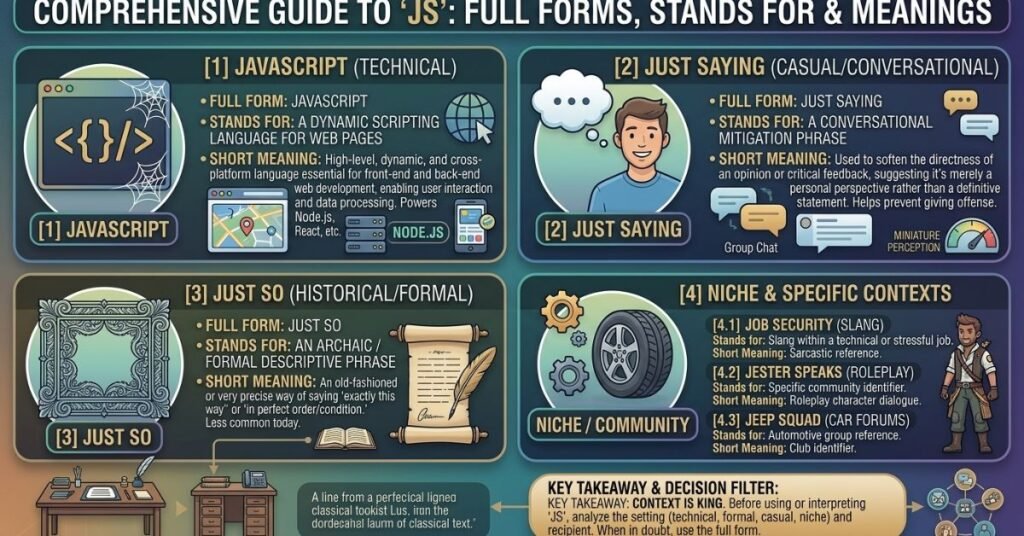
The full form of JS in texting is Just Saying. It is a popular acronym, abbreviation, and short form people use in online conversations. The js meaning in chat is simple. It lets you express an opinion while making your message sound less direct. Instead of arguing, you simply add “JS” to soften the statement.
This short expression has become part of everyday digital language because it saves typing time and feels natural in fast conversations. You’ll find it across social media, messaging apps, SMS, and chat rooms. Although JS has several meanings, Just Saying remains the most common one in casual texting.
Quick facts:
- Full form: Just Saying
- Type: Texting slang
- Purpose: Soften a message
- Tone: Usually casual and polite
- Used on: WhatsApp, Instagram, TikTok, Snapchat, SMS
Other possible meanings:
Besides Just Saying, JS can also have different meanings depending on the context. In technical use, it often stands for JavaScript, the popular programming language used for coding, websites, apps, and software development. In some workplaces, it may refer to Job Safety. Certain organizations or schools also use it for Journal System in academic use.
These meanings are much less common in casual texting. Before deciding what JS stands for, always consider the topic, conversation, and the people involved.
Other meanings include:
- Just Suggesting
- Just Sharing
- JavaScript
- Job Safety
- Journal System
Conversation example:
Developer: “I’m learning JS this weekend.”
Friend: “Nice! JavaScript is great for building websites.”
Origin, History & First Known Use of JS
The js meaning in chat comes from the early days of online messaging, where people started shortening common words and phrases to type faster. JS is often used as an abbreviation in casual conversations.
In many chats, JS means “just saying.” People use it when they want to share an opinion, thought, or comment without sounding too serious or aggressive.
The abbreviation became common with the growth of:
- Text messaging
- Online forums
- Social media platforms
- Gaming chats
- Instant messaging apps
Before people used emojis and reactions widely, short forms like JS helped users communicate quickly.
Simple breakdown:
- J = Just
- S = Saying
- JS = Just Saying
People usually add JS after a statement to show that they are only sharing a thought.
Conversation example:
Person 1: “I think you should save more money before buying that phone.”
Person 2: “JS, I’m not trying to control your choice.”
Here, JS makes the message sound more like friendly advice instead of criticism.
Why It Became Popular
JS became popular because online communication needed faster and shorter ways to express ideas.
People wanted quick replies that still carried meaning. Abbreviations became a natural part of digital conversations.
Some reasons for its popularity include:
- Faster typing on mobile phones
- Character limits on older platforms
- Casual internet communication styles
- Increased use of social media chats
- Growth of texting culture
The phrase “just saying” was already common in spoken English. Users simply shortened it into JS while chatting.
Today, people use JS on platforms like:
- Facebook Messenger
- Instagram DMs
- Gaming chats
- Online communities
Conversation example:
Friend: “You always stay up late before exams.”
You: “JS, getting enough sleep might help you focus better.”
The abbreviation keeps the message relaxed and friendly.
How People Use JS in Daily Conversations
The js meaning in chat is mostly “just saying,” and people use it to add a personal opinion, suggestion, or observation.
It helps speakers express their thoughts without making the message sound like a strict order.
For example, someone may use JS when giving advice, sharing feelings, or making a small comment.
Common reasons people use JS include:
- Giving a suggestion politely
- Sharing an honest opinion
- Adding a personal thought
- Making a statement less serious
- Avoiding misunderstandings
Conversation example:
Person 1: “I’m thinking about quitting my job.”
Person 2: “JS, maybe consider all options before deciding.”
Here, JS shows that the person is offering an opinion, not forcing a decision.
Common Situations
People use JS in many everyday chat situations. It often appears after a sentence where someone wants to sound casual.
Common situations include:
- Giving advice
Example:
“JS, you should check the reviews before buying it.” - Sharing an opinion
Example:
“JS, I think the old design looked better.” - Making a small complaint
Example:
“JS, you always reply late.” - Adding humor
Example:
“JS, you are officially addicted to coffee.” - Expressing concern
Example:
“JS, don’t forget to take care of yourself.”
The meaning depends on the conversation tone. It can sound friendly, serious, or playful.
Examples
Here are some simple examples showing how JS works in chats:
- Friend: “I want to spend all my savings on this trip.”
Reply: “JS, having some emergency money is always useful.” - Person 1: “I don’t like this new update.”
Person 2: “JS, many users feel the same way.” - Friend: “I’m going to message my ex again.”
Reply: “JS, think about whether it’s the right choice.” - Person 1: “I never need help from anyone.”
Person 2: “JS, accepting support doesn’t make you weak.”
In each example, JS introduces a personal thought without sounding too forceful.
Tone Variations
The tone of JS changes depending on the words around it and the relationship between people.
It can have different meanings in different situations.
Friendly tone:
“JS, you looked great in that picture.”
This sounds like a simple compliment.
Helpful tone:
“JS, you should prepare earlier for better results.”
This sounds like advice.
Sarcastic tone:
“JS, being late every day is definitely a talent.”
This adds humor or teasing.
Serious tone:
“JS, your health should come before work.”
This shows concern.
Before using JS, consider the situation. With close friends, it feels natural. In professional conversations, writing the full phrase “just saying” may sound clearer.
Understanding the js meaning in chat helps you read messages correctly and use the abbreviation in the right way.
JS Meaning Across WhatsApp, Instagram, TikTok & Snapchat
The js meaning in chat usually refers to “just saying” on social media platforms. People use it to share an opinion, thought, or suggestion in a casual way.
The meaning stays mostly the same across different apps, but the tone can change depending on the platform and conversation style.
People commonly use JS in:
- Private messages
- Comments
- Captions
- Group chats
- Story replies
Because social media conversations move quickly, short forms like JS help users express ideas faster.
Conversation example:
Friend: “I think you should try a different style.”
Reply: “JS, I think it would look better.”
Here, JS shows that the person is sharing an opinion, not giving a strict command.
On WhatsApp, JS meaning in chat is commonly “just saying.” Users add it when they want to make a comment sound more relaxed.
WhatsApp is mostly used for personal conversations, so JS often appears between friends, family members, and groups.
Common uses include:
- Giving friendly advice
- Sharing personal opinions
- Making jokes
- Adding extra thoughts
Conversation example:
Person 1: “I’m planning to buy an expensive laptop.”
Person 2: “JS, check other options before spending that much.”
The phrase helps the sender avoid sounding too direct.
In WhatsApp groups, JS can also make discussions feel less serious and more conversational.
On Instagram, JS is often used in DMs, comments, and replies. The js meaning in chat remains “just saying,” but users may use it to react to posts or opinions.
People often add JS when:
- Commenting on pictures
- Replying to stories
- Sharing reactions
- Giving suggestions
Conversation example:
Comment: “JS, this outfit looks amazing on you.”
The abbreviation creates a casual and friendly feeling.
Instagram users also use JS when they want to express an opinion without creating an argument.
Example:
“JS, I liked your old profile picture more.”
It makes the message sound like a personal preference rather than criticism.
TikTok
On TikTok, JS appears in comments, direct messages, and creator conversations.
The js meaning in chat usually means “just saying,” but TikTok culture often uses short forms to keep comments quick and simple.
People may use JS when:
- Sharing reactions to videos
- Adding personal views
- Making playful comments
- Giving feedback
Conversation example:
Comment: “JS, this song deserves more attention.”
Here, the user shares an opinion without making it sound like a fact.
TikTok comments are often casual, so JS fits well with the platform’s fast communication style.
Snapchat
On Snapchat, JS is mostly used in quick chats and snaps between friends.
Since Snapchat focuses on short conversations, abbreviations like JS help users type faster.
People use JS for:
- Quick opinions
- Friendly advice
- Small comments
- Personal reactions
Conversation example:
Friend: “I might skip the event tonight.”
Reply: “JS, you might regret missing it.”
The phrase keeps the message informal.
On Snapchat, the meaning depends heavily on the relationship between users. Among friends, JS usually feels natural and friendly.
Different Meanings of JS in Other Fields
Although the js meaning in chat usually means “just saying,” JS can have different meanings in other areas.
The meaning depends on the topic, industry, or situation where it appears.
For example, in technology, JS commonly refers to JavaScript, a programming language used for creating websites and applications.
Different meanings include:
- Just Saying (online chats)
- JavaScript (technology)
- Job Satisfaction (business)
- Joint Services (organizations)
- Juvenile Status (some legal contexts)
Always check the surrounding words before deciding what JS means.
Conversation example:
Developer: “I’m learning JS for web development.”
Meaning: JavaScript, not “just saying.”
The same abbreviation can represent completely different ideas.
Common Alternative Meanings:
JS can stand for many phrases outside casual conversations.
Some common alternative meanings include:
- JavaScript: A programming language used to build interactive websites.
- Just Saying: A casual chat expression used after sharing an opinion.
- Job Satisfaction: A workplace term related to employee happiness.
- Joint Services: A term used for combined organizations or departments.
- Junior School: Sometimes used in education contexts.
Example:
Person 1: “I started a JS course.”
Person 2: “Is it JavaScript?”
The correct meaning depends on the conversation topic.
Tip:
Always look at the context before understanding JS.
A simple abbreviation can have different meanings in different conversations.
Helpful tips:
- Check the topic of the conversation.
- Look at the words before and after JS.
- Consider the platform being used.
- Ask for clarification if the meaning is unclear.
Conversation example:
Message: “I’m practicing JS every day.”
Possible meanings:
- In a coding group: JavaScript
- In a casual chat: Just saying
Understanding context helps you avoid incorrect interpretations.
Common Confusions, Mistakes & Wrong Interpretations
Many people misunderstand JS because the abbreviation has multiple meanings.
The js meaning in chat is usually “just saying,” but some users may confuse it with technology-related meanings like JavaScript.
Mistakes often happen when:
- Reading messages without context
- Assuming one meaning everywhere
- Ignoring the conversation topic
- Misunderstanding the sender’s intention
For example, a developer talking about JS is probably discussing coding, while a friend using JS in a message is likely saying “just saying.”
Conversation example:
Friend: “JS, you should rest more.”
Wrong interpretation: JavaScript
Correct meaning: Just saying
Understanding the situation prevents confusion.
Common Mistakes:
Here are some common mistakes people make when reading or using JS:
- Thinking JS always means JavaScript
- Using JS in formal writing without explanation
- Assuming JS always sounds friendly
- Ignoring the tone of the message
For example:
“JS, your idea needs improvement.”
This could sound helpful or slightly critical depending on the relationship.
Another mistake is using JS with someone who does not know internet abbreviations.
A clearer option may be writing:
“Just saying, your idea needs improvement.”
This avoids misunderstanding.
Example Confusion:
Sometimes JS creates confusion because the same letters represent different ideas.
Example 1:
Message: “I’m learning JS this month.”
Possible meanings:
- Coding conversation → JavaScript
- Casual chat → Could mean something else
Example 2:
Message: “JS, I think you should try again.”
Meaning:
- Just saying
To understand the correct meaning, check the conversation topic first.
The js meaning in chat becomes easy to understand when you focus on the platform, context, and tone of the message.
How to Avoid Confusion:
Understanding the js meaning in chat becomes easier when you pay attention to the situation, platform, and conversation topic.
JS can mean different things, so avoid guessing without checking the context.
Follow these simple tips:
- Read the full message before deciding the meaning.
- Check whether the conversation is about technology or casual chatting.
- Notice the tone of the sender.
- Ask politely if the meaning is unclear.
For example, a programmer saying “I use JS daily” probably means JavaScript. A friend saying “JS, you should try this place” means “just saying.”
Conversation example:
Person 1: “I’m studying JS now.”
Person 2: “Do you mean JavaScript or just saying?”
This simple question removes confusion quickly.
Using context helps you understand abbreviations correctly and reply naturally.
Similar Terms, Alternatives & Related Slang
The js meaning in chat is connected with other short phrases people use online. Many internet abbreviations help users express feelings, opinions, or reactions quickly.
Some similar terms have the same purpose but slightly different meanings.
People often use:
- IMO (In My Opinion)
- TBH (To Be Honest)
- FYI (For Your Information)
- BTW (By The Way)
- IKR (I Know, Right?)
- NGL (Not Gonna Lie)
These expressions help make conversations shorter and more casual.
Conversation example:
Friend: “JS, I think this movie was better than the first one.”
Reply: “IMO, I agree with you.”
Both JS and IMO introduce a personal opinion, but their usage is slightly different.
Alternatives:
Several slang terms can replace JS depending on the message.
Common alternatives include:
- Just saying: The full version of JS.
- IMO: Used when sharing a personal opinion.
- TBH: Used before an honest statement.
- NGL: Used when admitting something honestly.
- BTW: Used when adding extra information.
Examples:
- “JS, you should check this song.”
- “IMO, this song is amazing.”
- “TBH, I expected something different.”
Each phrase adds a different feeling to the message.
JS usually sounds softer because it suggests the person is only sharing a thought.
Differences:
Although these slang terms look similar, they have different purposes.
JS (Just Saying):
- Shares an opinion casually.
- Makes advice sound less direct.
- Often appears after a statement.
IMO (In My Opinion):
- Clearly shows personal thoughts.
- Focuses on someone’s viewpoint.
TBH (To Be Honest):
- Shows honesty or a personal confession.
NGL (Not Gonna Lie):
- Introduces a truthful or strong opinion.
Conversation example:
“JS, that outfit looks great.”
This sounds like a casual comment.
“TBH, that outfit looks great.”
This sounds like a more direct honest opinion.
Examples of JS in Real Chat Situations
The js meaning in chat becomes clearer when you see real examples. People usually use JS while sharing opinions, giving advice, or making friendly comments.
Here are common situations:
Giving advice:
“JS, you should start preparing earlier.”
Sharing thoughts:
“JS, I think this restaurant is better.”
Making a friendly comment:
“JS, your new profile picture looks amazing.”
Expressing concern:
“JS, don’t forget to take care of yourself.”
Conversation example:
Friend: “I want to quit my fitness routine.”
Reply: “JS, you worked hard to build that habit.”
Here, JS makes the advice feel supportive instead of demanding.
The phrase works best in relaxed conversations with friends, followers, or online communities.
How to Reply When Someone Says JS
When someone uses JS in a message, your reply depends on the meaning and tone of the conversation.
Since js meaning in chat usually means “just saying,” the person is often sharing an opinion without expecting an argument.
You can reply by:
- Agreeing with their point
- Sharing your own opinion
- Asking more questions
- Keeping the conversation friendly
Conversation example:
Person 1: “JS, you should watch this series.”
Reply: “Thanks, I’ll check it out.”
A simple response is often enough.
If the message sounds like advice, you can acknowledge it politely.
Possible Responses:
Here are different ways to respond when someone says JS:
Friendly response:
“Yeah, I understand what you mean.”
Agreeing response:
“You’re right, I was thinking the same thing.”
Curious response:
“What makes you think that?”
Funny response:
“JS accepted, opinion noted!”
Polite response:
“Thanks for sharing your thoughts.”
Conversation example:
Friend: “JS, you should take a break today.”
Reply: “You might be right. I probably need one.”
The best response depends on your relationship with the person and the message tone.
Is JS Still Popular? Trends & Online Usage
The js meaning in chat is still used today, especially in casual online conversations. While some older abbreviations are becoming less common, JS remains recognizable among many internet users.
People continue using JS because it is:
- Short and easy to type
- Common in social media conversations
- Useful for sharing opinions
- Familiar among younger users
Platforms like WhatsApp, Instagram, TikTok, and Snapchat continue supporting short-form communication.
Conversation example:
Comment: “JS, this update feels much better than before.”
The abbreviation fits modern online communication because users prefer quick messages.
Although newer slang appears regularly, JS remains a simple way to add personal thoughts.
Why It’s Still Trending:
JS continues to stay popular because digital conversations keep becoming faster and shorter.
People like abbreviations that save time while keeping messages understandable.
Main reasons include:
- Mobile texting habits
- Social media culture
- Short comment styles
- Online communities
- Fast communication needs
The phrase “just saying” is also common in everyday speech, which helps JS remain familiar.
Example:
User comment: “JS, this trend is everywhere now.”
The abbreviation feels natural because it matches casual online language.
As long as people share opinions and advice online, JS will continue appearing in chats and social conversations.
FAQs
1. What does JS mean in texting?
The js meaning in chat usually means Just Saying when texting casually
to share opinions or thoughts with other people.
2. Is JS rude or polite?
The js meaning in chat can sound polite because it softens advice
but tone depends on the conversation and context.
3. Does JS always mean Just Saying?
The js meaning in chat does not always mean Just Saying because
JS may have other meanings in different fields.
4. What does JS mean in programming?
In programming, JS means JavaScript and is different from
js meaning in chat used for casual online conversations and messages.
5. How do I know what JS means?
Check the topic and tone to understand js meaning in chat because
context shows whether it means Just Saying accurately.
Conclusion
The js meaning in chat is easy to understand when you know the conversation context. In most online messages, js meaning in chat refers to Just Saying. People use JS to share opinions, advice, or thoughts in a casual way. The js meaning in chat helps make messages feel softer and less direct. You can see JS on WhatsApp, Instagram, TikTok, and other social platforms.
Understanding the js meaning in chat also helps you avoid confusion. JS can have different meanings in areas like programming, where it means JavaScript. Always check the topic before replying. The js meaning in chat depends on the sender’s words, tone, and situation. Learning these differences makes online conversations clearer and easier.

Henry Parker is an English language writer with several years of experience helping learners understand grammar and improve their writing. He enjoys breaking down confusing grammar rules into simple explanations and practical examples. Through his work at HexoWaves, Henry shares useful tips on grammar, vocabulary, sentence structure, and everyday English.