

Have you ever stopped mid-sentence and wondered, “Is it cacoon or cocoon?” You’re not alone. This small spelling confusion catches students, English learners, writers, and even native speakers. Both versions may look believable, especially when you only hear the word spoken. However, English spelling can be tricky, and one wrong vowel can completely change whether a word is considered correct.
The answer is simple: only one spelling belongs in standard English. Yet there is more to this word than a simple spelling correction. A cocoon has an important meaning in biology and a surprisingly rich place in everyday language. From caterpillars and metamorphosis to comfort, privacy, and protection, this guide covers everything you need to know. You’ll learn the correct spelling, meaning, pronunciation, common mistakes, and easy memory tricks that make the answer stick for good.
What Is the Correct Spelling: Cacoon or Cocoon?
When choosing between cacoon or cocoon, only one spelling is correct in standard English: cocoon. You will find this spelling in dictionaries, academic writing, science books, and professional writing.
Cacoon is a common misspelling. Although many people understand what you mean, it isn’t recognized as the standard English word.
Using the correct spelling matters because it improves:
- Readability
- Credibility
- Grammar accuracy
- Professional communication
Whether you’re a student, blogger, teacher, or content creator, write cocoon when referring to the protective covering associated with insect development.
Quick Answer
The answer to cacoon or cocoon is simple:
| Word | Correct? | Meaning |
| Cocoon | Yes | A protective silk casing |
| Cacoon | No | A common misspelling |
Conversation example:
Student: Is cacoon the correct spelling?
Teacher: No. The correct spelling is cocoon.
Remember this simple rule: English dictionaries recognize cocoon, not cacoon, as the standard spelling.
What Does Cocoon Mean?
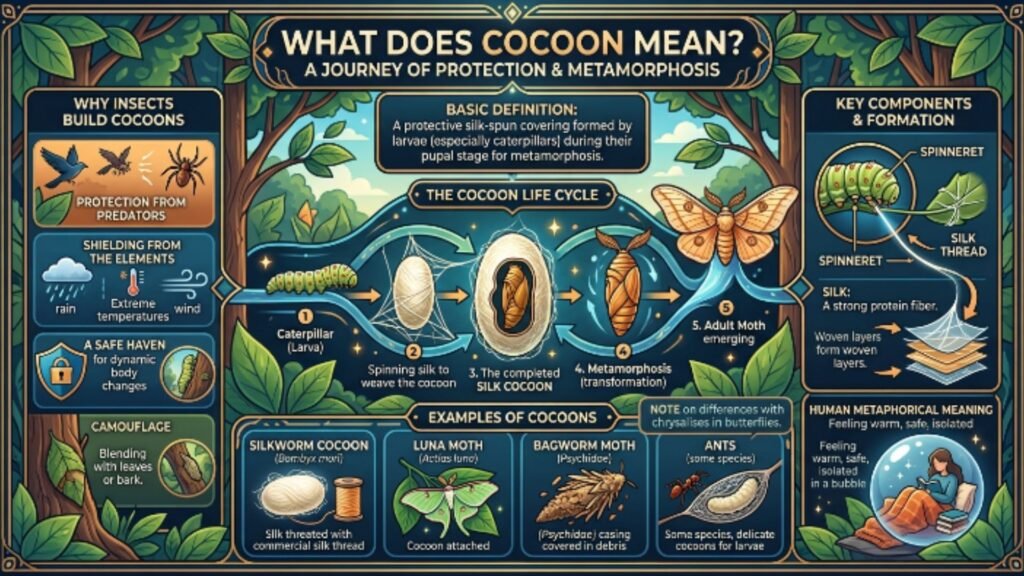
A cocoon is a protective silk casing made by certain insect larvae during metamorphosis. It helps protect the developing insect during its transformation.
For example, a caterpillar may create a cocoon before developing into an adult moth. The word is closely connected with biology, insects, and natural transformation.
Example:
The caterpillar spun a cocoon before becoming a moth.
Cocoon also has a figurative meaning. People use it to describe a place that feels safe, warm, private, or protected.
For example:
Her bedroom became a cocoon of comfort during winter.
So, when discussing cacoon or cocoon, remember that cocoon can describe both a real silk casing and a feeling of safety or protection.
Why Do People Write “Cacoon”?
People usually write cacoon because English pronunciation can sometimes be misleading. When spoken quickly, the first vowel sound may cause confusion.
Several factors can lead to this common misspelling:
- Similar vowel sounds
- Typing errors
- Regional accents
- Weak familiarity with the word
- Phonetic spelling habits
Some English learners simply write the word the way they think it sounds. Native speakers can make the same mistake when typing quickly.
Conversation example:
Writer: I wrote “cacoon.” Is that right?
Editor: Almost. Change the first “a” to “o.”
The correct spelling is c-o-c-o-o-n. A spell-check tool can often catch the mistake, but learning the correct spelling helps you avoid repeating it.
Understanding the Meaning of Cocoon
The word cocoon carries more meaning than many people realize. Its literal meaning comes from biology, but everyday English has given it several figurative uses.
You might hear cocoon used when discussing:
- Insect larvae
- Metamorphosis
- Protection
- Comfort
- Isolation
- Privacy
The context usually tells you which meaning applies.
For instance, a scientist may describe a moth’s cocoon. Meanwhile, a lifestyle writer might describe a cozy home as a cocoon of comfort.
Understanding both meanings helps you use the word correctly. It also makes the difference between cacoon or cocoon easier to remember.
Literal Meaning
In its literal sense, a cocoon is a protective silk casing produced by certain insect larvae. Many people associate cocoons with caterpillars and moths.
During metamorphosis, the developing insect undergoes a major transformation. The cocoon provides protection during this important stage.
Example:
The scientist found a cocoon hanging from the tree branch.
It’s worth noting that people often confuse cocoons and chrysalises. Generally, moth larvae spin silk cocoons, while butterflies form a chrysalis.
Key biology terms include:
- Caterpillar
- Moth
- Butterfly
- Insect larvae
- Silk casing
- Metamorphosis
- Transformation
So, when choosing between cacoon or cocoon, use cocoon for the protective covering created during insect development.
Figurative Meaning
Outside biology, cocoon often describes a feeling of safety, comfort, or separation from the outside world.
Someone may create a cocoon of comfort by wrapping themselves in blankets on a cold evening. The word creates an image of warmth and protection.
Examples:
The cabin became a cocoon of comfort during the snowstorm.
After a busy week, he wanted to retreat into his private cocoon.
Figuratively, cocoon can suggest:
- Safety
- Protection
- Isolation
- Privacy
- Comfort
Conversation example:
Friend: Why haven’t you gone out all weekend?
Friend: I’m enjoying my little cocoon of comfort.
This figurative usage gives the word emotional depth. It describes more than a physical space. It can also describe how a place makes you feel.
Business and Lifestyle Usage
Businesses and lifestyle writers often use cocoon as a metaphor. The word creates feelings of comfort, privacy, luxury, and protection.
Hotels may promise a cocoon of luxury. Interior designers may promote a cocoon-like workspace. Lifestyle brands sometimes discuss a cocooning lifestyle centered on staying home and creating comfort.
Common expressions include:
- Cocoon of comfort
- Cocoon of luxury
- Cocoon-like workspace
- Cocooning lifestyle
Example:
The spa creates a cocoon of luxury where guests can relax.
This language works because people naturally connect a cocoon with security and transformation. Marketers use that connection to create a warm emotional image.
Still, regardless of the context, the spelling remains the same. In the cacoon or cocoon debate, cocoon is always the standard English spelling.
Why the Spelling Confusion Happens
The confusion between cacoon or cocoon doesn’t happen randomly. English spelling often creates problems because words don’t always sound exactly like they look.
Pronunciation, accents, typing habits, and unfamiliarity can all lead to mistakes.
The first syllable of cocoon can sound weak when spoken naturally. As a result, some people hear a sound closer to “a” and write cacoon.
Other common causes include:
- Phonetic spelling
- Regional accents
- Fast typing
- Weak vowel sounds
- Missed spell-check suggestions
English learners aren’t alone here. Native speakers also make spelling mistakes when words have unexpected vowel patterns.
Similar Sound Patterns
English contains many words that sound simple but cause spelling problems. Similar vowel sounds can make writers choose the wrong letters.
Consider these common examples:
| Correct Word | Common Misspelling |
| Balloon | Baloon |
| Occasion | Ocassion |
| Cocoon | Cacoon |
| Committee | Comitee |
Words such as cool, moon, and balloon also share the familiar “oo” sound found in cocoon.
The problem is that sound doesn’t always guarantee correct spelling. English contains many spelling patterns that don’t perfectly match pronunciation.
Conversation example:
Student: It sounds like “cacoon.”
Teacher: Maybe, but English spelling doesn’t always follow sound alone.
That’s why reading, dictionary use, and regular writing practice help. Once you remember the double “o” pattern, spelling cocoon becomes much easier.
Influence of Regional Accents
Regional accents can change how vowel sounds are heard. A word may sound slightly different depending on where the speaker grew up.
This variation can influence spelling, especially for English learners. If you hear cocoon pronounced with a softer first vowel, you may mistakenly write cacoon.
Accents don’t change the correct spelling, however.
The standard spelling remains:
Cocoon
This applies in American English and other standard forms of English.
Example:
Two people may pronounce the first syllable slightly differently, but both should write the same word.
Regional accents can influence:
- Vowel sounds
- Stress patterns
- Listening accuracy
- Phonetic spelling attempts
That’s why relying only on pronunciation can be risky. When you’re unsure about a word, check a trusted dictionary such as Merriam-Webster Dictionary or Oxford Learner’s Dictionaries.
Auto-Correct Doesn’t Always Help
Auto-correct and spell-check tools are useful, but they aren’t perfect. They can catch many typing errors, yet you shouldn’t depend on them completely.
Sometimes a writing tool may miss an error because:
- The wrong word resembles another word.
- The spelling appears in a name or brand.
- Auto-correct settings vary.
- The writer ignores the suggested correction.
For cacoon or cocoon, most modern spell-check tools recognize cocoon as the correct English word. Still, mistakes can slip through when you type quickly.
Conversation example:
Writer: Why didn’t auto-correct fix my mistake?
Editor: Tools help, but proofreading still matters.
Before publishing academic writing, professional writing, or online content, review important words manually. A quick final check can protect your credibility and improve overall readability.
Cacoon vs Cocoon: Side-by-Side Comparison
When comparing cacoon or cocoon, the difference is simple but important. Cocoon is the correct spelling and a recognized English word. Cacoon is a common misspelling that should not appear in standard writing.
A side-by-side comparison makes the distinction easier to remember.
| Feature | Cocoon | Cacoon |
| Correct spelling | Yes | No |
| Standard English word | Yes | No |
| Found in dictionaries | Yes | No |
| Used in academic writing | Yes | No |
| Recommended usage | Always | Avoid |
The confusion usually comes from pronunciation and vowel sounds. However, spelling rules and dictionary recognition clearly support cocoon.
Dictionary Recognition
Major dictionaries recognize cocoon as the standard English word. You can check trusted references such as the Merriam-Webster Dictionary and Oxford Learner’s Dictionaries when you need confirmation.
The word refers to a protective silk casing associated with insect larvae and metamorphosis. Dictionaries also recognize its figurative meaning related to protection, isolation, and comfort.
Cacoon, however, does not appear as the standard spelling.
Conversation example:
Student: Should I write cacoon in my assignment?
Teacher: No. Check the dictionary. Cocoon is correct.
Dictionary checks are especially helpful for English learners and students. They can quickly confirm spelling, pronunciation, grammar, and meaning.
When facing the question cacoon or cocoon, dictionary evidence leaves little room for doubt: always use cocoon in standard English writing.
Writing Recommendation
The safest writing recommendation is simple: always use cocoon unless a specific brand, username, or fictional name intentionally uses another spelling.
Correct spelling matters in many situations:
- Academic writing
- Professional writing
- Blog posts
- Science assignments
- Website content
- Educational materials
A small misspelling may not stop readers from understanding you. Still, repeated errors can affect credibility and readability.
Conversation example:
Writer: Does one spelling mistake really matter?
Editor: Sometimes one mistake can change how professional your work appears.
For cacoon or cocoon, don’t rely only on what sounds right. Write cocoon and use spell-check when proofreading.
This simple habit helps bloggers, students, teachers, content creators, and business owners communicate with greater confidence and accuracy.
Real-Life Example: How a Small Spelling Error Can Affect Professional Writing
Imagine a student preparing a biology report about metamorphosis. The student writes:
“The moth develops inside a cacoon before emerging.”
Most readers will understand the intended meaning. However, the spelling mistake can distract teachers and make the work appear less polished.
Now imagine the same error appearing on a business website that sells science learning materials. Customers may start questioning the quality of the information.
A single mistake won’t destroy your credibility. Repeated mistakes, though, can slowly weaken trust.
Spelling accuracy matters because it supports:
- Professionalism
- Readability
- Credibility
- Brand trust
- Clear communication
Conversation example:
Manager: Did anyone proofread this article?
Editor: Yes, but we missed “cacoon.”
That small error shows why proofreading matters. In professional writing, details often speak louder than intentions.
Language and Search Trends: Why Correct Spelling Matters in 2025–2026
Digital writing has made correct spelling more important than ever. People now publish content instantly across blogs, websites, social media, emails, and business platforms.
Search engines have become better at understanding common misspellings. Still, writers should use standard spelling whenever possible.
For the keyword cacoon or cocoon, search engines may understand the user’s intended meaning. However, readers still expect accurate grammar and spelling.
Correct spelling helps create content that feels reliable and easy to understand.
It can benefit:
- Bloggers
- SEO professionals
- Content creators
- Students
- Business owners
- Teachers
The internet is crowded with information. Clean and accurate writing won’t guarantee success, but it helps create a stronger first impression.
Key Trends
Modern writing tools and search engines can recognize many common spelling mistakes. Auto-correct, spell-check, and search suggestions often guide users toward the correct English word.
Several trends shape how people search and write today:
- Search engines understand misspelled queries.
- Google often suggests corrected spellings.
- Spell-check tools catch common typing errors.
- Readers expect polished online content.
- Accurate language supports credibility.
However, technology doesn’t replace careful proofreading.
Conversation example:
Writer: Google understood my misspelling, so does it matter?
Editor: Google may understand it, but your readers still see it.
Keyword relevance also matters for online content. Using cocoon correctly helps keep the topic clear for both readers and search engines.
The best approach combines technology with human attention. Let tools help, but always review your final work.
What This Means for Writers
For writers, the lesson is straightforward: don’t depend entirely on search engines or auto-correct to fix mistakes.
Whether you create blog posts, academic papers, product descriptions, or social media content, correct spelling strengthens your message.
Using cocoon instead of cacoon helps maintain:
- Professional standards
- Reader trust
- Better readability
- Clear keyword relevance
- Stronger credibility
Conversation example:
Blogger: Should I target the misspelled keyword too?
SEO professional: You can discuss it, but keep the correct spelling clear.
Writers should address common misspellings because users search for them. However, the main content should teach the correct form.
For cacoon or cocoon, explain the confusion naturally while making it clear that cocoon remains the proper spelling.
How to Remember the Correct Spelling of Cocoon
Spelling mistakes happen to everyone. Fortunately, a few simple memory tricks can help you remember how to spell cocoon correctly.
The word may look confusing at first because it contains several vowels. Once you break it into smaller parts, though, it becomes easier to remember.
Try these methods:
- Focus on the two pairs of “o.”
- Connect it with familiar words.
- Create a visual image.
- Write the word several times.
The best memory trick is usually the one that sticks in your mind. You don’t need complicated grammar rules for this word.
When choosing between cacoon or cocoon, remember that the correct spelling has two pairs of rounded “o” letters. That visual pattern makes the word much easier to recognize.
Trick 1: Think of Two O’s for Protection
One easy way to remember cocoon is to notice its two pairs of the letter “o.”
You can break the word like this:
CO + COON
The rounded letters almost look like small protective circles. That makes them a useful visual connection to the meaning of a cocoon.
Think of the spelling this way:
- First pair: co
- Second pair: coon
- Four “o” letters in total
Conversation example:
Student: How many “o” letters are in cocoon?
Teacher: Four. Think of two pairs of protective circles.
This trick connects spelling with meaning. A cocoon provides protection, while the repeated rounded letters create a memorable visual pattern.
Whenever you wonder about cacoon or cocoon, remember the two pairs of “o” letters.
Trick 2: Associate It with Common Words
Another useful trick is to connect cocoon with familiar English words that use the “oo” sound.
Think about:
- Cool
- Moon
- Balloon
- Cocoon
These words can help your brain recognize the long “oo” sound. However, don’t assume every similar sound follows the same spelling pattern.
The goal is simply to build a memory connection.
Example:
The moon looked cool above the balloon-shaped cocoon.
It sounds silly, but unusual sentences often stick in your memory. That’s the beauty of a good spelling trick.
Conversation example:
Student: What word reminds me of cocoon?
Teacher: Try moon and balloon.
By connecting new vocabulary with familiar words, English learners can remember difficult spellings more easily.
Trick 3: Visual Memory
Visual memory can make spelling easier. Instead of seeing cocoon as a random collection of letters, picture what the word represents.
Imagine a caterpillar wrapped inside a soft silk casing. The rounded shape of the cocoon can remind you of the rounded letter “o.”
Now picture the word:
C O C O O N
Notice how many rounded letters appear in the middle.
You can also write the word several times while imagining:
- A caterpillar
- A silk casing
- Protection
- Metamorphosis
- Transformation
Conversation example:
Student: I keep writing cacoon.
Teacher: Picture the caterpillar and remember the four “o” letters.
Visual associations turn spelling into a mental picture. That makes the correct form easier to recall when you’re writing quickly.
Common Examples of Cocoon in Sentences
Understanding cacoon or cocoon becomes easier when you see the correct word used in real sentences. The word cocoon works in scientific, everyday, and professional contexts.
Its meaning changes slightly depending on the situation. In biology, it refers to a protective casing. In everyday language, it often suggests warmth, safety, or privacy.
Here are examples from different situations:
- Science and nature
- Daily conversation
- Business writing
- Lifestyle content
Conversation example:
Student: Can cocoon be used outside science?
Teacher: Yes. It can also describe comfort and protection.
The following examples show how to use cocoon naturally while helping you remember that cocoon, not cacoon, is the correct spelling.
Biological Usage
In biology, a cocoon usually refers to a protective silk casing associated with certain insect larvae. It plays an important role during metamorphosis and transformation.
Here are some natural examples:
- The caterpillar spun a cocoon around itself.
- A moth later emerged from the cocoon.
- Scientists studied the silk casing under a microscope.
- The cocoon protected the developing insect.
- We found several cocoons hanging from the branch.
These examples show the word in its scientific context.
Conversation example:
Child: What is inside that cocoon?
Parent: An insect is developing during its transformation.
When discussing cacoon or cocoon in science assignments, always use cocoon. This spelling appears in biology textbooks and standard dictionaries.
Using accurate scientific vocabulary also helps students write clearer and more credible academic work.
Everyday Usage
People often use cocoon outside biology. In everyday language, it describes a feeling of warmth, safety, comfort, or privacy.
For example:
- She wrapped herself in a cocoon of blankets.
- The small cabin felt like a cocoon of comfort.
- He spent the weekend in his cozy cocoon at home.
- The baby slept safely inside a warm cocoon.
- Rainy weather made the house feel like a private cocoon.
These sentences use the word figuratively.
Conversation example:
Friend: Why are you staying home tonight?
Friend: I want to relax in my little cocoon.
The word creates a warm mental image. It suggests protection from the outside world.
So, when comparing cacoon or cocoon, remember that cocoon works beautifully in both scientific and casual conversation.
Professional Writing
Professional writers also use cocoon as a descriptive word. It often appears in marketing, architecture, travel, and lifestyle writing.
For example:
- The hotel offers guests a cocoon of luxury.
- The office created a cocoon-like workspace for focused work.
- The spa provides a cocoon of privacy and relaxation.
- The brand promotes a comfortable cocooning lifestyle.
- The design creates a sense of safety and protection.
This language helps businesses create emotional connections with customers.
Conversation example:
Copywriter: How should we describe the hotel room?
Manager: Make it sound like a cocoon of comfort.
In professional writing, check your spelling carefully. A simple mistake like cacoon can distract readers.
Whether you’re a blogger, business owner, or content creator, correct spelling improves readability and supports brand trust.
Common Mistakes to Avoid
The confusion between cacoon or cocoon usually comes from small but understandable mistakes. English spelling can feel unpredictable, especially when pronunciation and spelling don’t perfectly match.
Fortunately, once you understand the common errors, avoiding them becomes easier.
Watch out for these problems:
- Writing cacoon
- Trusting pronunciation alone
- Ignoring spell-check warnings
- Typing too quickly
- Assuming familiar sounds guarantee familiar spelling
A spelling mistake doesn’t mean you have poor grammar. Everyone makes errors. The important thing is learning how to spot and correct them.
Conversation example:
Writer: I always mix up this word.
Editor: Learn the pattern once, then proofread carefully.
These common mistakes explain why the correct spelling deserves attention.
Mistake 1: Writing Cacoon
The most common mistake is simply writing cacoon instead of cocoon.
This usually happens because writers replace the first “o” with “a.” The incorrect form may look believable, especially when typed quickly.
Incorrect:
The butterfly came out of its cacoon.
Correct:
The insect emerged from its cocoon.
Remember that cocoon contains four “o” letters.
A quick visual breakdown can help:
CO + COON
Conversation example:
Student: Is cacoon accepted in English?
Teacher: No. Cocoon is the correct spelling.
When deciding between cacoon or cocoon, don’t guess. Use cocoon in standard writing.
A dictionary or spell-check tool can confirm the spelling if you forget it.
Mistake 2: Using Spellings Based on Pronunciation
Many spelling mistakes happen because people write words exactly as they hear them. Unfortunately, English doesn’t always make spelling that easy.
The pronunciation of cocoon can lead some people to hear the first vowel differently. Regional accents may also affect vowel sounds.
Similar spelling problems include:
- Balloon → Baloon
- Occasion → Ocassion
- Committee → Comitee
- Cocoon → Cacoon
Conversation example:
Student: But cacoon sounds right to me.
Teacher: English spelling doesn’t always follow sound perfectly.
Pronunciation is useful, but it shouldn’t be your only guide. Check unfamiliar words in a reliable dictionary.
When facing cacoon or cocoon, trust the standard spelling rather than a phonetic guess.
Mistake 3: Ignoring Spell Check Suggestions
Spell-check tools can catch many common typing errors, including cacoon. However, they only help when you pay attention to their suggestions.
Writers often ignore warnings because they:
- Type quickly
- Feel rushed
- Assume the tool is wrong
- Skip proofreading
- Publish without reviewing
Conversation example:
Editor: Did your spell-check flag this word?
Writer: Yes, but I ignored it.
Auto-correct is helpful, but it isn’t a substitute for careful writing. Always review important documents before publishing or submitting them.
This matters in academic writing and professional writing, where small errors can affect credibility.
For cacoon or cocoon, remember that technology can help. Still, learning the correct spelling yourself is the best long-term solution.
Mini Quiz: Cocoon or Cacoon
Ready to test your understanding of cacoon or cocoon? This quick quiz covers spelling, meaning, and correct usage.
Try answering each question before checking the answer. The goal isn’t to trick you. It simply helps reinforce what you’ve learned.
You will practice:
- Correct spelling
- Word meaning
- Biological usage
- Figurative usage
- Common mistakes
Conversation example:
Teacher: Ready for a spelling quiz?
Student: As long as it’s not too difficult!
The questions below gradually test your knowledge. By the end, you should feel confident using cocoon correctly in everyday and professional writing.
Quiz 1: Which Spelling Is Correct?
Question: Which spelling is correct?
A) Cacoon
B) Cocoon
Answer: B) Cocoon
Cocoon is the standard English word. It refers to a protective casing made by certain insect larvae.
The spelling cacoon is a common misspelling.
Quick reminder:
Cocoon = Correct
Cacoon = Incorrect
Conversation example:
Student: I chose cocoon.
Teacher: Correct. You got it right.
This simple question covers the main point behind the cacoon or cocoon confusion. If you remember only one thing, remember that standard English always uses cocoon.
Quiz 2: Fill in the Blank
Question: The correct spelling is ________.
Answer: Cocoon
The word begins with the letters “co,” not “ca.” It also contains a double “o” sound near the end.
Think about the spelling pattern:
CO + COON
Example sentence:
The caterpillar formed a cocoon before its transformation.
Conversation example:
Teacher: What belongs in the blank?
Student: Cocoon.
Exactly right. This question reinforces the correct answer to cacoon or cocoon.
Writing the word several times can also help build visual memory. The more often you see the correct spelling, the easier it becomes to recognize mistakes.
Quiz 3: What Is the Wrong Spelling?
Question: Which spelling is incorrect?
Answer: Cacoon
Cacoon is not the standard spelling of the English word. It usually appears because of typing errors, pronunciation confusion, or unfamiliarity with the word.
The correct form is:
Cocoon
Conversation example:
Student: Why do people write cacoon?
Teacher: They often spell it according to how they hear it.
English contains many words that don’t perfectly match their pronunciation. That’s why dictionary checks are useful.
When comparing cacoon or cocoon, remember that only one spelling belongs in standard writing. Use cocoon in assignments, articles, reports, and professional documents.
Quiz 4: Fill in the Blank
Question: A cocoon is made by a ________ during its development.
Answer: Caterpillar
A caterpillar may create a protective silk casing as part of its transformation. This process connects closely with insect development and metamorphosis.
Example:
The caterpillar spun a cocoon around itself.
Conversation example:
Child: Who makes a cocoon?
Parent: Certain insect larvae, including many moth caterpillars.
This question helps connect the word with its biological meaning.
The answer also makes the spelling easier to remember. Picture the caterpillar inside its protective casing. Then remember that the correct word in the cacoon or cocoon debate is always cocoon.
Quiz 5: Meaning Check
Question: What does cocoon mainly mean?
Answer: A protective casing made during insect development.
A cocoon often consists of silk and protects the insect during an important stage of transformation.
The word can also have a figurative meaning.
For example:
The warm bedroom felt like a cocoon of comfort.
In this sentence, no insect is involved. Instead, cocoon represents safety, warmth, and protection.
Conversation example:
Student: Does cocoon only mean an insect covering?
Teacher: No. It can also describe a safe and comfortable space.
Understanding both meanings helps you use the correct word naturally.
Quiz 6: Fill in the Blank
Question: The moth emerged from its ________.
Answer: Cocoon
This sentence uses the biological meaning of the word. A developing insect remains protected during its transformation before emerging as an adult.
Correct sentence:
The moth emerged from its cocoon.
Remember, cacoon would make the sentence incorrect in standard English.
Conversation example:
Teacher: What word completes the sentence?
Student: Cocoon.
Correct.
Questions like this help you connect spelling with real-world usage. Instead of memorizing letters alone, imagine the insect and its silk casing.
That mental picture makes the correct answer to cacoon or cocoon easier to remember.
Quiz 7: True or False
Question: “Cacoon” is a correct standard English word.
Answer: False
The correct spelling is cocoon.
Cacoon is generally treated as a misspelling. You should avoid it in academic writing, professional writing, and everyday formal communication.
Conversation example:
Student: True or false: Cacoon is correct?
Teacher: False.
This is one of the easiest questions in the quiz, but it reinforces the article’s main lesson.
Don’t let pronunciation confusion change your spelling. If you’re unsure, check a trusted dictionary or use a spell-check tool.
For standard English grammar and spelling, the answer remains the same: write cocoon.
Quiz 8: Fill in the Blank
Question: Cocoon can also mean a place of ________ and comfort.
Answer: Safety
Outside biology, cocoon can describe a protected and comfortable environment.
For example:
Her home became a cocoon of safety and comfort.
Other related ideas include:
- Protection
- Privacy
- Warmth
- Isolation
- Relaxation
Conversation example:
Friend: Why does this room feel so relaxing?
Designer: We wanted it to feel like a cocoon.
This figurative meaning appears frequently in lifestyle and interior design writing. It shows how the word extends beyond science into everyday emotional language.
Quiz 9: Choose the Correct Option
Question: Which word should you use in standard English writing?
A) Cacoon
B) Cocoon
Answer: B) Cocoon
The spelling cocoon appears in dictionaries and formal writing. It is the correct choice for all normal contexts.
Example:
We found a cocoon attached to the garden fence.
Conversation example:
Writer: Which option should I publish?
Editor: Always choose cocoon.
This question may seem similar to Quiz 1. However, repetition can help new English learners remember the correct spelling pattern.
When you encounter cacoon or cocoon again, you should now recognize the correct form immediately.
Quiz 10: Fill in the Blank
Question: A cocoon is part of an insect’s ________ process.
Answer: Transformation
A cocoon is closely connected with the dramatic changes an insect experiences during development.
The scientific process is often called:
Metamorphosis
During metamorphosis, an immature insect changes into its adult form. The cocoon provides protection during part of this process for insects that form one.
Conversation example:
Child: Why does the insect need a cocoon?
Teacher: It protects the insect during transformation.
This question connects spelling with meaning and science vocabulary.
The next time you think about cacoon or cocoon, picture metamorphosis. That image can help lock the correct spelling into your memory.
Quiz 11: Spelling Test
Question: Which spelling is correct?
Answer: Cocoon
Let’s break it down:
C-O-C-O-O-N
The word contains four “o” letters. That visual detail can help prevent the common cacoon misspelling.
Try writing it once without looking:
Cocoon
Now compare your spelling with the correct version.
Conversation example:
Teacher: Spell cocoon aloud.
Student: C-O-C-O-O-N.
Excellent.
Spelling tests work best when you combine memory with meaning. Picture the protective silk casing while writing the word.
This creates a stronger connection than simply memorizing random letters.
Quiz 12: Fill in the Blank
Question: Many people mistakenly write ________ instead of cocoon.
Answer: Cacoon
This is the most common spelling mistake discussed in the cacoon or cocoon comparison.
Why does it happen?
- Pronunciation can mislead writers.
- Vowel sounds may vary.
- Regional accents can influence hearing.
- Typing errors happen.
- Writers may guess the spelling.
Conversation example:
Student: I always wrote cacoon.
Teacher: Now you know the correct spelling.
The important thing isn’t whether you made the mistake before. What matters is recognizing it and correcting it going forward.
Once you remember the two pairs of “o” letters, cocoon becomes much easier to spell correctly.
Quiz 13: Quick Understanding
Question: Cocoon is mainly related to which field?
Answer: Biology
The literal meaning of cocoon belongs primarily to biology because it involves insects, caterpillars, moths, and metamorphosis.
Important related terms include:
- Insect larvae
- Caterpillar
- Moth
- Butterfly
- Silk casing
- Transformation
However, the word also appears in lifestyle, business, and everyday writing.
Conversation example:
Student: Is cocoon only a biology word?
Teacher: No, but biology gives it its original literal meaning.
Understanding the scientific connection helps you remember both the meaning and correct spelling.
Conclusion
The confusion between cacoon or cocoon is easy to understand, but the correct answer is always clear. Cocoon is the correct spelling in standard English, while cacoon is a common misspelling. Whether you are writing about a caterpillar, moth, butterfly, or metamorphosis, you should always use cocoon. The word can also describe comfort, safety, privacy, and protection. Knowing the difference between cacoon or cocoon helps you write with greater confidence and avoid a simple but noticeable spelling mistake.
So, the next time you wonder about cacoon or cocoon, remember the two pairs of “o” letters in cocoon. Don’t rely only on pronunciation because English spelling can sometimes be misleading. Check a dictionary or spell-check tool when needed. With a little practice, the cacoon or cocoon confusion will disappear. Simply remember: cocoon is correct, and cacoon is not.
FAQs
Is cacoon or cocoon the correct spelling?
Cocoon is correct in standard English, while cacoon is a common misspelling. Always use cocoon in formal and everyday writing.
Is cacoon a real English word?
No, cacoon is not a standard English word. The correct answer to cacoon or cocoon is always cocoon.
What does cocoon mean?
A cocoon is a protective silk casing made by certain insect larvae during metamorphosis. It can also describe comfort and safety.
Why do people spell cocoon as cacoon?
People confuse cacoon or cocoon because pronunciation, vowel sounds, regional accents, and typing errors can make the incorrect spelling seem believable.
How can I remember the correct spelling of cocoon?
Remember that cocoon contains two pairs of o letters. This simple visual trick makes cacoon or cocoon easier to remember correctly.

Henry Parker is an English language writer with several years of experience helping learners understand grammar and improve their writing. He enjoys breaking down confusing grammar rules into simple explanations and practical examples. Through his work at HexoWaves, Henry shares useful tips on grammar, vocabulary, sentence structure, and everyday English.