

You typed a text, then paused. Should it say “I send you the file” or “I sent you the file”? That tiny pause happens to almost everyone, and it’s usually because send and sent get mixed up in the heat of a fast conversation.
Here’s the answer before we go any further. Send is what you do right now or plan to do later. Sent is what you already did. One lives in the present, the other in the past. That’s the whole difference in a nutshell, and everything below just builds on this one idea.
Send

Send is the base form of the verb. You use it for things happening now, things that happen regularly, or things you’re about to do. Think “I send emails every morning” or “I’ll send it tomorrow.”
Sent

Sent is the past tense and past participle form. It points to something already finished. “I sent the report last night” tells your reader the job is done.
sent or send: Quick Answer ✅⚡
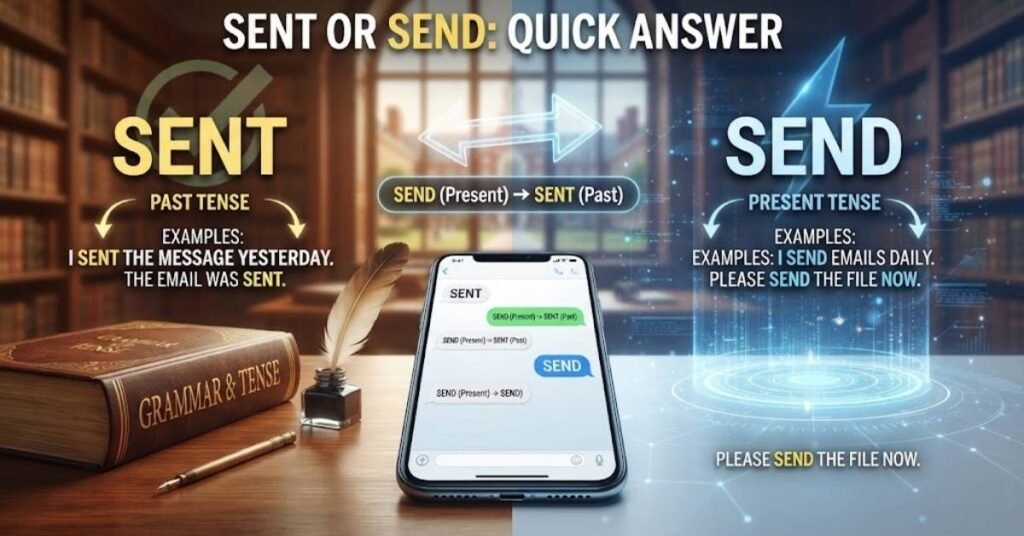
Still skimming for the short version? Good, because that’s exactly what this section is for. No long detours here, just the core rule laid out plainly.
✔ Main Difference:
Send describes a present action or a future action. Sent describes a completed action that already happened. If the event is over and done, sent is your word. If it’s happening now or hasn’t happened yet, stick with send.
📌 Examples:
- I send invoices every Friday.
- She sent the invoice yesterday.
- Please send me the link when you get a chance.
- He already sent the link an hour ago.
Send or Sent: Definitions with Examples 📖✍️
Definitions help, but examples make them stick. Let’s break both words down properly so there’s zero confusion left by the time you finish reading.
🟢 Send (Definition)
Send means to cause something (a message, an object, a signal) to go from one place to another. It’s an action verb, and it works in simple present tense, future tense, and even commands.
📌 Examples:
- I send my mom a photo every week.
- We will send the package tomorrow.
- Please send this document to HR.
🔵 Sent (Definition)
Sent is the irregular past form of send. Unlike regular verbs that add “ed,” send skips straight to sent for both simple past tense and the past participle used with “have” or “has.”
📌 Examples:
- I sent the file at 9 a.m.
- She has already sent her homework.
- They sent gifts last Christmas.
🟡 Simple Meaning
Picture a mailbox. Send is the moment you’re walking toward it with a letter in hand. Sent is the moment after you’ve dropped the letter in and walked away. One is in motion, the other is finished business.
The Origin of Send or Sent 📜⏳
Words don’t just appear out of nowhere, and send has a pretty old backstory. It traces back to Old English, from the word “sendan,” which meant to cause someone or something to go somewhere.
That root belongs to a much bigger family of Germanic languages, and over centuries of historical language change, sendan slowly turned into the send and sent we use today. The irregular past form (sent, not “sended”) survived because so many everyday English verbs kept their old, worn-down shortcuts instead of following the newer regular pattern.
Knowing the word origin doesn’t just satisfy curiosity. It actually explains why send behaves like an oddball instead of following the neat “add ed” rule that regular verbs follow.
Send or Sent: Grammar Differences 🌍
Grammar rules can feel dry, but this one is refreshingly simple once you see it laid out. The whole difference comes down to tense, nothing more complicated than that.
Send fits simple present tense (I send), future tense (I will send), and commands (Send it now). Sent fits simple past tense (I sent) and pairs with helping verbs like “have,” “has,” or “had” for the past participle form (I have sent, she has sent, they had sent).
📊 Comparison Table:
| Tense | Word Used | Example |
| Present | Send | I send messages daily. |
| Future | Send | I will send it tonight. |
| Past | Sent | I sent it last night. |
| Present Perfect | Sent | I have sent it already. |
| Past Perfect | Sent | I had sent it before noon. |
Which Word Should You Use? 🎯📝
This is where most people actually get stuck, not in knowing the definitions, but in picking the right word mid-sentence. So here’s a clean breakdown to settle it fast.
✔ Use “Send” When:
- You’re talking about now: “I send this every Monday.”
- You’re talking about the future: “I’ll send it soon.”
- You’re giving an instruction: “Send the report by 5 p.m.”
- You’re describing a habit or ongoing action: “She sends updates daily.”
✔ Use “Sent” When:
- The action is already completed: “He sent it yesterday.”
- You’re using “have,” “has,” or “had”: “We have sent the invite.”
- You’re referring to something that happened in the past, full stop.
🧠 Easy Memory Trick
Here’s a trick that sticks. If you can swap the word with “did it” and the sentence still makes sense, use sent. “I sent it” becomes “I did it,” and that checks out. But “I send it” doesn’t turn into “I did it” naturally, so send stays for the present and future.
Common Mistakes with Send or Sent ❌⚠️
Even confident writers slip on this one, especially in emails typed in a rush. Let’s look at the most common grammar mistakes so you can spot them instantly.
1. Using “Sent” for Present
Wrong: I sent this file every week. Right: I send this file every week. Weekly habits belong in the present tense, not the past.
2. Using “Send” for Past
Wrong: I send it yesterday. Right: I sent it yesterday. “Yesterday” is a dead giveaway that the action already happened.
3. Mixing Tenses
Wrong: I send the email and sent the attachment. Right: I sent the email and sent the attachment (if both are done), or I send the email and send the attachment (if both are ongoing). Keep the tense consistent within the same sentence.
4. Ignoring Time Words
Time words like “yesterday,” “already,” “before,” “last night,” and “earlier” almost always signal past tense, so sent is your word. Words like “now,” “every day,” “soon,” and “later” point toward send instead.
Send or Sent in Everyday Examples 💬📱
Grammar rules land better when you see them in real life, not just in a textbook. So here’s how send and sent show up across different corners of daily communication.
🏠 Daily Life
At home, you might say “I send my grandmother a message every Sunday” for a weekly habit, or “I sent her a message this morning” once it’s done. Small shifts like this happen dozens of times a day without anyone noticing.
📱 Social Media
On social platforms, it’s common to see “Just send me your handle” in a comment, versus “I already sent you a DM” in a reply. Online messages move fast, so this mix-up is everywhere in casual digital communication.
📚 School
Students juggle this constantly. “Please send your assignment by Friday” is an instruction for the future, while “I already sent my homework” confirms it’s turned in. Teachers often catch this exact mistake in student emails.
💼 Work
Workplace communication runs on this distinction. “I’ll send the report after lunch” sets an expectation, and “I sent the report an hour ago” closes the loop. Getting this right in professional emails makes you sound sharp, not sloppy.
Send or Sent: Usage Trends & Popularity 📊📈
Language data actually backs up how often these words show up in daily writing, and it’s worth a quick look. Both words rank extremely high in everyday English because messaging, emailing, and digital communication never really stop.
Sent tends to spike in customer service replies, order confirmations, and workplace updates, since so much of that language is about confirming something already happened. Send, on the other hand, dominates instructions, requests, and reminders, the language of things still ahead of us.
📌 Trend Insight:
With emails, texts, and instant messages replacing phone calls for a lot of daily communication, the send versus sent mix-up shows up more often than it used to. It’s a small grammar point, but it gets tested constantly because we’re all typing so much more than we used to.
Why This Mix-Up Happens So Often 🤔
Here’s something worth pointing out. English has a lot of irregular verbs that don’t follow the standard “add ed” rule, and send is one of them. Unlike “walk” becoming “walked,” send jumps to sent, and that irregular jump is exactly where people trip.
Add in the speed of typing on a phone, and it’s easy to default to whichever word feels shorter or more familiar in the moment. That’s not a sign of poor grammar, it’s just how fast, casual spoken English habits bleed into written English.
Send vs Sent in Formal Writing ✉️
Formal writing tends to be less forgiving than a casual text thread. In professional communication like reports, cover letters, or official emails, mixing up tense can make the writer look careless even if the message is otherwise clear.
A good habit before hitting send on any formal email is to read the sentence back and ask if the action already happened. If yes, sent it is. If it’s happening now or still ahead, send stays on the page.
Comparison Table 📋⚖️
| Feature | Send | Sent |
| Type | Base verb | Past tense / past participle |
| Tense | Present, future | Past |
| Common Pairing | will, do, please | have, has, had, already, yesterday |
| Example | I send updates daily. | I sent the update yesterday. |
| Feeling | Action about to happen or ongoing | Action already finished |
Common User Queries 🔍🔥
People search this topic with all kinds of phrasing, and most of it circles back to the same handful of questions. “Is send present tense?” Yes, it is, along with future tense in the right sentence. “Is sent past tense?” Also yes, and it doubles as the past participle. “I send or I sent, which is correct?” It depends entirely on when the action happened. “Send me or sent me, which one?” “Send me” is a request for the future, “sent me” confirms something already arrived.
These queries all boil down to one thing: timing. Once you lock onto whether the action is finished or not, the right word picks itself.
Conclusion 🧾📌
Send and sent aren’t complicated once you strip away the confusion. Send belongs to now and later, sent belongs to before. That one filter, asking “has this already happened,” solves almost every mix-up you’ll ever run into.
Next time you’re halfway through a text or an email and your fingers hesitate, just picture that mailbox. Are you still walking toward it, or have you already dropped the letter in? Answer that, and you’ll never second guess send or sent again.
Got a sentence you’re still unsure about? Drop it in the comments and let’s sort it out together.
FAQs ❓💡
1. Are send and sent the same?
No. Send is the present and future form, while sent is the past form. They share meaning but not timing.
2. Which is present tense?
Send is the simple present tense form, used for habits, routines, and current requests.
3. Which is past tense?
Sent is the simple past tense form, used once the action is fully completed.
5. Which is more common?
Both appear constantly in everyday English, though sent shows up more in confirmations and send dominates instructions and requests.
6. Easy way to remember?
Try swapping the word for “did it.” If it fits, use sent. If it doesn’t, use send.
7. Is “I send yesterday” correct?
No, that’s a common grammar mistake. Since “yesterday” is a time word pointing to the past, the correct sentence is “I sent yesterday.”

Henry Parker is an English language writer with several years of experience helping learners understand grammar and improve their writing. He enjoys breaking down confusing grammar rules into simple explanations and practical examples. Through his work at HexoWaves, Henry shares useful tips on grammar, vocabulary, sentence structure, and everyday English.