
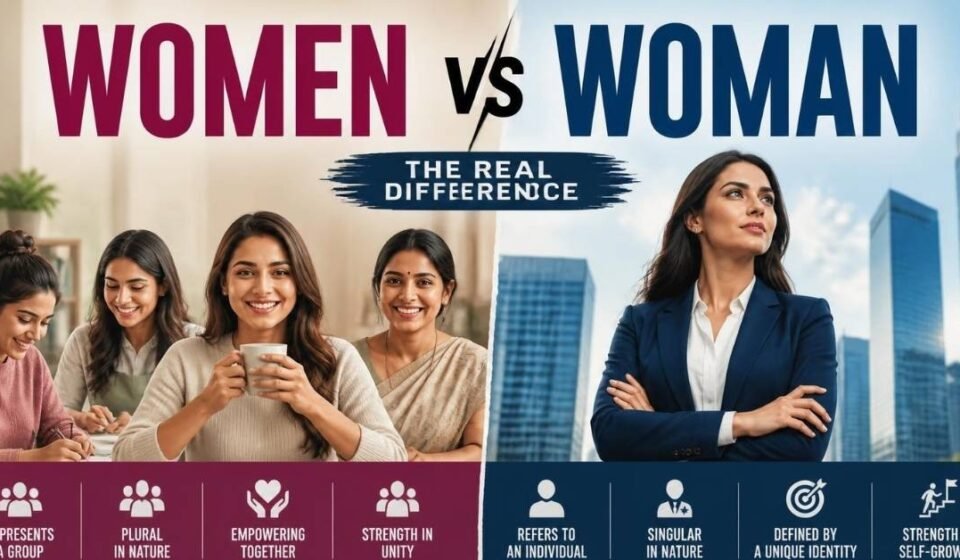
Woman means one adult female. Women means more than one. That’s the whole trick, really.If you’re talking about a single person, you write woman.
The moment there’s more than one, it becomes women. Simple as that, but people still mix it up all the time.
The Meaning of Woman and Women

English loves to throw curveballs, and this pair is one of them. Both words point to the same idea, an adult female person, just in different amounts.
Woman – Meaning
Woman is the singular noun. You’d use it for one female person, like “That woman is my neighbor” or “She’s a kind woman.” One person, one word.
It also shows up in phrases like woman leader or modern woman, where you’re describing a single individual and her role or identity.
Women – Meaning
Women is the irregular plural noun version. Instead of adding an “s” like most English words do, the spelling shifts entirely. “Two women walked in” or “Women worldwide are speaking up” both use the plural form correctly.
This is where a lot of English learners trip up, because the change isn’t the usual pattern they’ve learned for plural usage.
The Origin of Woman and Women

Here’s something fun for your next trivia night. The word origin traces back to Old English, from wīfmann, which literally combined “wife” (meaning female) and “man” (meaning person).
Over centuries, that word split into two spellings depending on number. The etymology explains why the vowel sound changes between woman and women, even though they look like they should rhyme the same way.
It’s a good reminder that English didn’t grow from one neat rulebook. It grew from centuries of shifting speech, and this word carries that history right in its spelling.
Women or Woman Pronunciation Difference
This is the part that confuses even native speakers. The pronunciation difference hides in the first syllable, not the ending like you’d expect.
Woman is pronounced “WUH-muhn,” with a soft “uh” sound. Women is pronounced “WIH-min,” with a short “ih” sound instead. In IPA pronunciation, that’s roughly /ˈwʊmən/ versus /ˈwɪmɪn/.
Try saying both out loud back to back. You’ll notice the vowel sounds shift even though the spelling only changes by one letter. That tiny swap is exactly why so many people mishear or misspell this pair.
British English vs American English Spelling
Good news here: there’s no split. American English, British English, Canadian English, and Australian English all spell it the same way. US English and UK English agree on this one, unlike “color” versus “colour.”
Where you’ll spot regional flavor is in tone, not spelling. British writing might lean toward “women’s rights” phrasing tied to policy, while American writing often ties it to leadership and workplace conversations. But the letters themselves never change.
So if you’re writing for a global audience, you can relax on this front. One spelling works everywhere.
Which Form Should You Use? (Audience-Based Advice)
Think about who’s in the room, or reading the screen. If you’re describing a single client, colleague, or character, woman is your word. Writing about a group, a movement, or a demographic? Reach for women.
This matters a lot in professional writing and academic writing, where precision builds credibility. A report that says “the woman surveyed” when it means dozens of participants looks sloppy fast.
Context also shapes tone. “Women in leadership” reads as a broader, almost inspirational framing, while “a woman in leadership” narrows the focus to one specific story.
Women or Woman in Grammar Rules
Subject-verb agreement is where this gets tricky. Woman pairs with singular verb forms: “The woman is here” or “The woman was late.” Women pairs with plural verb forms: “The women are here” or “The women were early.”
Mixing these up is one of the most common grammar mistake patterns among non-native speakers, and honestly, plenty of native speakers slip too when they’re typing fast.
Here’s a quick way to check yourself: swap in “he” or “they” mentally. If “he” fits, you need woman and a singular verb. If “they” fits, you need women and a plural verb.
Common Mistakes with Women or Woman
Let’s call out the usual suspects, because naming them makes them easier to avoid.
- Writing “many woman” instead of “many women”
- Using “women” for a single person, like “she is a women”
- Forgetting the possessive form, writing “womens rights” instead of women’s rights
- Mixing up the apostrophe placement, like “woman’s” when you mean a group’s rights
These slip-ups are small, but they chip away at writing confidence and can make even solid content look rushed. A quick proofread catches most of them.
Women vs Woman in Everyday Examples
Seeing the words in real settings helps the rule stick. Let’s walk through a few common ones.
Emails
In emails, precision matters because tone is everything when there’s no voice behind the words. “I spoke with the woman from HR” refers to one person, while “I met with the women from HR” signals a group conversation.
Getting this right avoids awkward follow-up questions like “wait, how many people were there?”
News
News writing leans heavily on accuracy, especially with numbers. A headline like “Women Demand Change” implies a movement, while “Woman Demands Change” tells one person’s story. Swapping them changes the entire weight of the headline.
Editors catch this constantly, because one wrong letter can shift a story from personal to political in tone.
Social Media
Social media and social media writing move fast, so mistakes here are common. You’ll see captions like “she’s such a strong women,” which should read “such a strong woman.” Small typo, but it stands out in a scroll-heavy feed.
Slowing down for one extra second before posting saves the correction comment later.
Formal Writing
In formal writing, like reports or proposals, consistency is everything. If you’re citing statistics about a group, “women” is correct throughout. Switching accidentally to “woman” mid-paragraph confuses readers and weakens your writing clarity.
Woman or Women – Comparison Table
| Feature | Woman | Women |
| Number | Singular | Plural |
| Example | One woman | Many women |
| Verb form | Is / was | Are / were |
| Possessive | Woman’s | Women’s |
| Pronunciation | WUH-muhn | WIH-min |
Keep this table bookmarked if you’re someone who second-guesses spelling under deadline pressure. It happens to everyone.
Women or Woman: Google Trends & Usage Data
Search behavior around this topic tends to spike during moments tied to women’s rights campaigns, awards season, or major women in leadership stories. People often search the exact phrase when they’re unsure mid-sentence, usually while writing an email or a caption.
Interest also climbs during academic seasons, when English learners are working through grammar rules for exams. It’s one of those quietly persistent searches that never really goes away, because the confusion is common across generations and countries.
Related Contexts & Semantic Usage
Beyond grammar, these words carry cultural weight. Phrases like independent woman, inspiring woman, and women leaders show up constantly in conversations about leadership, society, and organization culture.
You’ll also see them tied to women’s health, awards, projects, and studies that focus specifically on female experiences. Understanding the educational search intent and informational search intent behind these terms helps you use them naturally rather than forcing them into a sentence.
A Simple Memory Trick
If the spelling still trips you up sometimes, try this: remember that “wo-MEN” contains “men,” which is already plural in your head. That mental shortcut helps a lot of English learners lock in the difference for good.
Another trick is reading your sentence out loud before hitting send. Your ear often catches what your eyes skip past.
Why This Small Difference Actually Matters
It might seem like a tiny detail, but getting woman and women right affects how professional and trustworthy your writing feels. Readers notice patterns, even subconsciously, and consistent grammar builds quiet credibility.
Whether you’re drafting a proposal, a headline, or a quick text to a friend, this is one of those small wins that makes your writing feel polished without extra effort.
Conclusion
At the end of the day, this comes down to one number: singular or plural. Woman for one, women for more than one. The pronunciation shifts, the spelling shifts, but the logic stays simple once it clicks.
Keep the comparison table handy, trust the “wo-MEN equals plural” trick, and you’ll never second-guess this pair again.
FAQs
Why does the pronunciation change so much?
The first vowel sound shifts due to how the word evolved from Old English, even though only one letter changes in spelling.
Is “women’s” or “womens” correct for possessive?
“Women’s” is correct. Always include the apostrophe before the “s.”
Do British and American English spell it differently?
No, both use the same spelling. The difference lies in tone and context, not letters.
What’s a quick way to remember the plural form?
Notice that “women” contains “men,” a built-in plural cue that can jog your memory instantly.

Henry Parker is an English language writer with several years of experience helping learners understand grammar and improve their writing. He enjoys breaking down confusing grammar rules into simple explanations and practical examples. Through his work at HexoWaves, Henry shares useful tips on grammar, vocabulary, sentence structure, and everyday English.