

Quick answer first: other than is correct. Other then is a spelling mistake, and it shows up more often than you’d think, even in emails from people who write for a living.
If you’ve ever paused mid sentence wondering which one to type, you’re not alone. This little mix up trips up students, bloggers, and even seasoned writers. Let’s clear it up for good.
What Is the Correct Phrase: Other Than or Other Then?
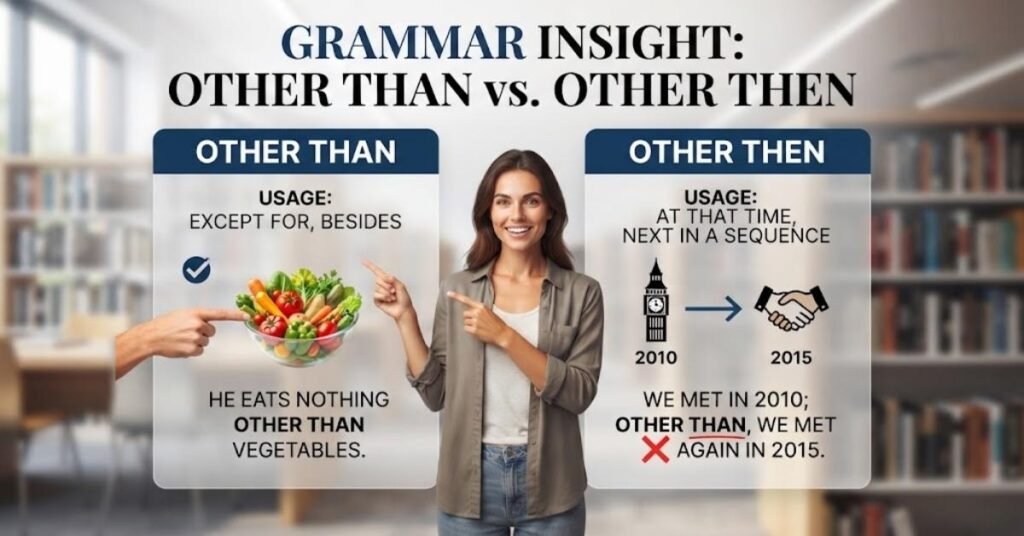
Other than is the phrase you want in almost every case. It works when you’re comparing things, listing exceptions, or pointing out something different from the rest.
You use it to mean “except for” or “besides.” Think of it as your go to phrase whenever you’re narrowing something down or drawing a contrast.
Examples of Correct Usage
Here’s how it looks in real sentences.
- Other than the rain, the trip was perfect.
- Nobody showed up other than my sister.
- I have no plans other than finishing this report.
Why People Get Confused
The confusion comes from how than and then sound almost identical when spoken fast. Your ear hears one word, but your fingers type the wrong one out of habit.
Autocorrect doesn’t always catch it either, since both words are spelled correctly on their own. It’s just the wrong one for the job.
Understanding the Difference Between “Than” and “Then”
Once you separate these two words in your head, the mistake becomes much easier to avoid. They do completely different jobs in a sentence.
What Does “Than” Mean?
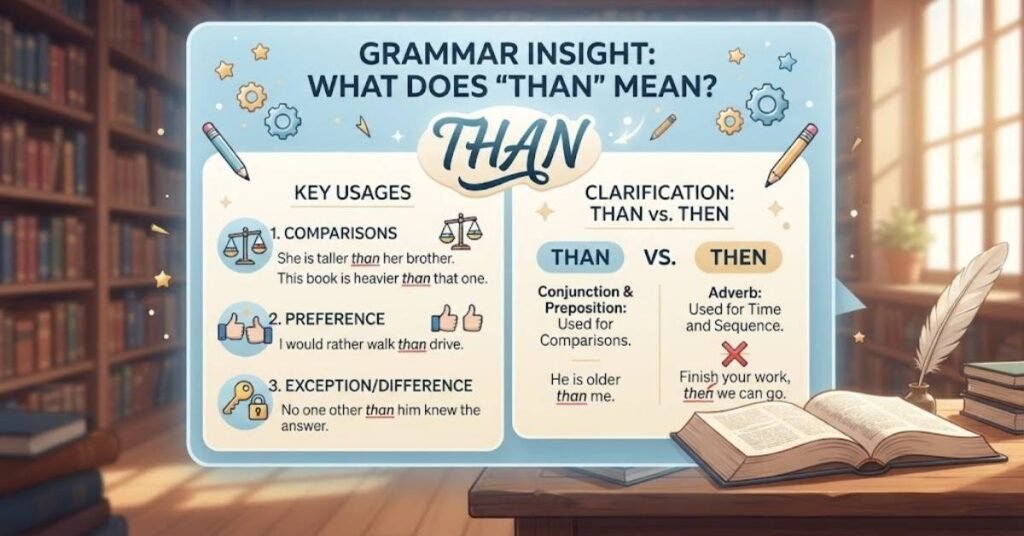
Than is a comparison word. You use it when you’re weighing one thing against another, like size, speed, or preference.
For example: “Coffee tastes better than tea” or “She runs faster than him.” Notice there’s always a comparison happening.
What Does “Then” Mean?
Then deals with time or sequence. It tells you what happens next, or when something took place.
For example: “We had dinner, then watched a movie” or “Back then, homework felt endless.” No comparison here, just order of events.
Quick Rule to Remember
If you’re comparing two things, reach for than. If you’re talking about time or what comes next, use then. That’s really the whole rule.
Why “Other Then” Is Usually Incorrect
Since other than is a fixed phrase used for comparison and exception, swapping in then almost always breaks the sentence. It’s not a stylistic choice, it’s a spelling error.
Incorrect Examples
- Other then that, everything went fine.
- I didn’t eat anything other then a sandwich.
Correct Versions
- Other than that, everything went fine.
- I didn’t eat anything other than a sandwich.
Can “Other Then” Ever Be Correct?
Rarely, and only in odd sentence constructions where “other” and “then” happen to sit next to each other without forming the fixed phrase. For example: “If it’s not raining, other, then, we’ll head out.” That’s a stretch, and honestly, most writers will never need it.
Other Than Meaning and Usage Explained
Other than carries a few related meanings depending on context. Here’s a breakdown.
1. To Mean “Except”
“Other than the ending, I loved the movie.” You’re pointing out the one thing that stands apart from the rest.
2. To Mean “Besides”
“Other than English, she speaks three languages.” This usage adds information beyond what’s already known.
3. To Show Difference
“His answer was other than what I expected.” Here it highlights a contrast between two outcomes.
Common Grammar Mistakes With Other Than
Let’s look at where this grammar mistake usually sneaks in, so you can catch it before hitting publish or send.
Mistake #1: Using “Then” Instead of “Than”
This is the classic slip. It happens most in fast typing, texting, or when you’re focused on the idea rather than the spelling.
Mistake #2: Mixing Up Comparison and Time Words
Sometimes writers use then in a sentence that’s actually comparing two things, or vice versa. Reading your sentence back out loud usually reveals the error fast.
Mistake #3: Relying Only on Spellcheck
Autocorrect and basic spellcheck won’t flag “other then” because “then” is a real word. Only grammar tools built for context, or a careful human eye, will catch it.
Comparison Table: Other Than vs Other Then
| Phrase | Correct? | Used For | Example |
| Other than | Yes | Comparison, exception | Other than pizza, I don’t eat fast food |
| Other then | No | Not a standard phrase | Incorrect in nearly all cases |
Real-Life Example: How One Small Grammar Mistake Hurt a Blog’s Credibility
A freelance blogger once published a travel post packed with useful tips, but it repeatedly used “other then” instead of “other than.” Readers noticed. A few left comments pointing out the error, and the bounce rate on that page climbed noticeably higher than her other posts.
It wasn’t just about looking unpolished. Search engines reward people-first content that reads clean and trustworthy, and small spelling mistakes like this can quietly chip away at reader trust and credibility, even when the actual advice is solid.
2025-2026 Grammar and Writing Statistics
Grammar accuracy still matters more than many writers assume, especially with how much content competes for attention online.
Key Statistics
- Content with fewer grammar and spelling errors tends to see longer average reading time and better engagement, according to recent digital marketing survey data.
- Tools like Grammarly report that “than” versus “then” remains one of the most commonly flagged word confusions among English writers.
- Google Search Central continues to emphasize content quality and clarity as ranking factors for people-first content, which includes basic grammar accuracy.
Easy Tricks to Remember the Difference
If the rule doesn’t stick right away, try one of these memory tricks instead.
Trick #1: “A” for Comparison
Than has an “a,” and so does “comparison.” Link the two in your head and you’ll remember it during any comparing sentence.
Trick #2: “E” for Time
Then has an “e,” just like “time” doesn’t, but “sequence” and “next” do share that letter pattern loosely enough to jog your memory. Some writers just remember: “then, when.”
Trick #3: Replace the Word
Swap in “compared to.” If the sentence still makes sense, you need than. If it doesn’t, you probably need then.
How to Avoid This Mistake in Professional Writing
Getting this right matters more in business communication, academic writing, and blog writing, where credibility is everything.
Proofread Slowly
Read your work at a slower pace than you wrote it. Fast reading skips over small errors like this one.
Use Grammar Tools
ProWritingAid and similar grammar checker tools catch context based mistakes that basic spellcheck misses entirely.
Learn Commonly Confused Words
Pairs like Your vs You’re, Their vs There, and Affect vs Effect trip people up the same way. Learning them together builds sharper writing habits overall.
Mini Quiz: Other Than or Other Then
Test yourself with these quick questions.
Quiz 1: Spot the Correct Phrase
“I like every fruit ___ bananas.” Answer: other than
Quiz 2: Than or Then?
“She’s taller ___ her brother.” Answer: than
Quiz 3: Time or Comparison?
“We ate lunch, ___ went shopping.” Answer: then
Quiz 4: Fix the Grammar Mistake
“Other then the noise, I slept well.” Fix: Other than the noise, I slept well.
Quiz 5: Choose the Right Meaning
“Other than work, what do you enjoy?” This means: besides
Quiz 6: Quick Grammar Challenge
“Better ___ never.” Answer: than
Quiz 7: Fill in the Blank
“Nothing changed ___ the price.” Answer: other than
Quiz 8: Common Mistake Check
True or false: “Other then” is standard English. Answer: false
FAQs
Q1: Is “other then” ever correct?
Almost never. It only appears in rare sentence structures where the two words land next to each other by coincidence, not as a fixed phrase.
Q2: Why do people confuse than and then?
They sound nearly the same in casual speech, and both are real words, so autocorrect rarely flags the mix up.
Q3: What does “other than” mean?
It means “except for” or “besides,” and it’s used to point out an exception or add extra information.
Q5: Is “other than” formal English?
Yes, it fits comfortably in formal English, casual writing, emails, and everyday conversation alike.
Q6: Can grammar tools detect this mistake?
Context aware tools like Grammarly and ProWritingAid usually catch it, though basic spellcheck often won’t.
Q7: Which is correct: “better then” or “better than”?
“Better than” is correct, since it’s a comparison. “Better then” isn’t standard usage.
Conclusion
Other than is the phrase you want nearly every time you’re comparing, excluding, or adding an exception. Other then isn’t standard English, and mixing them up can quietly hurt how trustworthy your writing feels to readers.
Once you lock in the difference between than for comparison and then for time, this mistake becomes easy to spot and even easier to avoid.

Henry Parker is an English language writer with several years of experience helping learners understand grammar and improve their writing. He enjoys breaking down confusing grammar rules into simple explanations and practical examples. Through his work at HexoWaves, Henry shares useful tips on grammar, vocabulary, sentence structure, and everyday English.