

Understanding pre vs post becomes much easier once you connect each word to timing, sequence, and context. In simple terms, pre generally means before, while post generally means after.
These two prefixes appear throughout the English language, from everyday writing to professional communication, education, fitness, business, and SEO content. Knowing the difference helps you choose the right terminology, improve clarity, and avoid awkward or confusing sentences.
What Do “Pre” and “Post” Mean?
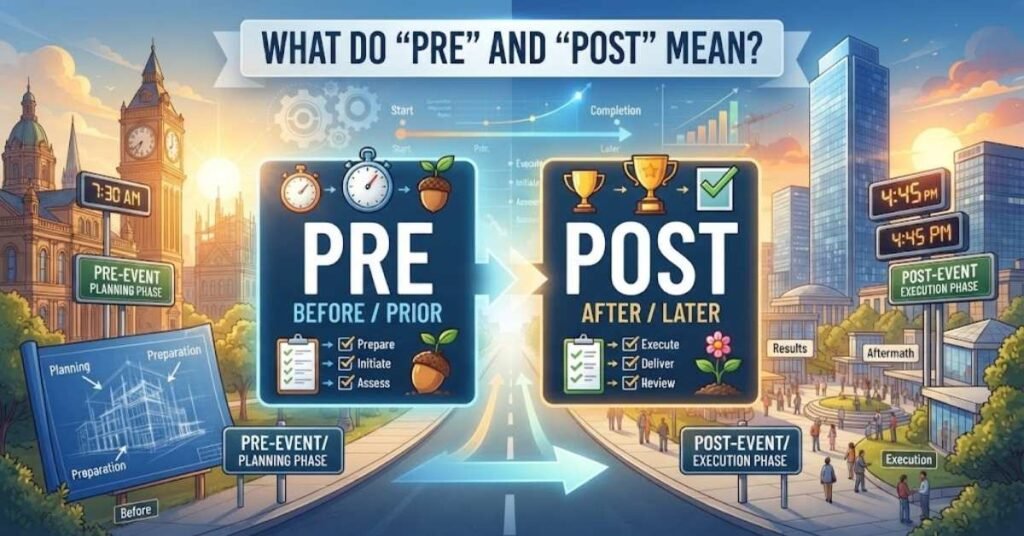
The basic meaning of pre and post is related to position in a sequence or timeline. When something happens before an event, it can often be described with pre. When it happens afterward, post is usually appropriate.
Both terms are widely used because they provide a short way to describe an action, stage, or condition in relation to another event. However, the exact usage can depend on the word that follows and the intended context.
Pre Meaning
Pre is a prefix that usually means before. It comes from Latin and became an important part of modern English language vocabulary.
For example, pre-workout refers to something used before exercise, while pre-order describes arranging an order before a product release. Similarly, pre-launch activity happens before a launch.
You can think of pre as pointing toward something that has not happened yet. It often communicates planning, preparation, or anticipation.
Post Meaning
Post commonly means after when used as a prefix. It also has Latin roots and is now common in modern English.
A post-event report comes after an event, while post-workout activities happen after exercise. A postgraduate program, meanwhile, refers to education pursued after completing an earlier level of formal schooling.
In practical terms, post usually tells the reader that something belongs to the later stage of a process.
Key Takeaway
The easiest way to remember the pre vs post difference is simple: pre = before and post = after.
If you are describing pre-exam preparation, the preparation happens before the exam. If you are discussing post-exam preparation, the phrase means preparation that occurs after the exam, although the exact meaning should always be checked through context.
Pre vs Post: Key Differences Explained
The main difference between pre and post is their position relative to an event, action, or stage. Pre places something earlier in the order, while post places it later.
| Term | Basic meaning | Typical idea |
| Pre | Before | Preparation, anticipation, setup |
| Post | After | Results, reflection, review |
| Pre-event | Before an event | Planning or preparation |
| Post-event | After an event | Review or follow-up |
| Pre-launch | Before release | Campaign preparation |
| Post-launch | After release | Performance analysis |
This distinction matters because the wrong prefix can completely change the intended meaning. A pre-launch campaign is designed before a product is released, while a post-launch campaign or review deals with activity after the release.
Why This Matters
Correct terminology makes professional writing easier to understand. In business communication, confusing pre and post can cause team members or clients to misunderstand where something belongs in a workflow.
The difference is also useful for ESL learners and people improving their grammar. Once the relationship between before, after, and the main event becomes clear, these terms become much easier to use naturally.
Quick Example
Consider a meeting. Pre-meeting notes are prepared before the meeting, perhaps to establish an agenda or identify discussion points. A post-meeting summary is written afterward to record decisions and next steps.
The same pattern works with a campaign. Pre-launch work prepares the audience and systems, while post-launch work measures engagement, analyzes results, and identifies improvements.
How to Use Pre vs Post Correctly in Sentences
Using pre and post correctly starts with understanding the event that acts as your reference point. Ask yourself what happened first and what happened afterward.
The goal is not simply to add a prefix to a word. Good usage requires attention to context, grammar, clarity, and readability.
Rule 1: Identify the Event
First, identify the main event or action. This gives you a fixed point for deciding whether something occurred before or after it.
For example, if you are discussing a product release, activities before the release can be called pre-launch activities. Activities following the release may be described as post-launch activities.
Rule 2: Use Hyphenation Properly
Hyphenation depends on the particular word and established modern usage. Some combinations are commonly written as one word, while others are often hyphenated for readability.
For example, preschool is generally written as one word, although pre-school can appear in some contexts. Pre-workout, post-workout, pre-analysis, and post-analysis are commonly seen with a hyphen.
When uncertain, check a current dictionary, style guide, or the terminology used consistently by your organization. The important thing is to avoid inconsistent formatting within the same document.
Rule 3: Match Context Clearly
A grammatically possible expression may still be unclear if the reader cannot tell what the pre or post refers to.
Instead of writing a vague phrase such as “post preparation,” specify the relevant stage when needed. Post-event preparation gives the reader more information and improves communication.
Common Mistakes with Pre vs Post
Most mistakes involving pre vs post are not difficult grammar errors. They usually happen because writers overlook the timeline or use a familiar expression without checking its meaning.
A quick review can prevent these problems and improve overall writing accuracy.
Mistake 1: Using the Wrong Prefix
One common mistake is choosing pre when the activity actually happens after an event, or choosing post when it happens beforehand.
For example, preparation before a meeting is pre-meeting preparation, while a summary written afterward is a post-meeting summary. Always identify the event before selecting the prefix.
Mistake 2: Overusing Hyphens
Another issue is adding a hyphen automatically to every word beginning with pre or post. English spelling does not work that way.
Established unhyphenated words such as preplanning, preschool, and postgraduate should not automatically be changed into forms such as “pre-planning” or “post-graduate.” Follow standard usage and maintain consistency.
Mistake 3: Confusing Context
Sometimes the prefix itself is technically correct, but the phrase remains confusing because the reference event is unclear.
For example, post-planning could mean planning after an earlier planning stage, but readers may not immediately know what you mean. Clearer wording can improve reader engagement and reduce confusion.
Pro Tip
When a phrase feels awkward, rewrite it using before or after. If “before the launch” communicates your meaning clearly, you can then decide whether pre-launch is the natural shorter form.
This simple test is particularly useful in business communication, reports, instructions, and SEO content.
Pre vs Post in Different Fields
The meaning of these prefixes stays broadly consistent, but their practical usage changes across industries. Learning common examples makes the difference easier to recognize.
In fitness, pre-workout refers to something associated with the period before exercise, while post-workout refers to the period afterward. In education, pre-exam preparation happens before an exam, while post-exam activities concern what follows it.
In digital marketing, a pre-launch campaign builds awareness before a product release. A post-launch review examines performance after the release. In production, post-production involves work completed after the primary production stage, including post-production edits.
Real-Life Case Study: Marketing Campaign Mistake
Consider a hypothetical marketing campaign run by an e-commerce brand. The team prepared content, email sequences, and promotional materials before a new product launch.
During internal communication, one document incorrectly labeled its activities as “post-launch preparation.” This caused confusion because the activities were actually being completed before the launch.
What Happened?
The marketing team used the wrong terminology in its workflow. Some team members interpreted “post-launch” as work that would begin after the product release.
As a result, the campaign execution schedule became less clear, and responsibilities had to be reviewed before campaign delivery.
Fix Applied
The team changed the labels to pre-launch campaign, launch, and post-launch analysis. They also created a simple timeline showing when each activity should occur.
This formatting change made the workflow easier for team members and reduced ambiguity in internal professional communication.
Outcome
The revised terminology allowed the team to distinguish preparation from evaluation. Pre-launch tasks focused on readiness, while post-launch tasks focused on results, customer response, and analysis.
The example shows why seemingly small language choices can affect business efficiency and client satisfaction.
Lesson Learned
The key lesson is straightforward: connect every pre or post term to a clearly understood event.
Correct terminology does more than improve grammar. It supports clearer processes, stronger client trust, and smoother communication between teams.
Data & Usage Trends (2025–2026)
Interest in language questions involving pre vs post continues to reflect a broader need for clear terminology in online writing. Searchers commonly encounter these prefixes in queries involving grammar, education, business, fitness, and digital content.
However, specific Google Search trends can change over time, and search interest should not be treated as proof that one spelling is universally correct. Search queries are useful for understanding what people ask, while dictionaries and established style resources are better for determining standard usage.
What This Means
For writers, the practical takeaway is to focus on accurate, understandable language rather than trying to force every related keyword into an article.
Natural use of terms such as preplanning, pre-analysis, post-analysis, pre-launch, and post-launch can improve topical relevance when they genuinely fit the subject. This supports SEO, but useful content should always prioritize the reader.
How Pre and Post Affect Professional Writing
In professional writing, small distinctions can have a surprisingly large effect on credibility. Readers expect reports, instructions, emails, and business documents to communicate sequence accurately.
Using pre and post correctly also improves readability. When terminology matches the actual stage of a process, readers can understand responsibilities and timing without repeatedly asking for clarification.
This is especially important when documents are shared between clients, managers, and team members. Clear language reduces unnecessary back-and-forth and helps maintain consistent business communication.
Step-by-Step Guide: Choosing Between Pre and Post
Choosing between these prefixes can become a quick five-step process. You do not need to memorize dozens of rules if you understand the relationship between the term and its reference event.
Step 1: Identify the Event
Start by identifying the central event. It could be a meeting, exam, graduation, launch, release, or production stage.
Once the reference point is clear, the timing becomes easier to determine.
Step 2: Determine Timing
Ask whether the action happens before or after the event.
If it happens before, consider pre. If it happens after, consider post. This simple distinction solves most basic cases.
Step 3: Apply the Prefix
Choose the established term that naturally describes the situation. For example, preparation before an event can be described as pre-event preparation, while evaluation afterward can be described as post-event analysis.
Remember that not every combination is equally common in English. Natural terminology matters.
Step 4: Check Clarity
Read the sentence from the perspective of someone who does not know your internal process.
If the reader can immediately identify what the pre or post refers to, your wording is probably clear. If not, add a few words to establish the context.
Step 5: Review Formatting
Finally, check hyphenation, capitalization, and consistency. If you use pre-launch in one section, do not randomly switch between different formats without a reason.
Consistent formatting gives your document a more polished appearance and supports overall writing accuracy.
Pre vs Post and SEO Content
The difference between pre and post also matters when creating SEO content. Search engines aim to understand the subject of a page, while readers want direct and useful answers.
Using relevant terms naturally can help establish topical coverage. For example, an article about launches might naturally discuss pre-launch, post-launch, planning, analysis, and results.
But keyword repetition alone does not create strong ranking potential. Helpful explanations, logical structure, accurate grammar, and good user experience are more valuable than stuffing variations into every paragraph.
A well-organized article can also answer related search queries without sounding artificial. This helps readers find the exact information they need while keeping the content conversational.
Pre vs Post: A Simple Memory Trick
If you frequently confuse the two, remember this sequence: pre → event → post.
Think of a product release. Pre-launch activities happen first, the product is released, and post-launch analysis follows. The same mental model works for meetings, exams, campaigns, workouts, and many other situations.
Once you picture the timeline, choosing the correct prefix becomes almost automatic.
Conclusion
The basic rule behind pre vs post is simple: pre usually means before, while post usually means after. Both are productive and widely used prefixes in the English language.The most important skill is identifying the reference event and understanding its timing. From pre-workout and post-workout to pre-launch and post-launch, the surrounding context determines which term makes sense.
Pay attention to hyphenation, established spelling, clarity, and natural usage. Whether you are an ESL learner, professional writer, marketer, student, or SEO creator, these small language choices can make your communication clearer and more credible.
FAQs
Q1. What is the main difference between pre and post?
The main difference is timing. Pre generally means before, while post generally means after. For example, pre-meeting notes come before a meeting, while a post-meeting summary comes afterward.
Q2. Can pre and post be used without a hyphen?
Yes. Some words are normally written as unhyphenated words, such as preschool, preplanning, and postgraduate. Other combinations are commonly written with a hyphen, such as pre-workout and post-event.
Q3. Is it correct to say pre and post analysis?
Yes, but the preferred formatting can depend on the intended phrase and style. Pre-analysis and post-analysis are clear forms when referring to analysis performed before and after a particular event or process.
Q4. Are pre and post only used for time?
No. Although pre and post frequently describe time or sequence, they can also describe stages, conditions, or relationships.
Q5. Which is correct: preplanning or pre-planning?
Preplanning is a standard unhyphenated form and is widely used. Pre-planning can also appear depending on a particular style or context, but writers should avoid unnecessary hyphens.

Henry Parker is an English language writer with several years of experience helping learners understand grammar and improve their writing. He enjoys breaking down confusing grammar rules into simple explanations and practical examples. Through his work at HexoWaves, Henry shares useful tips on grammar, vocabulary, sentence structure, and everyday English.