
You’re finishing a post about a lawsuit and your cursor freezes. Is it “suing” or “sueing”?Short answer: it’s suing. “Sueing” is an incorrect spelling that no major dictionary lists.Maybe you’re worried one typo will make your legal writing look sloppy.
Or you’ve already hit publish and you’re wondering if anyone noticed.Relax, because this one takes about two minutes to fix for good. Below you’ll get the rule, the reasons behind it, real examples, and a quiz to lock it in.
What Is the Correct Spelling: Suing or Sueing?
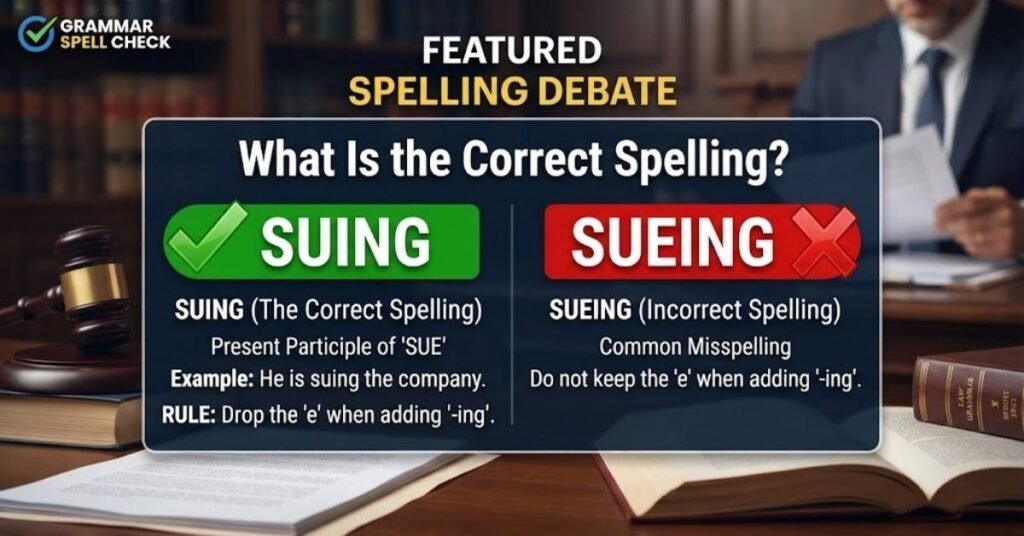
The correct spelling is “suing.”
You start with the base verb “sue,” drop the “e,” and add “-ing.”
American English and British English agree on this one.
Open the Merriam-Webster Dictionary or the Cambridge Dictionary and you’ll only find “suing.”
That kind of agreement is rare in English spelling.
So you can treat “suing” as the accepted spelling in every region.
Meaning of “Sue”
Sue means to start legal action against a person or an organization in a court.
Someone believes they were wronged, so they file a civil lawsuit and ask a judge to decide.
The verb form also has an older meaning, as in “sue for peace.”
These days, though, you’ll almost always see it in legal English.
Examples of Correct Usage
Here are a few samples of correct usage you can borrow:
- She’s suing her landlord over a broken heater.
- The customers are suing the company after a bad batch.
- He sued the hospital last spring.
- Suing a big company takes patience and money.
Notice that the last one uses “suing” as a gerund form, so it works like a noun.
That’s why it can sit at the start of a sentence.
Incorrect Examples
Now let’s look at the incorrect usage side:
- She’s sueing her landlord.
- They talked about sueing the newspaper.
Both sentences contain spelling mistakes.
A quick round of proofreading would catch them.
Why “Sueing” Looks Correct but Isn’t
“Sueing” feels right because “sue” ends in an e, and our brains hate losing letters.
It looks tidy on the screen, but it breaks a basic English spelling rule.
That’s why even confident native speakers slip on it.
The word looks normal at a glance, so it sails right past your eyes.
The Grammar Rule Behind It
This comes down to the silent “e” rule.
When a word ends in a silent letter “e,” you drop the “e” before adding “-ing.”
The result is the present participle, which also doubles as the gerund form.
That’s how “bake” becomes “baking,” and how “sue” becomes “suing.”
Why People Commonly Type “Sueing”
Most people type it on autopilot.
They picture “sue” plus “ing” and skip the rule entirely.
Auto-correction errors and rushed social media writing make it worse.
Nobody proofreads a quick post at 11 p.m.
Suing Meaning in Legal English
In legal writing, “suing” describes the act of bringing a claim.
You’ll spot it in court cases, contracts, news headlines, and legal discussions.
It’s plain, direct legal vocabulary, and that’s the point.
Clear court terminology keeps readers from second guessing what you mean.
Common Legal Situations Involving Suing
People start litigation for many reasons.
Some of the most common legal disputes include:
- Personal injury after an accident or unsafe conditions
- Breach of contract between business partners
- Defamation in print or online
- Property disputes with neighbors
- Workplace discrimination and unfair dismissal claims
- Medical malpractice at a clinic or hospital
- Product liability after a product recall
Example Sentences in Legal Context
A plaintiff files the legal complaint, and the defendant responds.
Here’s how that sounds in real sentences:
- The employee is suing the employer for unfair dismissal.
- The family is suing the manufacturer after a product recall.
- She’s suing for damages and compensation.
- A lawyer will tell you whether suing is worth the cost.
Difference Between “Sue” and “Suing”
“Sue” is the base verb.
“Suing” is the present participle, so it shows an action in progress.
Use “sue” after a helper word, as in “they will sue.”
Use “suing” with “is” or “are,” and use sued for the past tense.
Real-Life Example: A Costly Spelling Mistake in Professional Writing
Picture a freelance writer who submits a 1,500-word piece on workplace discrimination.
The headline reads “Employees Sueing Over Pay Gaps.” (This is a made-up scenario, but it happens more often than you’d think.)
The editor spots the error in five seconds.
Now they wonder what else slipped through, so they start rechecking every paragraph.
That’s how one typo turns into client rejection.
It’s rarely about the missing letter, and almost always about reader trust.
The fix costs nothing.
Read your headline out loud before you send it.
Suing vs Sueing: Quick Comparison Table
| Feature | Suing | Sueing |
| Spelling status | Correct spelling | Incorrect spelling |
| Follows the silent e rule | Yes | No |
| Found in dictionaries | Yes | No |
| Safe for legal documents | Yes | No |
| Safe for blogs and social posts | Yes | No |
Common Grammar Rules for Words Ending in “E”
Words with a final “e” follow a few clear English language patterns.
Learn them once and you’ll stop guessing.
Rule 1: Drop Silent “E” Before “-ing”
Most of the time, you drop the “e” and add “-ing.”
Make becomes making, write becomes writing, and sue becomes suing.
This rule covers the vast majority of verb endings you’ll meet.
It’s your default setting.
Rule 2: Keep “E” if Needed for Pronunciation
Some words keep the “e” so the pronunciation doesn’t change.
See becomes seeing, and free becomes freeing.
Words ending in “-oe” work the same way, like canoe and canoeing.
Dropping the “e” there would muddle the sound.
Important Exception: Dyeing vs Dying
Dye keeps its “e” because “dying” already belongs to die.
So “dyeing” means coloring fabric, and “dying” means ending life.
It’s a classic trap for English learners and native speakers alike.
Sue isn’t an exception, though, so it follows the normal rule.
Statistics and Language Trends (2025–2026)
I won’t hand you invented numbers here.
Instead, check search interest yourself by typing “suing vs sueing” into Google Trends.
Grammar-related searches tend to climb whenever more people write online.
More AI-generated content editing also pushes writers to double-check grammar accuracy before publishing.
Spell-check catches “sueing” in most editors.
It can still slip through in scanned files, images, and headlines typed into design tools.
Credible References
For accepted spelling, trust real dictionaries:
- Merriam-Webster Dictionary
- Cambridge Dictionary
- Oxford English Dictionary
All three treat “suing” as the standard form.
That makes them solid writing resources you can cite when a client questions your edit.
How to Remember the Correct Spelling Easily
You don’t need fancy memory tricks.
A few small habits do the job.
Think of Similar Verbs
Say “make, making” and “bake, baking.”
Then say “sue, suing,” and the pattern clicks into place.
Remember the Core Rule
Silent “e” at the end? Drop the “e” and add “-ing.”
Keep that one line in your head and you’re covered.
Read the Word Out Loud
Say it slowly: soo-ing.
The long vowel sound carries the word, so there’s no extra “e” for your ear to hear.
Use Spell-Checking Tools Carefully
Spell-check tools and proofreading tools catch most slips.
Still, proofreading manually is the safest final step, especially for legal documents.
Common Mistakes Writers Make With “Suing”
These writing errors show up in blogs, essays, and emails.
Spot them once and you’ll avoid them for good.
Mistake #1: Keeping the “E”
Writing “sueing” is the big one.
Remember to drop the “e” every single time.
Mistake #2: Using Wrong Verb Tense
“She is sued him” mixes two forms.
Say “she is suing him” for now, or “she sued him” for earlier.
Mistake #3: Confusing “Sue” With “Sew”
Sue vs sew trips people up because the words look alike.
They don’t sound alike, though, since sewing means stitching fabric and rhymes with “go.”
These are confusing words rather than true homophones.
Sue is also a common first name, which adds to the mix-up.
Sue, Sues, Sued, Suing: Every Verb Form at a Glance
Sometimes a grammar comparison works better than a rule.
Here’s the full verb form family in one place.
| Form | Example |
| Base verb: sue | They plan to sue. |
| Third person: sues | She sues when contracts break. |
| Past tense: sued | He sued last year. |
| Present participle: suing | We’re suing the company. |
Every form keeps the “u” and follows regular patterns.
The only one that changes shape before “-ing” is the base verb, and it simply loses its “e.”
Where Writers Slip Most: Headlines, Captions, and Social Posts
Everyday English gets typed fast.
That’s why “sueing” pops up in captions, comments, and tweets more than in books.
News reports and online content carry extra risk.
A wrong headline gets shared, screenshotted, and remembered.
If you publish often, build a two-step check.
Scan every headline first, then read the first sentence out loud.
Mini Quiz: Suing or Sueing?
Ready to test your grammar accuracy?
Try these fill-in-the-blank exercises before you scroll to the answers.
1. Which spelling is correct?
A) Sueing
B) Suing
2. Fill in the blank:
The tenant is thinking about ______ the landlord.
3. True or False:
“Sueing” is accepted in standard American English.
4. Which word means taking legal action?
A) Sew
B) Sue
C) Sow
5. Fill in the blank:
She ______ the company last year. (sue)
6. What happens to the silent “e” in “sue” before adding “-ing”?
A) It stays
B) It’s dropped
7. Spot the correct sentence:
A) He is sueing the hospital.
B) He is suing the hospital.
8. Fill in the blank:
They are ______ the manufacturer over unsafe conditions.
9. Which is NOT correct?
A) Suing
B) Sued
C) Sueing
10. True or False:
You drop the “e” in “dye” before adding “-ing.”
11. Sue → ______
Write the present participle.
12. The actor talked about ______ the newspaper.
13. Remove the silent “__” before adding “-ing.”
14. “Suing” is commonly used in ______ language.
15. Correct spelling: unscramble G N I U S
Conclusion
Suing is the correct spelling. Drop the silent e, add “-ing,” and you’re done.A tiny fix like this protects your online credibility and keeps your writing sharp. This is a spelling guide, not legal advice, so talk to a lawyer for anything about a real case.
Got a word pair that keeps tripping you up? Drop it in the comments, and share this with a friend who writes for a living.
FAQs
Q1: Is “Sueing” Ever Correct?
No, “sueing” isn’t accepted in standard English. Use “suing” in every context.
Q2: Why Is It “Suing” Instead of “Sueing”?
The silent “e” rule applies here. You drop the “e” before adding “-ing.”
Q3: What Does “Suing” Mean?
Suing means taking someone to court through a legal complaint.It’s the present participle of sue.
Q4: How Do You Spell “Sue” in Present Tense?
It’s “sue” for I, you, we, and they. For he, she, or it, use “sues.”
Q5: Is “Suing” a Legal Term?
Yes, it sits comfortably among common legal terms. It appears in court terminology, news reports, and legal writing.
Q6: Why Do People Misspell “Suing”?
Most people keep the “e” out of habit. Auto-correction errors and hurried typing add to the problem.
Q7: Is “Suing” Used in Everyday English?
Absolutely. You’ll hear it in everyday English, news reports, and online content.

Henry Parker is an English language writer with several years of experience helping learners understand grammar and improve their writing. He enjoys breaking down confusing grammar rules into simple explanations and practical examples. Through his work at HexoWaves, Henry shares useful tips on grammar, vocabulary, sentence structure, and everyday English.