
You typed “dwarfs” into a sentence, then paused. Should it be “dwarves” instead?
You’re not alone. This is one of those spelling difference questions that trips up even careful writers. The good news? Once you see the pattern, you’ll never second guess it again.
Quick Answer: Dwarfs or Dwarves?
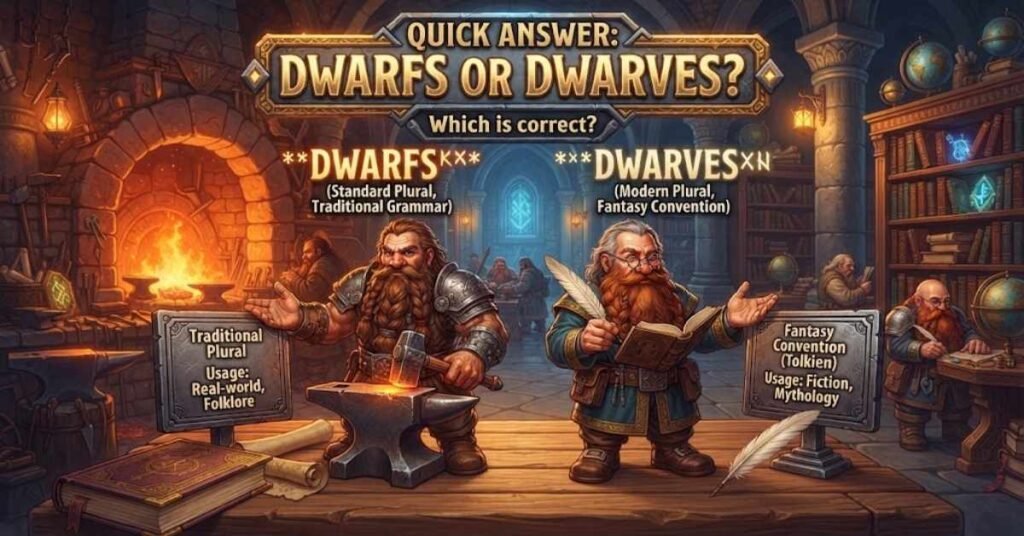
Both spellings are correct. That’s the short version.
Dwarfs is the standard plural form you’ll spot in science writing, especially astronomy. Think white dwarfs, brown dwarfs, dwarf stars.
Dwarves belongs to fantasy literature and folklore. J.R.R. Tolkien popularized this spelling for his stocky, axe wielding heroes, and fantasy writers followed his lead ever since.
Why People Confuse Dwarfs And Dwarves
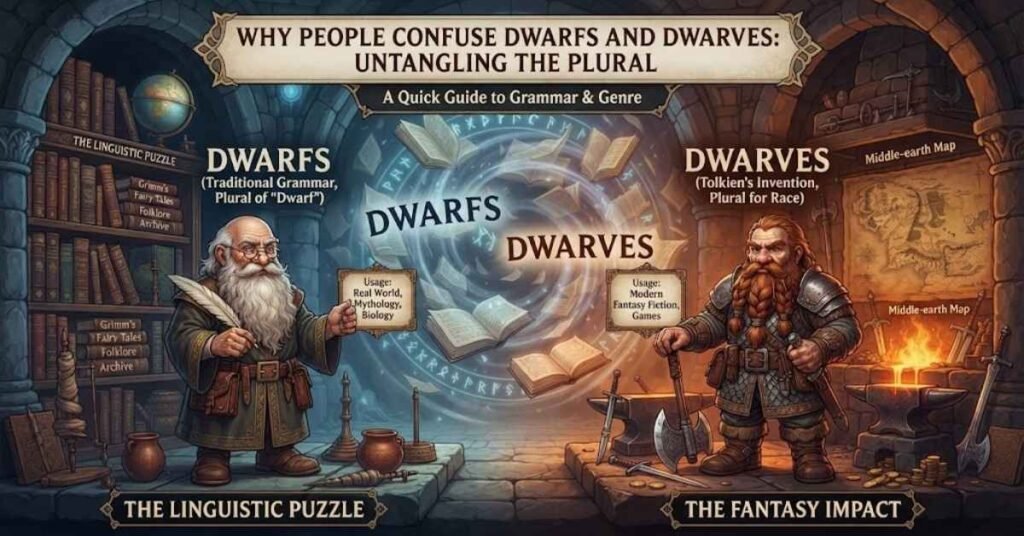
English has a habit of bending its own rules, and that’s exactly what happened here.
Most nouns ending in “f” switch to “ves” in the plural. Wolf becomes wolves. Leaf becomes leaves. Knife becomes knives. So your brain naturally expects dwarf to become dwarves.
But dictionaries also list dwarfs as grammatically valid. Movies, games, and books use dwarves so often that it feels like the “real” plural, even though dwarfs came first historically. That mix of traditional usage and modern usage is exactly why confusion sticks around.
What Does Dwarfs Mean?
The word carries two completely different jobs in a sentence, and knowing which one you need changes everything.
Dwarfs As A Noun
As a noun, dwarfs refers to small people, small animals, or compact celestial objects. White dwarfs and brown dwarfs are dense stellar remnants that astronomers study through a telescope.
You’ll also hear it in biology when talking about dwarf animals or plants bred to stay smaller than usual. It’s the go to scientific terminology for anything unusually small compared to its typical size.
Dwarfs As A Verb
Here’s where things get interesting. Dwarfs can also work as a verb form, specifically the third-person singular verb of “to dwarf.”
Say a skyscraper towers over a nearby village. You’d write “the skyscraper dwarfs the village.” It means the skyscraper makes smaller by comparison, or dwarfs it in size. This verb usage never switches to “dwarves,” no matter the context.
What Does Dwarves Mean?
Dwarves is almost always a noun, and it lives in a different world entirely: fiction.
Picture forest dwarves, mountain dwarves, or underground dwarves guarding treasure in a fantasy kingdom. These are the bearded, armor clad fictional creatures you meet in fantasy novels, fantasy movies, and video games. Snow White’s companions? Actually spelled “dwarfs” in Disney’s title, which surprises a lot of people.
Tolkien’s Middle earth books cemented dwarves as the accepted spelling for mythical characters in modern fantasy literature. Since then, nearly every fantasy game and fiction writing project has followed suit.
Meaning And Usage Difference
Here’s the simplest way to remember it. Dwarfs leans scientific and factual. Dwarves leans imaginative and story driven.
If you’re describing real-world references, like stars, animals, or literal size comparisons, dwarfs is your word. If you’re deep in fictional references, building out character creation for a fantasy world, dwarves fits naturally.
This isn’t a strict rule carved in stone, but it reflects how English usage has settled over the decades. Style guides and publishers generally respect this usage difference, which keeps your writing consistent and easy to trust.
Tone, Context, And Formality
Formality plays a bigger role here than most people realize.
Academic writing and scientific writing almost always default to dwarfs, since it matches the traditional grammatical plural. Journals, textbooks, and research papers rarely deviate from this, because formal writing values consistency over creative flair.
Informal writing, casual blog posts, and storytelling projects have more room to breathe. If your language context is a fantasy short story shared with friends, dwarves feels right at home. Match your word choice to your audience, and you’ll rarely go wrong.
Which One Should You Use?
Ask yourself one question before you type: is this fact or fiction?
Writing about space, biology, or literal height differences? Choose dwarfs. Working on a fantasy manuscript, game script, or anything involving magical creatures? Choose dwarves.
Here’s a simple table to keep handy.
| Situation | Use This Spelling |
| Astronomy or space science | Dwarfs |
| Biology, animals, plants | Dwarfs |
| Fantasy books, games, movies | Dwarves |
| People with dwarfism | Dwarfs |
| Verb meaning “to make smaller” | Dwarfs |
When One Choice Sounds Wrong
Swap the words in the wrong setting, and readers notice immediately.
Picture a NASA article describing “brown dwarves” instead of brown dwarfs. It sounds off to anyone familiar with space science, almost like a typo slipped past editing. Researchers and scientists stick to dwarfs for a reason: consistency builds trust in technical writing.
Flip it around. A fantasy novel describing “seven dwarfs” guarding a castle instead of seven dwarves feels slightly stiff, almost too clinical for a magical setting. Readers of fairy tales and epic fantasy expect that “v” sound because it’s become part of the genre’s voice.
Common Mistakes And Quick Fixes
Small slip ups happen constantly, but they’re easy to catch once you know what to look for.
Mistake 1: Using Dwarves For Astronomy
Writers sometimes default to dwarves out of habit, even in scientific contexts. If you’re discussing dwarf stars or dwarf planets, always correct it to dwarfs. This single fix instantly boosts your language accuracy in technical content.
Mistake 2: Using Dwarfs For Fantasy Creatures
The reverse mistake shows up in fantasy usage too. Calling your fantasy kingdom heroes “dwarfs” instead of dwarves can feel jarring to genre readers who expect the Tolkien inspired spelling.
Mistake 3: Assuming Only One Plural Is Correct
Some people insist only one spelling exists, and that’s simply not true. Both are dictionary approved irregular plurals of dwarf, and English plural rules allow for this kind of split depending on context.
Everyday Examples
Seeing these words in action makes the difference click faster than any rule ever could.
Science Examples
“Astronomers discovered a new brown dwarf using a powerful telescope.” “White dwarfs represent the final stage in a star life cycle for smaller stars.” “The dwarf planet Pluto sparked years of debate among scientists.”
Fantasy Examples
“The dwarves marched toward the mountain, axes gleaming under torchlight.” “Seven dwarves lived deep in the forest, far from the wizard’s tower.” “Video games often feature dwarves as skilled blacksmiths and fierce warriors.”
General Examples
“His towering skyscraper dwarfs every other building downtown.” “Compared to the castle, the cottage looked like it belonged in a magical kingdom for tiny folk.” “The company’s massive budget dwarfs what smaller competitors can spend.”
Dictionary-Style Word Details
Let’s slow down and break the word apart the way a dictionary would.
Verb
To dwarf means to make something appear small by comparison. It’s a verb usage rooted purely in relative size, nothing more. “The mountain dwarfs the hiking trail below it” works perfectly, describing scale rather than fantasy creatures.
Noun
As a noun usage, dwarf describes a person, animal, plant, or object noticeably smaller than typical members of its category. This includes small humanoid creatures in folklore, compact forms in biology, and even architectural comparisons like a shed next to a skyscraper.
Synonyms
Finding the right synonym depends heavily on context, since these two words rarely overlap in meaning.
Dwarfs
Think small people, small beings, miniature, undersized, or small versions. In science writing, “diminutive” and “compact” often work as close alternatives depending on the sentence.
Dwarves
Think fictional worlds vocabulary: gnomes, goblins (loosely), mythological beings, or simply “the dwarven folk” in more stylized fantasy prose.
Example Sentences
More examples help lock the pattern into memory.
Dwarfs
“The greenhouse specializes in dwarf animals and miniature plant breeds.” “That dwarf star burned out billions of years ago.” “His achievements dwarfs anything his rivals accomplished.”
Dwarves
“The dwarves of the mountain kingdom guarded ancient gold.” “Fantasy novels rarely skip a dwarves subplot involving lost treasure.” “The game’s dwarves specialize in mining and heavy armor crafting.”
Word History
The word dwarf traces back to Old English “dweorg,” itself rooted in older Germanic language branches. For centuries, dwarfs stood as the only accepted plural, following standard English language history patterns for words ending in “f.”
Dwarves entered popular use largely through Tolkien’s influence in the mid twentieth century. He preferred the “v” spelling for stylistic reasons, and it stuck so firmly that dictionaries eventually recognized both. That’s a rare case where fiction writing genuinely reshaped accepted dictionary definition entries.
Phrases Containing
Certain phrases lock permanently into one spelling, and swapping them sounds instantly wrong.
Dwarfs
“Dwarf planets,” “white dwarfs,” “brown dwarfs,” “dwarf stars,” and “dwarfism” related phrasing all keep the “f” spelling without exception.
Dwarves
“Seven dwarves” (in casual and fantasy contexts), “mountain dwarves,” “dwarven kingdom,” and “dwarves and elves” are common phrases you’ll see repeated across fantasy media.
Conclusion
Dwarfs and dwarves aren’t competing against each other. They’re simply built for different jobs.Reach for dwarfs when you’re writing about science, biology, or using the verb form meaning “to make smaller.”
Reach for dwarves when you’re building fictional worlds, writing fantasy, or referencing genre classics.Once that context clicks, you’ll pick the right word choice instinctively, without ever pausing mid sentence again.
FAQs
Are dwarfs and dwarves both correct?
Yes. Both are recognized plural forms of dwarf. The choice depends entirely on context, not correctness.
Is it seven dwarfs or seven dwarves?
Both appear commonly. Disney’s official title uses “Seven Dwarfs,” while general fantasy writing often favors “seven dwarves.” Neither is technically wrong.
Which spelling is used in astronomy?
Astronomy sticks with dwarfs, as seen in white dwarfs, brown dwarfs, and dwarf planets, keeping scientific writing consistent.
Is dwarfs a verb?
Yes. Dwarfs works as the third-person singular verb of “to dwarf,” meaning to make something look small by comparison.
Should I use dwarves for people with dwarfism?
No. When referring to people with dwarfism, avoid both dwarfs and dwarves. Use “people with dwarfism” or “little people,” since these terms are respectful and widely preferred over either plural form.

Henry Parker is an English language writer with several years of experience helping learners understand grammar and improve their writing. He enjoys breaking down confusing grammar rules into simple explanations and practical examples. Through his work at HexoWaves, Henry shares useful tips on grammar, vocabulary, sentence structure, and everyday English.