
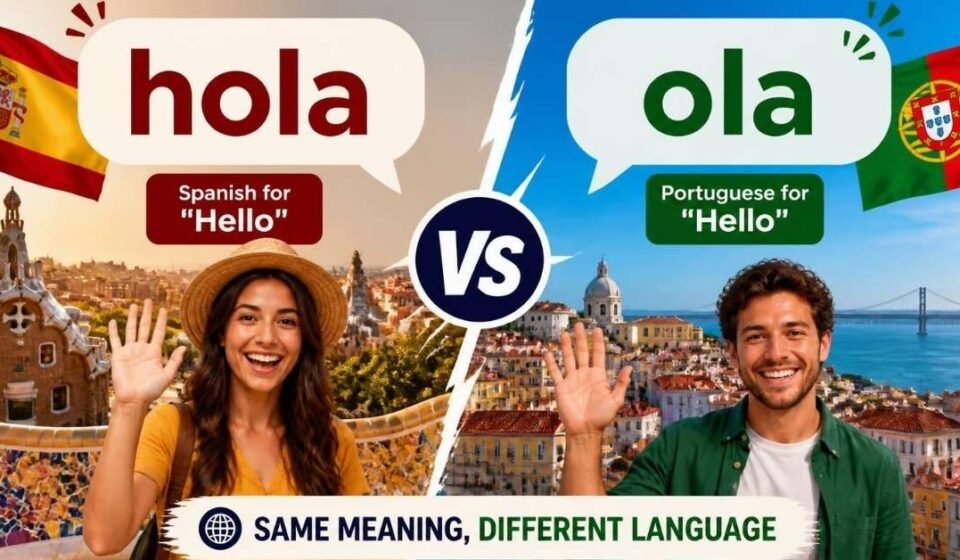
You typed a quick message to a friend in Spain. You wanted to say hi. But did you write hola or ola? If you paused for even a second, you’re not alone.
This mix up trips up beginners, casual travelers, and even people who’ve studied Spanish for years. One letter changes everything, and today you’ll never mix them up again.
Hola or Ola: What Is the Difference?

Here’s the short answer before we go deeper. Hola means hello in Spanish. Ola means wave, as in an ocean wave. They sound identical when spoken out loud, but they mean completely different things on paper.
That single missing letter, the H, is the whole story. Spanish speakers hear no difference between the two. Only the spelling tells you which word is which, so context and written Spanish rules matter more than your ears here.
Let’s break each word down so the difference sticks for good.
Hola Meaning in Spanish

Hola is an interjection, a small word that carries a big social job. It’s how you greet someone the moment you walk into a room or start a text conversation.
Think of it as the Spanish twin of hello or hi. You’ll hear Hola, María or Hola, amigo all across Latin America and Spain, in shops, classrooms, and phone calls alike.
It’s casual, warm, and works in almost any setting. Even formal Spanish greetings often open with a friendly hola before getting to business.
Ola Meaning in Spanish
Ola is a completely different animal. It’s a feminine noun, and it refers to a wave, most often an ocean wave rolling toward the beach or coast.
Surfers wait for the perfect ola before paddling out. A fisherman might warn you about a giant wave hitting the boat. Weather reporters use it too, since a heat wave in Spanish becomes ola de calor.
So ola isn’t just about water. It stretches into figurative wave territory, covering trends, crime spikes, or a wave of change sweeping through a city.
Olá Meaning in Portuguese
Now here’s where things get spicy. In Portuguese, the greeting isn’t spelled like Spanish at all. It’s olá, with an accent mark sitting right over the A.
That accent isn’t decoration. It shifts the stress and tells Portuguese learners this word means hello, not wave. Native speakers in Brazil and Portugal say Olá, tudo bem? constantly, meaning hello, how’s it going.
So if you’re writing to a Portuguese speaking friend, olá with the accent is correct. Drop that accent mark in Spanish, though, because Spanish never uses it here.
Hola or Ola: Which One Should You Use?
Confused about when each word belongs where? Here’s your quick usage guide, built around real situations you’ll actually run into.
The rule of thumb is simple once you see it laid out. Ask yourself what you’re describing: a person or the ocean.
Use Hola When Greeting Someone
Anytime you’re starting a conversation, texting a friend, or answering the phone in Spanish, reach for hola. It works before a name, a question, or a whole sentence.
Try these real examples. Hola, ¿cómo estás? asks how someone’s doing. Hola a todos welcomes a whole group at once, perfect for a classroom or a party.
You’ll also spot it opening emails and voice messages. Hola, Carlos, mucho gusto mixes a greeting with a proper introduction, and it sounds completely natural to any Spanish speaking listener.
Use Ola When Talking About a Wave
Switch gears the moment you’re describing water, weather, or a metaphorical surge. That’s your cue for ola, no exceptions in standard Spanish.
A surfboard magazine might write La ola era enorme, meaning the wave was huge. A news anchor covering rising temperatures says una ola de calor afecta la región, a heat wave is hitting the region.
Even outside the ocean, this word shows up. Crime reports mention una ola de robos, a wave of robberies, proving how flexible this little noun really is.
Use Olá in Portuguese
If your message is going to someone who speaks Portuguese, not Spanish, swap in olá with its accent intact. This applies whether you’re writing to someone in Lisbon or São Paulo.
Olá, Daniel, prazer em conhecê-lo greets Daniel and says it’s a pleasure to meet him. It’s warm, polite, and instantly recognizable to any Portuguese learners or native speaker.
Mixing this up with Spanish hola is one of the most common slips bilingual writers make. Keep the languages separate in your head, and the accent will remind you which one you’re using.
Why Do Hola and Ola Cause So Much Confusion?
Honestly, this mix up makes total sense once you understand Spanish pronunciation. It’s not a sign you’re bad at languages. It’s just how the alphabet works here.
Three real reasons explain why even careful writers slip. Let’s walk through each one so you know exactly what’s happening in your brain.
They Sound the Same in Spanish
Spanish has a rule that trips up almost every English speaker at first. The letter H is always silent, in every single word, no exceptions.
That means hola and ola are true homophones. Say them out loud and there’s zero audible difference, which is exactly why your ear can’t help you here.
Your eyes have to do the work your ears can’t. That’s the whole reason spelling matters so much more in Spanish than pronunciation does for this particular pair.
The Meaning Depends on Context
Without that silent H sitting there, only the surrounding sentence tells you what’s meant. Reading la ola next to playa instantly signals wave, not greeting.
Reading Hola, buenos días signals a greeting immediately, since nobody wishes a wave good morning. Your brain fills in the meaning fast once you’ve seen enough real sentences.
This is why exposure matters so much for language learners. The more written Spanish you read, the faster context clues click into place without conscious thought.
English Learners May Rely Too Heavily on Sound
Here’s the trap. English spelling often mirrors pronunciation loosely, so English learners sometimes assume Spanish works the same way. It doesn’t, not for this word pair.
Since both words sound identical, learners guess the spelling instead of memorizing it. That guess is right about half the time, which honestly makes the mistake worse to catch.
The fix isn’t complicated, though. Once you consciously separate spelling from pronunciation in your mind, this particular spelling mistake basically disappears from your writing forever.
Hola vs Ola: A Simple Comparison Guide
Sometimes a side by side comparison beats paragraphs of explanation. Here’s the whole hola vs ola distinction boiled down to one clean table.
| Word | Language | Meaning | Part of Speech | Example |
| Hola | Spanish | Hello, hi | Interjection | Hola, Pedro |
| Ola | Spanish | Wave | Feminine noun | La ola es grande |
| Olá | Portuguese | Hello, hi | Interjection | Olá, tudo bem |
The Easy Memory Trick
Picture the letter H standing tall like a person waving hello. That mental image links H equals hello permanently, and it’s genuinely hard to unlearn once it sticks.
For ola, picture rolling water instead, no H in sight, just a smooth curved wave shape. Visual mnemonic tricks like these work far better than memorizing rules on a page.
Quick Decision Checklist
Before you hit send on that message, run through this fast checklist. Am I greeting a person? Then it’s hola. Am I describing water, weather, or a surge of something? Then it’s ola.
Is the recipient a Portuguese speaking friend instead of a Spanish one? Swap to olá with the accent. Three quick questions, and the right spelling practically picks itself.
Common Mistakes With Hola and Ola
Even careful writers slip sometimes, and that’s completely normal. Let’s look at the four mistakes that show up most often in real writing.
Mistake 1: Writing Ola as a Spanish Greeting
This is the single most common spelling error out there. Someone types Ola, ¿cómo estás? meaning to say hello, but technically they’ve written a nonsensical wave greeting instead.
Spanish speakers will usually understand you anyway, since context saves the day. Still, it reads as an obvious incorrect spelling to anyone paying close attention, including teachers grading your homework.
Mistake 2: Adding an Accent to Spanish Hola
Some learners borrow the Portuguese accent mark and write holá, thinking it looks more official. It doesn’t. Standard Spanish grammar never places an accent mark on this word.
RAE, the Real Academia Española, confirms hola carries no written accent in any context. Adding one is a small but noticeable beginner mistake that native speakers immediately clock as off.
Mistake 3: Assuming Olá Is Always Wrong
Here’s a mistake that runs the opposite direction. Writers see olá and assume it’s simply Spanish spelled incorrectly, when really it’s perfectly correct in Portuguese.
Both spellings are right, just in different languages. The Portuguese exception exists because these are two separate languages that happen to share a common root word for greeting.
Mistake 4: Confusing Ola With Other Types of “Waves”
Not every English wave translates directly to ola. A hand wave, like waving goodbye, uses a totally different Spanish verb, saludar con la mano, not this noun at all.
Ola sticks specifically to physical waves and their figurative cousins, like a wave of change or a heat wave. Keep that boundary in mind and you’ll avoid an awkward mistranslation.
A Real-Life Example: The Beginner Who Wrote “Ola”
Picture a classmate named Ana in her first month of a Spanish class. She’s texting her new pen pal in Mexico City and wants to open warmly, so she types Ola, Maria, como estas.
Maria replies within seconds, a little confused but friendly about it. She gently points out the missing H, explaining that ola actually means wave, not hello, in written Spanish.
Ana laughs it off, fixes her spelling, and never makes that mistake again. That’s honestly how most people learn this distinction, through one slightly embarrassing but harmless real conversation.
Stories like Ana’s happen constantly in language exchange apps and Spanish learners forums. It’s practically a rite of passage, so don’t sweat it if it’s happened to you too.
Hola and Ola in Modern Language Learning: 2025 to 2026 Data
Spanish keeps growing at a remarkable pace, which means more people than ever are bumping into this exact confusion. The numbers tell a striking story.
According to the Instituto Cervantes yearbook for 2025, the Spanish speaking population worldwide climbed past 635 million people, a jump of roughly 30 million in just one year. Native speakers alone crossed 520 million for the first time, making Spanish the third most spoken native language on the planet, trailing only Mandarin and Hindi.
That same report counts more than 24 million active Spanish learners studying the language formally across the globe, alongside another 92 million people with limited proficiency. Every one of those learners eventually meets the hola versus ola puzzle somewhere in their first few lessons.
Spanish has also become the internet’s second most used language, right behind English, which means written mistakes like this one show up constantly in comments, captions, and chats. It’s part of why guides like this one, and dictionaries like WordReference and the RAE database, stay in such high demand among language learners worldwide.
Meanwhile, official exams like the DELE examinations continue testing exactly these kinds of spelling distinctions. If you’re aiming for a certified proficiency level, this small H is the sort of detail that separates a passing score from a costly point lost.
How to Remember Hola vs Ola Forever
Ready to lock this in permanently? These four methods cover every learning style, so pick whichever clicks fastest for your brain.
Method 1: Remember “H = Hello”
Both words start with the letter H in English. Lean into that overlap on purpose, since hello and hola literally share their first letter, while wave and ola don’t share anything at all.
Method 2: Associate Ola With the Ocean
Picture a surfboard slicing across a rolling ocean wave every time you see the word ola. No H, no person, just open water and motion. That image alone prevents most future slip ups.
Method 3: Practice Them Together
Write both words in the same sentence a few times. Hola, la ola es grande hoy, hello, the wave is big today. Repetition inside one sentence cements the contrast faster than studying them apart ever could.
Method 4: Remember the Portuguese Exception
Whenever you see an accent mark over the A, your brain should immediately flag Portuguese, not Spanish. That accent is the single clearest visual signal separating olá from its Spanish cousin.
Mini Quiz: Hola or Ola
Test yourself now. No peeking back at the answers until you’ve picked one for each question.
Quiz 1. Quick Pick: Which Means “Hello” in Spanish?
A) Ola B) Hola Answer: B, Hola.
Quiz 2. Fill in the Blank
“_____, ¿qué tal?” (Hello, how’s it going?) Answer: Hola.
Quiz 3. What Does “Ola” Mean?
A) A greeting B) A wave Answer: B, a wave.
Quiz 4. Spot the Correct Sentence
A) Ola, María, mucho gusto. B) Hola, María, mucho gusto. Answer: B.
Quiz 5. Fill in the Blank: Think Ocean
“La _____ del mar era enorme.” (The ocean wave was enormous.) Answer: Ola.
Quiz 6. Spanish or Portuguese?
“Olá, tudo bem?” is written in which language? Answer: Portuguese.
Quiz 7. True or False?
Hola carries a written accent mark in standard Spanish. Answer: False.
Quiz 8. Fill in the Blank: Greeting Time
“_____ a todos, bienvenidos a la clase.” (Hello everyone, welcome to class.) Answer: Hola.
Quiz 9. Which One Means “Wave”?
A) Hola B) Ola Answer: B, Ola.
Quiz 10. Don’t Let the Silent H Fool You!
Do hola and ola sound different when spoken aloud? Answer: No, they’re homophones.
Quiz 11. Fill in the Blank: Portuguese Edition
“_____, prazer em conhecê-lo.” (Hello, pleasure to meet you.) Answer: Olá.
Quiz 12. Which Sentence Talks About a Wave?
A) Hola, John, ¿cómo estás? B) La ola llegó a la playa. Answer: B.
Quiz 13. The Easy Memory Test
What letter should you picture as a waving person? Answer: H, as in hola and hello.
Quiz 14. Fill in the Blank: Final Challenge
“Una _____ de calor afecta la ciudad.” (A heat wave is affecting the city.) Answer: Ola.
Quiz 15. Final Boss: Can You Get This Right?
Which word would a surfer use before paddling out? Answer: Ola.
References
- Instituto Cervantes, El Español en el Mundo, 2025 yearbook
- Real Academia Española (RAE), official Spanish language dictionary
- WordReference Spanish Dictionary
- Infopédia, Portuguese language dictionary
- Spain’s Ministry of Foreign Affairs, Spanish in the World overview
Final Verdict
So, hola or ola, which one wins? Honestly, there’s no real competition once you know the trick. Hola greets people. Ola describes waves. One missing letter, two completely different worlds.Keep that silent H in your head as a friendly wave hello, and you’ll never second guess this spelling again.
Whether you’re texting a friend in Madrid or chatting with someone in Lisbon, you’ve now got every version covered, Spanish, Portuguese, and the confusion between them, handled for good.
FAQs
Q1: Is “hola” or “ola” correct for hello?
Hola is correct for hello in Spanish. Ola, without the H, means wave instead and isn’t a valid greeting in standard Spanish.
Q2: Is ola a Spanish word?
Yes, ola is a real Spanish word. It’s a feminine noun meaning wave, used for ocean waves, heat waves, and figurative surges alike.
Q3: Why does hola have an H if the H is silent?
Spanish kept the H from Latin spelling traditions even after the sound disappeared centuries ago. It’s a historical quirk of Spanish grammar, not a pronunciation cue.
Q4: Does hola mean hello in Spanish?
Yes, exactly. Hola is the standard informal greeting used across every Spanish speaking country, from casual chats to opening lines in emails.
Q5: Does ola mean hello in Portuguese?
No. In Portuguese, hello is spelled olá, with an accent mark. Without that accent, it’s not a recognized Portuguese greeting at all.
Q6: Is “Holá” correct?
No. Standard Spanish never places an accent mark over hola. Writing it that way is a common spelling mistake, not an accepted variation.
Q7: Are hola and ola pronounced the same?
Yes, they’re true homophones in Spanish. The silent H means both words sound identical out loud, so only spelling and context tell them apart.

Henry Parker is an English language writer with several years of experience helping learners understand grammar and improve their writing. He enjoys breaking down confusing grammar rules into simple explanations and practical examples. Through his work at HexoWaves, Henry shares useful tips on grammar, vocabulary, sentence structure, and everyday English.