

Ever typed a word so fast your brain froze halfway through it?That’s usually what happens with scary. You write the “scar” part, then pause. Is it one “r” or two? Should there be a “y” at the end, or an “e” first?
You’re not alone. This mix-up shows up in emails, blog posts, texts, and even school essays. Let’s clear it up once and for all, no fluff, just the facts you actually need.
Quick Answer
Scary is the correct spelling. Scarry is not a real word in standard English.
If something gives you chills, makes your pulse race, or leaves you glancing over your shoulder, that’s scary. Not scarry. Not scarey. Just scary.
This isn’t a case of British English versus American English either. Both regions agree on this one. The confusion comes from somewhere else entirely, and we’ll get into that shortly.
Examples:
- That horror movie was genuinely scary.
- Public speaking feels scary the first time you try it.
- The haunted house down the street looks scary at night.
- Losing your job unexpectedly is a scary thought for most people.
Notice something? Every single one uses scary. None of them use “scarry.” That’s your first clue this isn’t a 50/50 debate.
The Origin of Scary vs Scarry
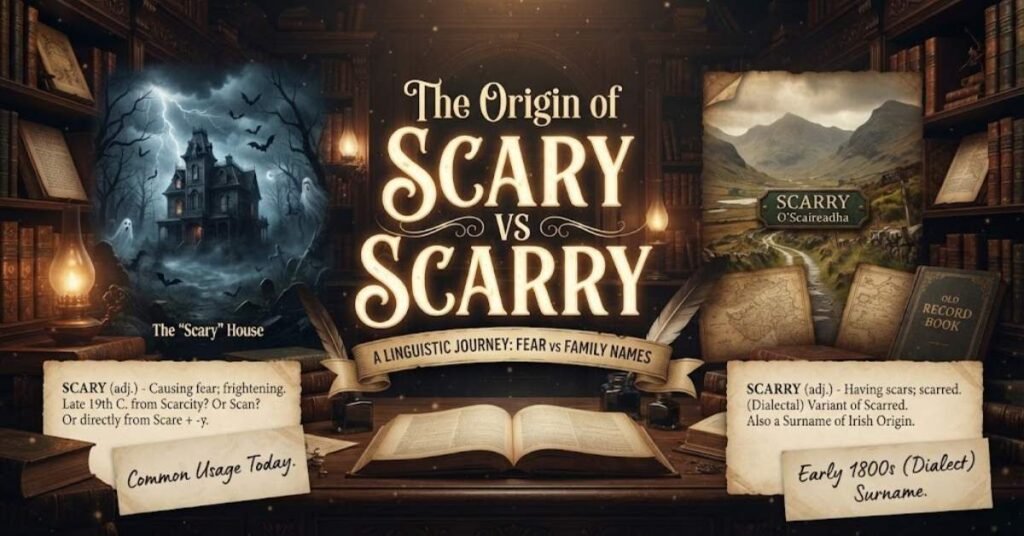
Words don’t just appear out of thin air. They come from a root word, and scary comes straight from scare.
Think about it. You take “scare,” drop the silent “e,” and add “y.” That gives you scary. It’s a clean, simple pattern that English uses all the time, like “bone” becoming “bony” or “shine” becoming “shiny.”
Scarry, on the other hand, has no real historical basis. It’s not tied to any older English form, and it doesn’t follow any accepted word formation pattern. People usually type it by accident, thinking double letters make a word look more “intense.” It doesn’t work that way here.
Dictionaries confirm this too. Merriam-Webster lists scary as the only valid entry. There’s no “scarry” definition sitting quietly in the back pages waiting to be discovered. It simply doesn’t exist as a recognized word.
British English vs American English Spelling
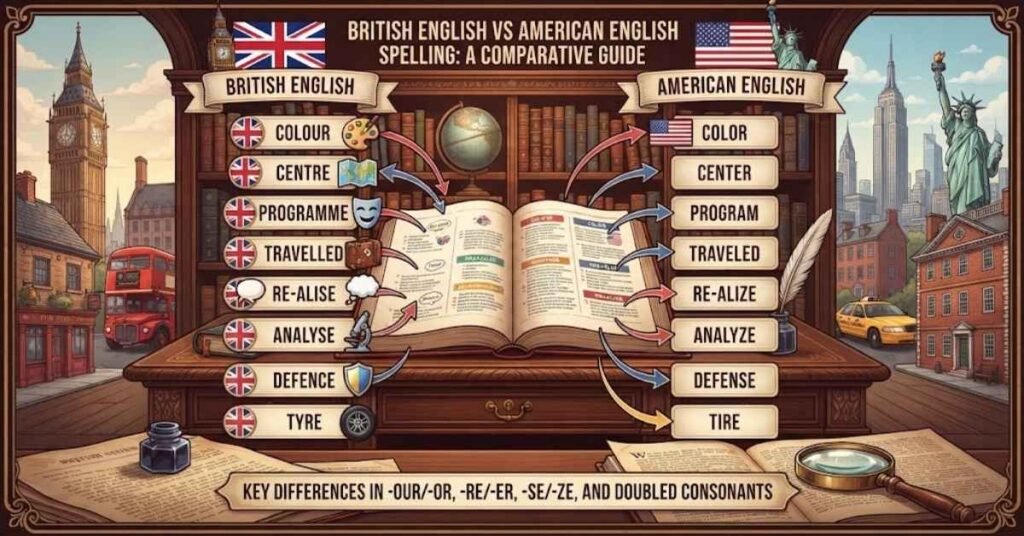
Here’s where a lot of people get tripped up. English has plenty of words that change spelling depending on the region. Color vs Colour. Organizing vs Organising. So it’s natural to wonder if scary falls into that same bucket.
It doesn’t. Both UK English and US English spell it the exact same way: scary. There’s no regional variation, no extra “u,” no swapped letters. This is one of those rare spots where the whole English-speaking world agrees without a fight.
That said, understanding British English vs American English spelling patterns still matters, especially if you write for a global audience. Knowing when spelling actually changes (and when it doesn’t) builds real confidence in your writing.
Comparison Table
| Region | Spelling | Correct? |
| US English | Scary | Yes |
| UK English | Scary | Yes |
| Any region | Scarry | No |
Simple, right? No regional split here. Just one correct spelling, everywhere.
Spelling Rules for Scary vs Scarry
So why does the “double consonant” version trip people up so much? It comes down to a few basic spelling rules that English speakers absorb early but sometimes forget under pressure.
When you add “y” to a word ending in a silent “e,” you typically drop that “e” first. Scare becomes scary. Same pattern with “spice” turning into “spicy,” or “noise” turning into “noisy.” The “e” disappears, and “y” takes its place.
Double consonant rules usually apply when a short vowel sound needs protecting, like in “run” becoming “runny” or “sun” becoming “sunny.” But “scare” already has a long vowel sound, held in place by that silent “e.” Once the “e” drops, there’s no reason to double the “r.” That’s exactly why scarry breaks the rule instead of following it.
Here’s a simple way to remember it:
- Silent “e” words usually drop the “e” and add “y” (scare → scary)
- Short, punchy words often double the last letter before adding “y” (sun → sunny)
- Scary follows the first pattern, not the second
Common Mistakes with Scary vs Scarry
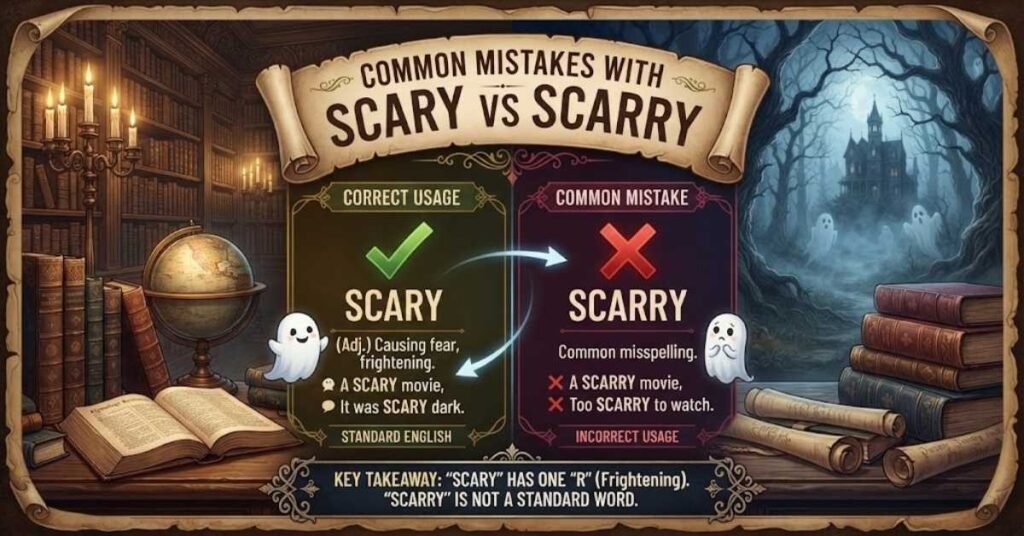
Even sharp writers slip up sometimes, and it’s rarely about intelligence. It’s about speed, autocorrect, or just plain habit.
One of the most common spelling mistakes happens when people type fast on their phones. Your thumb hits an extra letter, autocorrect doesn’t catch it, and suddenly “scarry” is sitting in your text message looking perfectly normal to you.
Another reason? Some folks genuinely believe doubling the “r” makes the word feel more intense, almost like it adds extra emphasis. It doesn’t. This is a classic lexical error, a mismatch between how a word sounds in someone’s head and how it’s actually built. English learners especially fall into this trap since English spelling doesn’t always match pronunciation in obvious ways.
A quick fix? Run your writing through spellcheck before hitting send. Most tools will flag scarry immediately and offer scary as the top spellcheck suggestion. It takes two seconds and saves you from looking sloppy in front of clients, teachers, or followers.
Scary in Everyday Examples
Words don’t live in dictionaries. They live in real conversations, real writing, real moments where you’re trying to say exactly what you mean. Let’s look at how scary shows up across different types of writing.
Emails
Professional writing still allows personality, and scary fits naturally when you’re being honest with someone.
“I know public speaking feels scary, but you’ve got this presentation nailed.”
That kind of line works because it’s human. It shows empathy without sounding stiff or robotic. Skip “scarry” here completely; one typo like that can quietly chip away at how professional your email feels.
Stories / Fiction
This is where scary really gets to shine. Fiction writers use it constantly to set mood and tension.
“The dark night wrapped around the old mansion, and every creak sounded scarier than the last.”
Notice the natural build here. Stories rely on scary moments to keep readers hooked, flipping pages just to see what happens next.
Social Media
Social media captions love short, punchy words, and scary fits perfectly.
“This roller coaster was scary but so worth it.”
Casual, quick, and instantly understood. Blogs and captions both benefit from this kind of direct, relatable language instead of overly formal phrasing.
Academic / Formal Writing
Even academic writing uses scary, just with a bit more restraint.
“The study revealed scary long-term consequences tied to climate change.”
Here, scary adds weight to a serious topic without sounding dramatic or exaggerated. It’s a word that scales up or down depending on your tone, which is exactly why it’s so useful.
Scary vs Scarry – Comparison Table
Let’s put everything side by side for a clean, quick reference.
| Feature | Scary | Scarry |
| Correct form | Yes | No |
| Recognized in dictionaries | Yes | No |
| Follows grammatical basis | Yes | No |
| Used in formal writing | Yes | No |
| Used in informal writing | Yes | Rarely, by mistake |
| Search intent match | High | Low |
This table sums up the whole debate in one glance. One column has real answers. The other is basically empty.
Google Trends & Usage Data
Curious how people actually search this online? Google Trends shows a steady pattern of people typing “scary or scarry” or “scary vs scarry” when they’re unsure which one to use.
This tells us something important about user intent. People aren’t randomly curious about grammar theory. They’re mid-sentence, unsure, and want a fast, clear answer before they hit send or publish. That’s exactly why search queries phrased as comparisons, using “or” instead of “vs,” tend to perform well for search optimization and general SEO.
Interestingly, the “or” phrasing tends to match how people actually talk. Nobody says “scary vs scarry” out loud in casual conversation. They think, “wait, is it scary or scarry?” That subtle difference matters for search rankings, especially when your content matches natural speech patterns instead of stiff, robotic phrasing.
Why Spelling Mistakes Hurt Your Writing
Here’s something people don’t talk about enough. A single spelling slip can quietly undercut your credibility, even if your ideas are solid.
Imagine reading a blog post, a presentation, or a work email riddled with small errors like “scarry.” Your brain notices, even if you can’t quite explain why the writing feels less trustworthy. That’s the real cost of incorrect spelling, it chips away at professionalism and confidence in writing without you even realizing it’s happening.
For first-time speakers, students, and professionals building a reputation, small details like this matter more than people assume. Consistent usage of correct spelling signals that you care about clarity, and readers pick up on that instantly.
Similar English Word Pairs You Should Know
If scary vs scarry tripped you up, you’re probably not alone with other tricky pairs either. English is full of them.
Take Aesthetic or Esthetic, another spot where spelling confusion creeps in depending on region and habit. Or Yea or Nay, a pair that sounds simple but gets misused constantly in casual writing. Even To That Effect vs Affect confuses seasoned writers, since “effect” and “affect” sound nearly identical but serve completely different grammatical roles.
Learning these patterns together builds stronger overall English grammar instincts. Once you understand why scary beats scarry, spotting similar mistakes elsewhere gets a whole lot easier.
Conclusion
So here’s the bottom line. Scary is the only correct form. Scarry is a misspelled word with no dictionary backing, no regional exception, and no grammatical justification.Whether you’re writing a spooky story, a casual text, or a formal report, stick with scary. It’s simple, it’s recognized everywhere, and it just works.
Got a spelling debate you’re still unsure about? Drop it in the comments below, share this with a friend who still types “scarry,” and let’s clear up more of these mix-ups together.
FAQs
1. Is scarry a real word?
No. Scarry isn’t recognized in any major dictionary, including Merriam-Webster. It’s simply an incorrect spelling of scary.
2. Which spelling is correct: scary or scarry?
Scary is correct. It’s the standard spelling used across both American English and British English.
3. Why do people spell scary as scarry?
Usually it comes down to autocorrect slips, typing speed, or a mistaken belief that doubling the “r” adds emphasis. It doesn’t follow real spelling rules, though.
4. Can scarry ever be used in informal writing?
Not correctly. Even in relaxed social media captions or texts, scarry is still a typo, not an accepted casual variant.
5. Does scary have different spellings in US and UK English?
No. Unlike Color vs Colour or Organizing vs Organising, scary stays the same in both US English and UK English.
6. How can I remember the correct spelling?
Just remember the root word: scare. Drop the silent “e,” add “y,” and you land on scary every time.
7. Should I type “or” or “vs” in Google searches?
Either works, but “or” tends to match how people naturally phrase the question, which often aligns better with real search intent.

Henry Parker is an English language writer with several years of experience helping learners understand grammar and improve their writing. He enjoys breaking down confusing grammar rules into simple explanations and practical examples. Through his work at HexoWaves, Henry shares useful tips on grammar, vocabulary, sentence structure, and everyday English.