
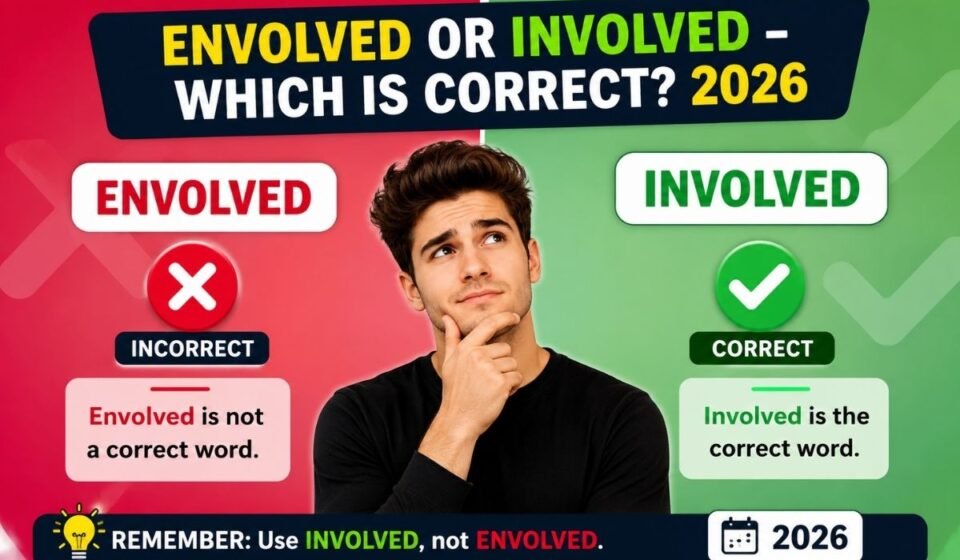
If you’ve ever paused mid-sentence wondering whether to type “envolved” or “involved,” you’re not alone. This is one of the most common spelling mix-ups in English, and it trips up native speakers and language learners alike. The good news is that the answer is simple and settled.
In this guide, you’ll learn exactly which word is correct, why the confusion happens in the first place, and how to use the right word confidently in every sentence you write from now on.
What Does “Involved” Mean?
“Involved” is the correct spelling. It comes from the verb “involve,” which means to include something as a necessary part of an activity, situation, or process. When someone is involved in a project, a relationship, or a discussion, they are actively taking part in it or closely connected to it.
The word carries a few related shades of meaning, depending on context:
- Participation – taking an active role in something (She got involved in the charity event.)
- Connection – being linked to a person, group, or situation (He’s involved with the new marketing team.)
- Complexity – describing something detailed, complicated, or hard to follow (The tax form was far more involved than expected.)
- Emotional attachment – feeling personally connected to an outcome or person (They became emotionally involved in the case.)
Involved as a Verb vs. Adjective
“Involved” does double duty in English grammar, and understanding both roles helps you use it correctly.
As a past tense verb, it follows the base form “involve”:
- The manager involved every team member in the decision.
- The plan involved three separate departments.
As an adjective, it describes a noun directly:
- She is an involved parent who attends every school meeting.
- It was a long and involved explanation.
Both uses are grammatically valid, and both always require the “i-n” spelling at the start, never “e-n.”
ALSO READ :Which or In Which – Which Is Correct? 2026
Is “Envolved” a Real Word?
No. “Envolved” is not a real word in the English language. It does not appear in Merriam-Webster, Oxford, Cambridge, or any other recognized dictionary. It is simply a misspelling of “involved,” and using it in formal or professional writing can make your work look careless.
Why People Think Envolved Might Exist
The confusion isn’t random — there are a few clear reasons why so many people write “envolved” by mistake:
- Similar sound to “evolved.” Both words share a soft “v” sound in the middle, and when spoken quickly, “involved” and “evolved” can blend together in the ear.
- The “en-” prefix looks familiar. English has plenty of real words that start with “en-,” such as “enable,” “enclose,” and “engage.” This makes “envolved” feel like it should logically exist, even though it doesn’t.
- Autocorrect inconsistency. Some spell-checkers catch the error immediately, while others let it slip through, especially on mobile keyboards.
- Non-native speaker influence. Learners transferring spelling patterns from other languages sometimes default to “en-” prefixes instinctively.
Dictionary Verdict
Every major English dictionary agrees: “envolved” has zero valid entries. Whether you check a print dictionary, an online reference, or a grammar tool, the result is the same — “involved” is the only accepted spelling, and there is no historical or regional variant that makes “envolved” acceptable.
Envolved vs Involved: Key Differences
The clearest way to see the difference between these two words is side by side.
| Feature | Involved | Envolved |
| Correct spelling | Yes | No |
| Found in dictionaries | Yes (Merriam-Webster, Oxford, Cambridge) | No |
| Part of speech | Verb (past tense) / Adjective | None — not a word |
| First two letters | I-N | E-N |
| Common usage | Everyday writing, business, academic work | Only appears as a typo |
| Meaning | Participating, connected, complex | No meaning; invalid |
| Acceptable in formal writing | Yes | Never |
As the table shows, there’s no real competition between the two. “Involved” is standard, recognized, and correct in every context, while “envolved” simply doesn’t belong in the English language.
Involved vs Evolved: Don’t Mix These Up Either
Since “envolved” is often confused with “evolved” too, it helps to separate all three clearly:
| Word | Meaning | Example |
| Involved | Participating or connected | She was involved in the negotiations. |
| Evolved | Developed or changed gradually | The species evolved over millions of years. |
| Envolved | Not a real word | (Always incorrect in any context.) |
Remember: “involved” starts with “in-,” meaning within or part of something, while “evolved” starts with “e-,” meaning out of or developing from something. That single vowel changes the entire meaning of the sentence.
How to Use “Involved” Correctly in Sentences
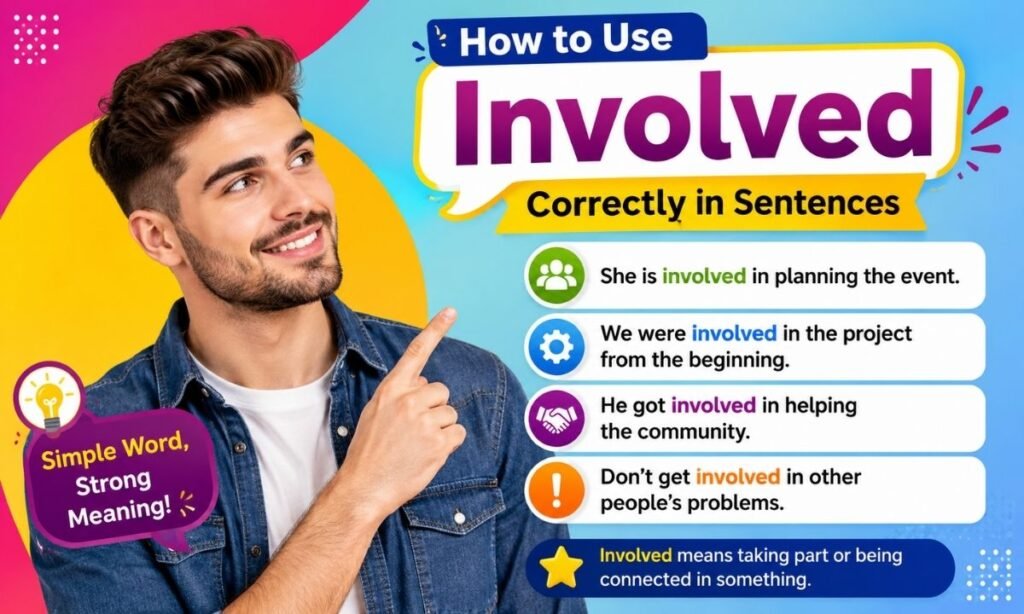
Once you know the spelling is settled, the next step is using “involved” naturally and accurately. Here are some example sentences covering its different meanings:
Showing participation:
- I want to get more involved in my community.
- He’s been involved with the project since day one.
Showing connection or relationship:
- They are romantically involved.
- Our company is involved with several nonprofit partners.
Describing complexity:
- The instructions were quite involved and took time to follow.
- It was a long, involved process to renew the license.
As a past tense verb:
- The investigation involved multiple witnesses.
- Yesterday, the coach involved every player in the drill.
Common Phrases with Involved
Certain phrases using “involved” appear frequently in everyday and professional English. Getting familiar with them makes your writing sound more natural:
- Get involved
- Stay involved
- Deeply involved
- Actively involved
- Heavily involved
- Emotionally involved
- The people involved
- What’s involved (in something)
A Quick Sentence-Building Tip
When you’re unsure whether to write “involved” or “envolved,” say the sentence out loud and focus on the beginning sound. If it starts like “in-side” or “in-clude,” you want “involved.” There is no scenario, tone, or writing style — casual, academic, or professional — where “envolved” is the right choice.
Why This Mistake Matters in Professional Writing
Spelling errors like “envolved” might seem minor, but they can affect how your writing is perceived, especially in resumes, emails, and business reports. A single misspelled word can distract a reader from your message and make your writing look less polished. Since spell-checkers don’t always catch this specific error — because “envolved” can sometimes be mistaken for an unusual name or technical term — it pays to double-check manually.
Here’s why getting it right matters:
- Credibility – Correct spelling signals attention to detail, which matters in job applications and client communication.
- Clarity – Readers shouldn’t have to pause and figure out what you meant.
- Consistency – Using the correct word every time builds trust with your audience, whether you’re writing a blog post, an email, or a report.
Synonyms for “Involved”
If you want to vary your vocabulary while keeping the same meaning, here are some useful alternatives depending on context:
- For participation: engaged, active, participating, taking part
- For connection: connected, linked, associated, related
- For complexity: complicated, intricate, elaborate, detailed, convoluted
- For emotional attachment: invested, attached, committed
Using synonyms can also help you avoid repeating “involved” too often in longer pieces of writing.
Tips to Never Confuse Envolved and Involved Again
Here’s a simple checklist to keep this mistake out of your writing for good:
- Always start the word with “i-n,” never “e-n.”
- Remember that “envolved” does not exist in any dictionary.
- If you’re thinking of “developed” or “changed,” you probably mean “evolved,” not “involved” or “envolved.”
- Use spell-check tools, but don’t rely on them completely — read your sentence back manually.
- Practice writing the word in full sentences until the correct spelling feels automatic.
- When in doubt, replace “involved” with a synonym like “engaged” or “connected” to sidestep the spelling question entirely.
Conclusion
The debate between “envolved or involved” really isn’t a debate at all. “Involved” is the correct, dictionary-recognized spelling used to describe participation, connection, complexity, or emotional attachment. “Envolved” is not a real word — it’s simply a common misspelling that likely arises from confusion with “evolved” and the familiar “en-” prefix seen in other English words.
The next time you’re unsure which one to type, remember this simple rule: it always starts with “i-n,” never “e-n.” Keep that in mind, and you’ll never second-guess this spelling again.
Frequently Asked Questions
Is “envolved” ever correct? No. “Envolved” is never correct in any context, formal or informal.
What does “involved” mean? It means participating in something, being connected to someone or something, or describing a situation as complex.
Why do people write “envolved” instead of “involved”? It usually happens because “envolved” sounds similar to “evolved” and mimics the “en-” prefix found in other real words.
Is “involved” a verb or an adjective? It can be both — a past tense verb (as in “the plan involved three teams”) and an adjective (as in “an involved discussion”).
What is the past tense of “involve”? The past tense is “involved,” as in “We involved the whole team in the decision.”
Do dictionaries list “envolved” as an alternate spelling? No. Major dictionaries, including Merriam-Webster, Oxford, and Cambridge, do not list “envolved” in any form.
What’s the difference between “involved” and “evolved”? “Involved” means participating or connected, while “evolved” means developed or changed gradually over time. They are unrelated words with different meanings.
How can I remember the correct spelling? Focus on the first two letters — “in-” for involved. If you picture “inside,” it will help you remember that “involved” always starts with “i-n.”

Henry Parker is an English language writer with several years of experience helping learners understand grammar and improve their writing. He enjoys breaking down confusing grammar rules into simple explanations and practical examples. Through his work at HexoWaves, Henry shares useful tips on grammar, vocabulary, sentence structure, and everyday English.