
Have you ever stopped mid-sentence, unsure whether to write “by which” or “in which”? You’re not alone. These two phrases look almost identical, sound equally formal, and pop up constantly in essays, legal documents, and professional emails — yet they mean completely different things.
The good news is that once you understand the logic behind by which or in which, you’ll never second-guess yourself again. In this guide, we’ll break down the exact difference, show you real examples, and share simple tricks to pick the right phrase every single time — even under pressure.
By the end of this article, choosing between by which and in which will feel as natural as choosing between “a” and “an.”
By Which vs In Which: What’s the Real Difference?
The core difference between by which and in which comes down to one simple idea: method versus place.
- By which explains how something happens — the method, process, or means.
- In which explains where or in what situation something happens — the location, context, or condition.
Think of it this way: “by” always points to a tool, system, or process, while “in” always points to a container, place, or circumstance. Once that idea clicks, the choice between by which or in which becomes almost automatic.
Here’s a quick side-by-side comparison to make the distinction crystal clear:
| Feature | By Which | In Which |
| Meaning | Method, means, or process | Place, situation, or context |
| Replaces with | “How” | “Where” or “in what” |
| Common verbs | achieved, caused, measured, solved, created | occurred, lived, found, worked, studied |
| Example | The method by which the data was collected | The office in which she works |
| Tone | Formal, technical | Formal, descriptive |
| Typical use | Legal, scientific, procedural writing | Narrative, descriptive, situational writing |
Both phrases combine a preposition with the relative pronoun “which,” and both are grammatically correct — the trick is matching the phrase to the verb that comes before it. If the verb naturally pairs with “by” (like “achieved by” or “caused by”), you need by which. If it pairs with “in” (like “found in” or “occurred in”), you need in which.
ALSO READ :https://hexowaves.com/when-i-can-or-when-can-i/
When to Use “By Which” (Rules + Examples)
Use by which whenever you’re describing the method, system, or means through which something is done. It answers the question “how?”
A simple test: try replacing the phrase with “how.” If the sentence still makes sense, by which is almost certainly correct.
Rules for using “by which”
- Use it when referring to a process, technique, or system.
- Use it after verbs like achieve, cause, measure, produce, solve, determine, and create.
- Use it in formal, technical, legal, or academic writing where precision matters.
- Avoid it when you’re describing a physical place — that’s where in which takes over.
Examples
- This is the method by which we solved the problem.
- The process by which the machine operates is surprisingly simple.
- The system by which data is collected needs an upgrade.
- The statute by which the court exercises jurisdiction is binding.
- Voting is the mechanism by which citizens choose their leaders.
- The technique by which the vaccine was developed took years to perfect.
Notice how every example above describes a process, method, or mechanism — never a physical location. That’s the hallmark of by which.
When to Use “In Which” (Rules + Examples)
Use in which when you’re describing a place, environment, situation, or condition. It answers the question “where?” or “in what?”
A quick test: try replacing the phrase with “where.” If it fits naturally, in which is the correct choice.
Rules for using “in which”
- Use it when referring to a physical location, room, or setting.
- Use it when describing a situation, scenario, or circumstance.
- Use it after verbs like live, work, study, occur, exist, and find.
- It’s the more commonly used of the two phrases in everyday and academic English.
Examples
- This is the room in which we study every morning.
- The situation in which he found himself was difficult.
- She described a case in which the law was applied unfairly.
- The environment in which children grow up shapes their future.
- The country in which she was born no longer exists on the map.
- The context in which the statement was made matters a lot.
As you can see, every one of these sentences describes a place, situation, or setting — not a method. That distinction is the heart of the by which or in which debate.
Quick Test: Ask Yourself These Questions
Before choosing between by which and in which, run through this short checklist:
- Does the sentence describe how something happens? → Use by which
- Does the sentence describe where or in what something happens? → Use in which
- Can you naturally swap the phrase for “how”? → By which is correct
- Can you naturally swap the phrase for “where”? → In which is correct
- Does the main verb pair with “by” (achieved by, caused by, measured by)? → By which
- Does the main verb pair with “in” (found in, occurred in, lived in)? → In which
This simple mental checklist works for almost every sentence you’ll encounter, whether you’re writing an academic paper, a business report, or a casual blog post.
Common Expressions and Idioms Using By Which and In Which
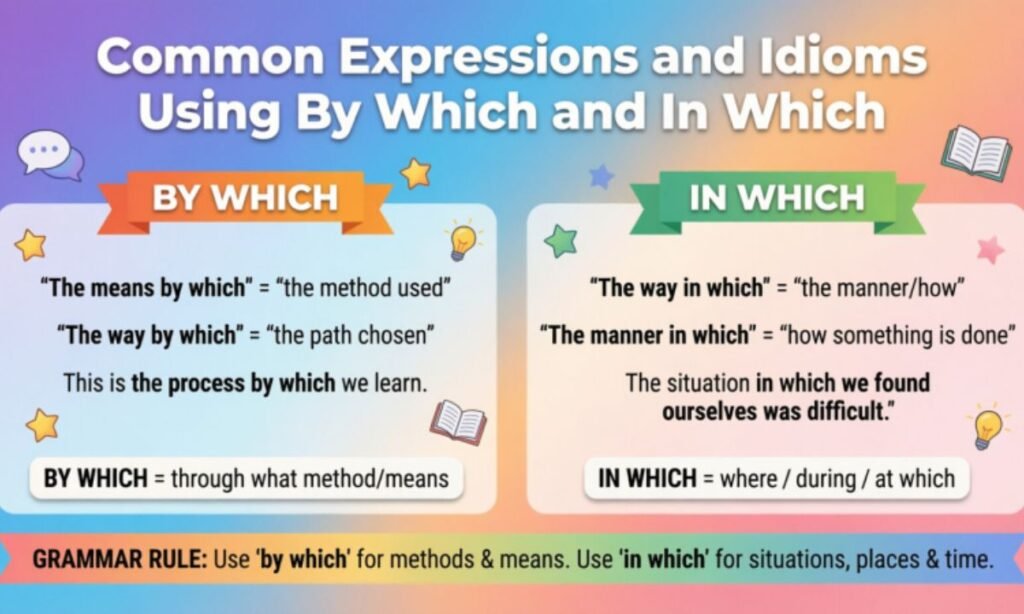
Beyond basic grammar rules, both phrases show up in fixed expressions and common idiomatic patterns. Recognizing these will help you use by which or in which more naturally and confidently.
Expressions with “by which”:
- “The means by which” — used to describe a method of achieving something.
- “The way by which” — a slightly less formal version of “the means by which.”
- “The process by which” — common in scientific and technical writing.
- “The mechanism by which” — often used in medical, legal, or engineering contexts.
- “The extent by which” — sometimes used, though “extent to which” is more standard.
- “The rate by which” — describes speed or pace of a method or system.
Expressions with “in which”:
- “The way in which” — describes the manner or style of doing something.
- “The world in which we live” — a common reflective or philosophical phrase.
- “A situation in which” — used to introduce a scenario or circumstance.
- “The context in which” — used in academic and analytical writing.
- “The environment in which” — common in business, education, and science writing.
- “The era in which” — used when referring to a historical time period.
Both sets of expressions are extremely common in formal English, and mastering them will instantly make your writing sound more polished and professional.
By Which or In Which: Real-World Examples in Context
To fully understand how professionals use these phrases, here are a few real-world style sentences that show the by which or in which distinction in action:
| Context | Correct Sentence | Why |
| Legal | The statute by which the court exercises authority is clear. | Refers to a legal method or mechanism |
| Technology | The environment in which the code runs affects performance. | Refers to a technical setting |
| Science | The process by which cells divide is called mitosis. | Refers to a biological method |
| Education | The classroom in which students learn best is well-lit. | Refers to a physical space |
| Business | The strategy by which the company grew was aggressive marketing. | Refers to a business method |
| History | The decade in which the war began was turbulent. | Refers to a time period |
This table highlights exactly why context matters so much when deciding between by which and in which — the surrounding words almost always give you the answer.
Common Mistakes to Avoid
Even advanced English speakers occasionally mix up these two phrases. Here are the most frequent errors:
- Using “in which” for a method — Incorrect: “The process in which we solved it.” Correct: “The process by which we solved it.”
- Using “by which” for a location — Incorrect: “The room by which we study.” Correct: “The room in which we study.”
- Overusing formal phrases in casual writing — Both phrases sound stiff in everyday conversation; simpler alternatives like “how” or “where” often work better.
- Ignoring the verb pairing — Always check whether the main verb naturally takes “by” or “in” before finalizing your sentence.
- Assuming they’re interchangeable — They’re not. Swapping them changes the meaning, even if the sentence still sounds grammatically fine.
Avoiding these mistakes will immediately sharpen your writing and make the by which or in which decision much easier going forward.
Why This Distinction Matters in Professional Writing
Precision matters in formal writing. In legal documents, using by which instead of in which (or vice versa) can subtly change the meaning of a clause. In academic papers, the wrong choice can confuse readers about whether you’re describing a method or a setting. Even in business communication, getting by which or in which right signals attention to detail and strong command of English.
That’s why so many writers, editors, and students actively search for guidance on by which or in which — it’s a small grammar point with a surprisingly large impact on clarity.
By Which or In Which: More Practice Examples
Practice is the fastest way to master by which or in which. Below are additional sentence pairs that show how the same topic can require either phrase, depending on whether you’re describing a method or a setting.
- The framework by which the software was built is open-source. (method)
- The office in which the software was built is downtown. (place)
- The formula by which interest is calculated changed this year. (method)
- The bank in which she opened her account offers low fees. (place)
- The approach by which teachers grade essays varies widely. (method)
- The school in which she teaches has excellent resources. (place)
- The procedure by which patients are admitted was simplified. (method)
- The hospital in which he was treated is world-renowned. (place/situation)
Reading these pairs side by side makes the by which or in which pattern much easier to internalize — the surrounding sentence almost always signals which phrase belongs.
Synonyms and Alternatives
If a sentence with by which or in which feels too formal, you can often swap it for a simpler alternative without losing meaning:
| Formal Phrase | Simpler Alternative |
| The method by which it was done | How it was done |
| The process by which it happens | How it happens |
| The room in which we met | Where we met |
| The situation in which she was placed | The situation she was placed in |
| The era in which it occurred | When it occurred |
Using these simpler alternatives is perfectly acceptable in casual writing and conversation. Save by which and in which for essays, reports, and formal correspondence where precision and tone matter most.
By Which or In Which in Academic and Business Writing
Academic writing leans heavily on both phrases because they allow writers to pack more information into a single sentence without starting a new clause. For example, instead of writing two separate sentences, a student can combine them using by which or in which to create a smoother, more sophisticated flow.
- Weak: “There is a method. The method solves the equation.”
- Strong: “There is a method by which the equation is solved.”
- Weak: “There is a field. Researchers work in the field.”
- Strong: “There is a field in which researchers work.”
Business writers use the same trick in reports, proposals, and emails to sound more polished. Once you’re comfortable choosing between by which or in which, your sentences will naturally read as more professional and concise.
Frequently Asked Questions
Is it “by which” or “in which”? Both are correct, but they mean different things — by which refers to method, and in which refers to place or situation.
Can “by which” and “in which” be used interchangeably? No. Swapping them changes the meaning of the sentence, since one describes “how” and the other describes “where.”
Which phrase is more common in everyday English? “In which” is used more often, especially in descriptive and narrative writing.
Is “by which” only used in formal writing? Mostly yes — it’s common in legal, academic, scientific, and professional contexts.
How do I quickly decide which phrase to use? Test the sentence by replacing the phrase with “how” or “where” — whichever fits naturally tells you the correct choice.
Is “through which” a synonym for “by which”? Yes, “through which” is very similar to “by which” and can often be used interchangeably.
Can these phrases start a sentence? Rarely — they’re typically used mid-sentence to connect a clause to a preceding noun.
Does British English use these phrases differently than American English? No, the rules for by which and in which are consistent across both British and American English.
Conclusion
Mastering the difference between by which and in which doesn’t require memorizing endless rules — it simply requires asking one question: are you describing how something happens, or where it happens? Once you internalize that logic, choosing correctly between by which or in which becomes second nature.
Keep the quick tests from this guide in mind: swap for “how” to check by which, and swap for “where” to check in which. With a little practice, you’ll use both phrases confidently in academic papers, professional emails, legal writing, and everyday conversation alike.
Small grammar distinctions like this one are exactly what separate good writing from great writing — so keep practicing, and your command of English will keep getting sharper.

Henry Parker is an English language writer with several years of experience helping learners understand grammar and improve their writing. He enjoys breaking down confusing grammar rules into simple explanations and practical examples. Through his work at HexoWaves, Henry shares useful tips on grammar, vocabulary, sentence structure, and everyday English.