If you’ve ever paused mid-sentence wondering whether to type “when can I” or “when I can,” you’re not alone. This tiny word-order swap trips up native speakers and English learners alike, and it can quietly make your emails, messages, or essays sound a little off.
The good news? The rule behind when I can or when can I is actually simple once you see the pattern. In this guide, we’ll break down the grammar, walk through real examples, compare the two forms side by side, and show you exactly how to pick the right one every single time — whether you’re asking a direct question or writing a smooth, natural statement.
By the end, you’ll never second-guess this phrase again.
“When Can I” vs “When I Can” – The Key Difference
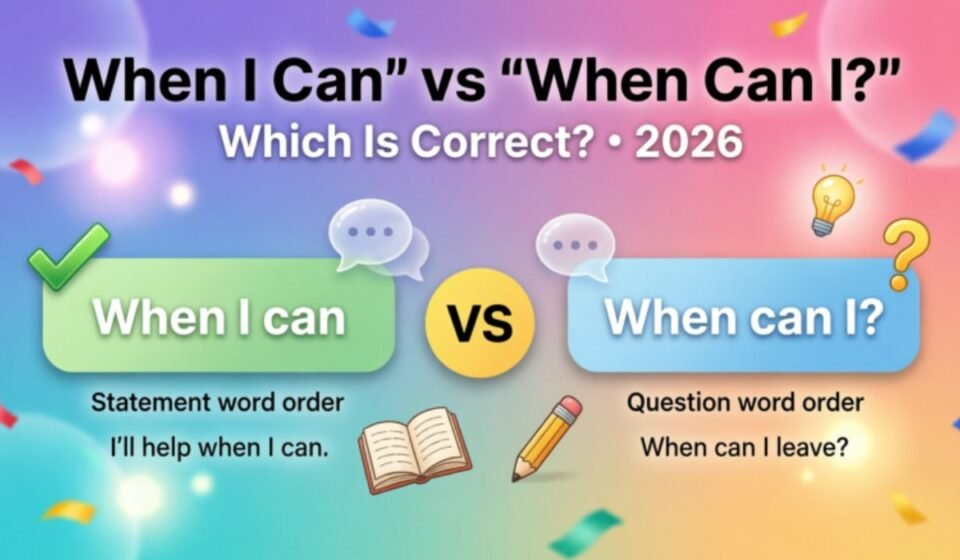
At the core, the difference comes down to one thing: are you asking a question, or are you making a statement?
- “When can I” is used for direct questions about timing, permission, or possibility.
- “When I can” is used inside statements, conditional clauses, or indirect questions.
Both phrases use the same three words, just rearranged. But that small shift in word order changes the entire grammatical function of the sentence. English relies heavily on word order to signal meaning, and this pair is a perfect example of how much a single flip can matter.
What Makes “When Can I” the Correct Question Form?
In English, direct questions require subject-auxiliary inversion. This means the modal verb (like “can,” “could,” or “may”) moves in front of the subject.
- Statement: I can leave.
- Question: Can I leave?
- With “when”: When can I leave?
This is why “when can I” sounds natural as a standalone question — it follows the same inversion rule used in nearly every English question. Ask yourself: does the sentence end with a question mark and stand on its own? If yes, “when can I” is the form you need.
Why “When I Can” Is Grammatically Incorrect as a Question
Now flip it around. “When I can start?” breaks the rule because it keeps the statement word order (subject before verb) but tries to function as a question. Native speakers instantly notice something feels wrong, even if they can’t explain exactly why.
That said, “when I can” isn’t wrong in general — it’s simply wrong as a standalone question. Inside a larger sentence, it becomes perfectly correct, which brings us to the next section.
ALSO READ :https://hexowaves.com/input-or-imput-2/
Quick Comparison Table: “When Can I” vs “When I Can”
| Feature | When Can I | When I Can |
| Grammatical role | Direct question | Statement / dependent clause |
| Word order | Modal + subject (inverted) | Subject + modal (normal order) |
| Ends with “?” | Yes, on its own | No, unless part of a larger question |
| Common use | Asking about timing or permission | Describing future action or capability |
| Example | When can I see the results? | I’ll share the results when I can. |
| Tone | Direct, inquisitive | Neutral, informative |
This table sums up the entire grammar rule in one glance — a handy reference whenever you’re unsure which form fits your sentence.
When to Use “When Can I” in Questions
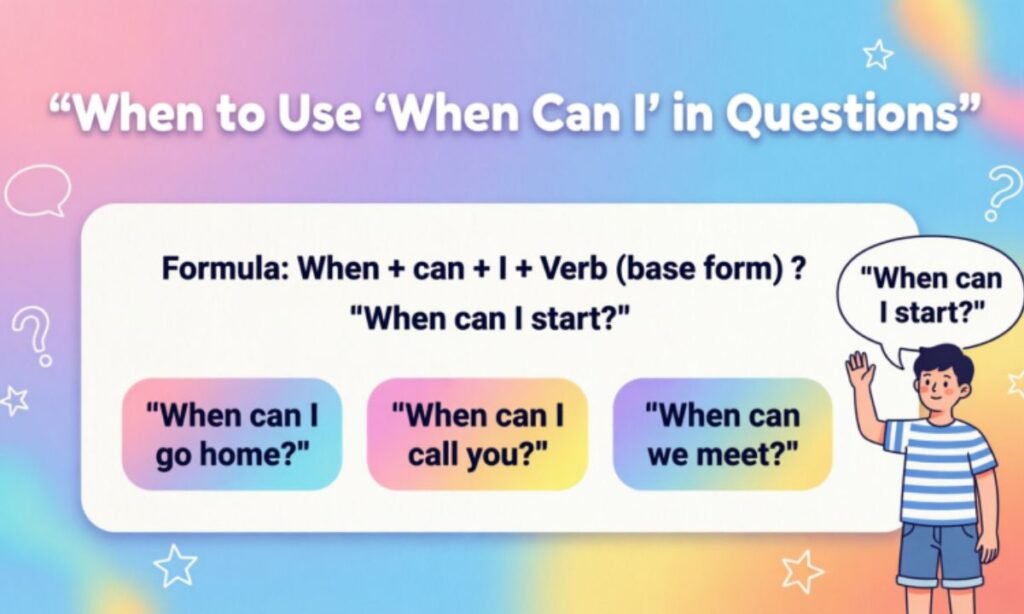
Use “when can I” any time you’re directly asking someone about scheduling, availability, or permission. It works in casual chats, professional emails, and formal requests alike.
Common situations include:
- Asking about appointment times
- Requesting permission to do something
- Checking on deadlines or availability
- Following up on a pending decision
Direct Questions That Require “When Can I”
Here are some natural examples of “when can I” in action:
- When can I schedule a call with you?
- When can I expect a reply?
- When can I pick up my order?
- When can I start the new project?
- When can I see the updated report?
Notice that each sentence could stand alone as a complete question, ending naturally with a question mark. That’s the clearest sign you need the inverted, question-style structure.
When to Use “When I Can” in Statements
“When I can” fits neatly inside statements, promises, or conditional ideas. It usually appears in the second half of a sentence, following a main clause.
Typical examples:
- I’ll call you when I can.
- She’ll finish the report when I can help her.
- We’ll meet again when I can free up my schedule.
- I promise to reply when I can.
- He said he would visit when I can arrange the time.
In each case, “when I can” behaves like a time clause attached to a main statement — it’s describing when something will happen, not asking about it.
Indirect Questions and Embedded Clauses
Interestingly, “when I can” also shows up inside indirect questions — questions that are wrapped inside a statement.
- Direct question: When can I leave?
- Indirect question: Please tell me when I can leave.
Notice how the direct question flips back to normal statement order once it’s embedded inside a larger sentence. This is a common area of confusion, so it’s worth remembering:
Indirect questions keep statement word order, even though they’re technically asking something.
Other examples of embedded clauses:
- I wonder when I can visit the office.
- Do you know when I can pick up the package?
- Let me know when I can submit the form.
How to Avoid Mixing Up Question and Statement Forms
Mixing up these two forms is one of the most common grammar mistakes in everyday English. Here’s a simple checklist to keep them straight:
- Ask yourself: is this a standalone question? If yes, use “when can I.”
- Check for a question mark at the end. A true direct question almost always needs one.
- Look for a main clause before it. If “when I can” follows a full sentence (like “I’ll call you…”), it’s a dependent clause, not a question.
- Read it out loud. Awkward rhythm is often a giveaway that the word order is wrong.
- Remember the golden rule: questions invert, statements don’t.
A quick trick many writers use: try removing everything before “when.” If what’s left makes sense as its own question, you need “when can I.” If it doesn’t work alone, “when I can” is correct.
Grammar Rules Behind “When Can I” vs “When I Can”
To really lock this rule in, it helps to understand the broader grammar system behind it — specifically how English forms questions and where modal verbs sit in a sentence.
Subject-Auxiliary Inversion in English Questions
English questions are built by swapping the position of the subject and the auxiliary (or modal) verb. This applies to yes/no questions and WH-questions (who, what, where, when, why, how) alike.
- Statement: You can leave.
- Question: Can you leave?
- WH-question: When can you leave?
This inversion isn’t optional in direct questions — it’s a core structural rule of English grammar. Skipping it (as in “When you can leave?”) creates a sentence that sounds foreign or unfinished to native ears.
Modal Verbs and Their Position in Sentences
Modal verbs like can, could, may, might, should, and would express ability, permission, or possibility. Their position depends entirely on sentence type:
| Sentence Type | Modal Position | Example |
| Statement | After the subject | I can help. |
| Question | Before the subject | Can I help? |
| Time clause (statement) | After the subject | …when I can help. |
| Time clause (question) | Before the subject | When can I help? |
This pattern stays consistent across all modal verbs, not just “can.” For example:
- When could I visit? / I’ll visit when I could.
- When should I call? / Let me know when I should call.
- When may I leave? / She’ll leave when she may.
Once you notice this pattern repeating across every modal verb, the “when can I vs when I can” confusion becomes far easier to resolve on the fly.
Real-Life Examples Side by Side
Seeing both forms in context often makes the rule click faster than any explanation. Here’s a practical side-by-side list:
- ❌ I will submit when can I. → ✅ I will submit when I can.
- ❌ When I can start? → ✅ When can I start?
- ✅ When can I get feedback on this draft?
- ✅ I’ll give you feedback when I can.
- ✅ When can I expect the shipment to arrive?
- ✅ The shipment will arrive when I can confirm the address.
Notice the pattern: whenever the sentence is asking something directly, the modal jumps ahead of the subject. Whenever it’s describing or explaining, the subject stays in front.
Common Mistakes to Watch Out For
Even confident English speakers slip up occasionally. Here are frequent errors and quick fixes:
- Mistake: “Please tell me when can I start.” Fix: “Please tell me when I can start.” (This is an indirect question, so it keeps statement order.)
- Mistake: “When I can see you?” Fix: “When can I see you?” (This is a direct question, so it needs inversion.)
- Mistake: Using “when can I” mid-sentence after a main clause. Fix: Switch to “when I can” once the sentence already has its own subject and verb earlier on.
Being aware of these patterns helps you self-correct in real time, whether you’re writing a quick text or a formal business email.
Why This Grammar Rule Matters for Clear Communication
It might seem like a small detail, but getting when can I or when I can right actually affects how professional and fluent your writing sounds. In formal settings — job applications, client emails, academic writing — small grammar slips can distract readers from your message.
Using the correct form:
- Makes your questions sound clear and confident
- Prevents miscommunication about deadlines or availability
- Signals strong command of English syntax
- Helps you sound natural in both spoken and written English
Whether you’re a native speaker brushing up on grammar or an English learner building fluency, mastering this distinction is a small investment that pays off in every conversation, email, and document you write.
Conclusion
The difference between when can I and when I can ultimately comes down to one simple test: are you asking, or are you telling? Direct questions call for inversion — “when can I” — while statements, promises, and indirect questions keep the natural subject-first order of “when I can.”
Once this pattern becomes second nature, you’ll stop second-guessing yourself and start writing (and speaking) with more clarity and confidence. Practice with your own sentences, apply the checklist above, and soon this once-tricky phrase will feel completely automatic.
Frequently Asked Questions
Is “when I can” grammatically correct?
Yes, it’s correct in statements and indirect questions, such as “I’ll help when I can.”
Is “when can I” always a question?
Yes, “when can I” functions as a direct question and typically ends with a question mark.
Can “when I can” ever start a sentence?
Yes, when it introduces a conditional idea, like “When I can, I’ll send the file.”
What’s the easiest way to remember the difference?
If the sentence stands alone as a question, use “when can I.” If it follows a main clause, use “when I can.”
Does this rule apply to other modal verbs too?
Yes, the same inversion pattern applies to could, should, would, may, and might.
Is “when I can start” correct as a question?
No, as a standalone question it should be “when can I start.”
Why does word order matter so much in English?
English relies on word order, rather than word endings, to show grammatical relationships and meaning.
Can “when I can” be used in formal writing?
Yes, it’s common and appropriate in formal statements, emails, and reports.

Henry Parker is an English language writer with several years of experience helping learners understand grammar and improve their writing. He enjoys breaking down confusing grammar rules into simple explanations and practical examples. Through his work at HexoWaves, Henry shares useful tips on grammar, vocabulary, sentence structure, and everyday English.