
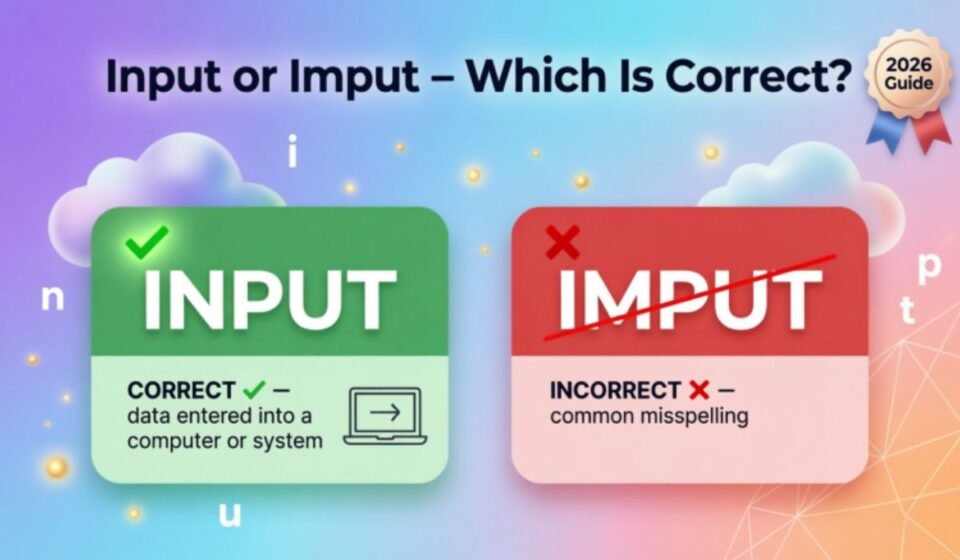
You typed a form, hit send, then paused. Was it “input” or “imput”? Your finger moved fast and now you’re not sure. Don’t worry, this mix-up trips up way more people than you’d think.
Here’s the short answer: input is the only correct spelling. “Imput” isn’t a real word in any English dictionary, not even a regional variant. It’s just a typing slip that happens to sound right when you say it out loud.
This guide breaks down why the mistake happens, how to use “input” the right way in real sentences, and a few tricks that’ll make sure you never second guess it again.
The Correct Spelling: “Input” (Not “Imput”)
Let’s settle this fast. Input means information, data, or ideas that go into something, whether that’s a computer, a project, or a conversation. It’s the word you want, every single time.
“Imput” has no meaning of its own. It’s not slang, it’s not old English, and it’s not a typo that turned into an accepted word over time (that does happen sometimes, but not here). Dictionaries like Merriam-Webster and Oxford list only one spelling, and it’s input.
Here’s a simple way to picture it. The word comes from “in” plus “put,” so you’re literally putting something in. If you keep that image in your head, the correct spelling almost writes itself.
● ✅ Please give me your input on this design.
● ❌ Please give me your imput on this design.
ALSO READ:-https://hexowaves.com/any-problem-or-any-problems/
Why Do People Misspell “Input” as “Imput”?
If “input” is so clearly correct, why does “imput” show up so often in emails, comments, and even resumes? The answer comes down to how your mouth actually works when you speak.
Say “input” out loud, slowly. Now say it fast. Notice something? The “n” sound starts to blend into an “m” sound because your lips are already getting ready for the “p” that follows. Linguists call this nasal assimilation, and it’s a completely normal part of how humans speak.
Your brain hears “imput,” so when you’re typing fast or texting without thinking twice, your fingers sometimes follow what your ears heard instead of what’s actually spelled correctly. It’s not about being careless. It’s just how speech and spelling can drift apart.
A few other reasons this error sticks around:
● Autocorrect gaps: not every keyboard catches it
● Speed typing: fast typists skip the double check
● Similar keys: “m” and “n” sit close together on a keyboard
● Non-native speakers: some accents naturally soften the “n” sound before a “p”
None of these reasons make “imput” correct. They just explain why smart, careful people still slip up now and then.
Input vs Imput
Side by side, the difference is pretty stark once you see it written out. One word exists in the dictionary. The other doesn’t, no matter how many times you’ve seen it in a comment section.
| Feature | Input | Imput |
| Dictionary status | Valid word | Not a word |
| Meaning | Data, information, or contribution entered into a system | None |
| Part of speech | Noun and verb | N/A |
| Used in professional writing | Yes, always | Never |
| Common in casual typing errors | No | Yes |
If you remember nothing else from this article, remember this: whenever you’re unsure, input is the safe, correct, and only real choice.
How to Use “Input” Correctly
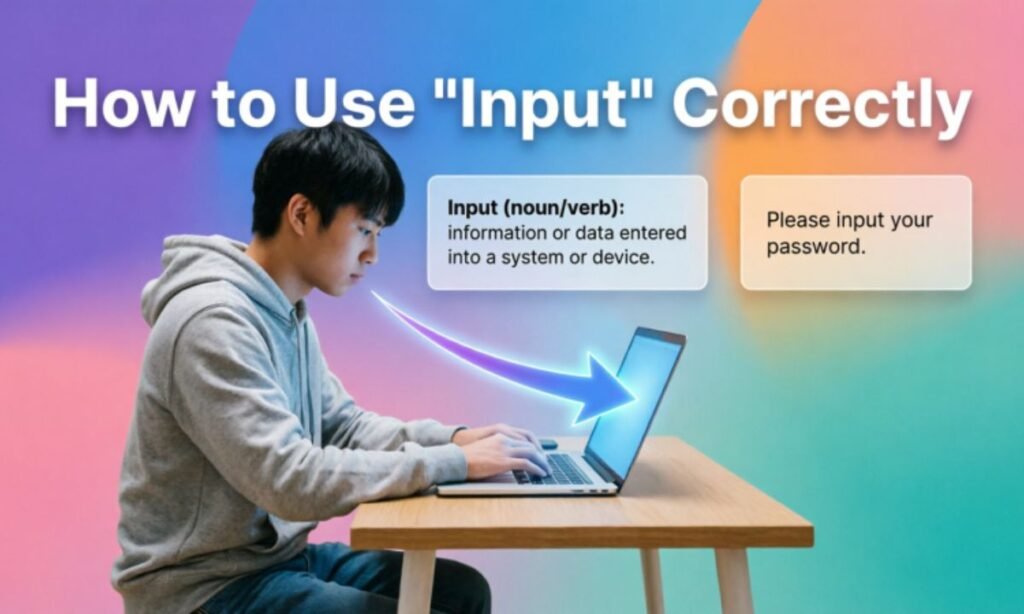
Once you’ve locked in the spelling, the next step is using input the right way in a sentence. It works as both a noun and a verb, which is part of why it shows up so often in daily writing.
Input as a Noun
As a noun, input refers to something you contribute or something a system receives. Think feedback, data, ideas, or effort.
● We need your input before finalizing the budget.
● The sensor collects input from the surrounding environment.
● Her input made the whole presentation stronger.
You’ll notice it’s often paired with words like “your,” “team,” or “user,” since input almost always comes from a source, whether that’s a person or a machine.
Input as a Verb
As a verb, input describes the act of entering data or information somewhere, usually into a system, form, or device.
● Please input your details on the next screen.
● I input the numbers wrong and had to redo the report.
● Employees input their hours at the end of every shift.
One quick note on tense: both “input” and “inputted” are used as the past tense, but “input” stays more common in American English, especially in tech and business writing. Either way, “imput” and “imputted” are never correct, so cross those off your list entirely.
Common Phrases and Collocations with “Input”
Input shows up in a bunch of everyday phrases across work, tech, and casual conversation. Learning a few of these makes the word feel natural instead of stiff.
● User input – information entered by a person using software or a form
● Data input – raw information fed into a system for processing
● Creative input – ideas or artistic contribution to a project
● Input field – the box on a form where you type information
● Team input – feedback or ideas gathered from a group
● Sensory input – information the brain receives from the senses
● Input device – hardware like a keyboard or mouse used to enter data
● Public input – feedback gathered from a community, often during planning decisions
Notice a pattern? Almost every phrase pairs input with a word that tells you where it’s coming from or where it’s going. That’s the whole job of the word: it moves information from one place to another.
Input vs Imput – Detailed Comparison
Let’s go a level deeper here, since some readers want more than a quick yes-or-no answer. This table breaks the two words down across a few categories that matter for everyday and professional writing.
| Category | Input | Imput |
| Origin | Old English “in” + “put,” first recorded in the late 1800s | No linguistic origin, purely a spoken error |
| Grammar role | Functions as noun and verb | Has no grammatical function |
| Formal writing | Standard and expected | Flags as an error in every style guide |
| Spell checkers | Recognized instantly | Underlined red, flagged as misspelled |
| Regional variation | Same spelling in US, UK, Australian English | Not accepted anywhere |
| Common contexts | Tech, business, education, everyday speech | Only appears in typos and rushed messages |
If you’re writing a report, an email to a client, or even a text to a friend, sticking with input protects your credibility. Spelling mistakes are small things, but they add up in how people read your writing.
Where Does the Word “Input” Come From?
A little history helps this stick even better. “Input” isn’t a modern tech word, even though it feels closely tied to computers and forms today.
The word first appeared in English writing back in the late 1800s, long before anyone had a laptop. Early economists and engineers used it to describe resources or effort going into a process, kind of like fuel going into an engine.
When computers became common in the mid-1900s, “input” got adopted by the tech world almost immediately, since it fit perfectly for describing data entering a machine. That’s why today it feels just as at home in a coding class as it does in a team meeting.
Input in Different Fields
Here’s something fun: input doesn’t mean quite the same thing depending on where you hear it. The core idea stays the same (something going in), but the flavor changes by field.
● Technology: data entered into software, apps, or devices (keyboard input, voice input)
● Business: feedback or ideas contributed during decisions (stakeholder input, client input)
● Education: information a student receives before producing output, like reading before writing an essay
● Science: energy or material that enters a system (input vs output in chemistry or physics)
● Everyday life: your opinion on something casual, like picking a restaurant for dinner
Once you see how flexible the word is, it makes sense why it shows up so often across writing of every kind.
Quick Tips to Remember the Correct Spelling
Want a foolproof way to never write “imput” again? Try one (or all) of these tricks.
1. Break it down: “in” + “put” = input. Say each part slowly.
2. Picture the action: imagine physically putting something into a box.
3. Turn on spell check: most tools will catch “imput” instantly if it slips through.
4. Read it out loud slowly: speaking it at a normal pace, not rushed, helps your ear catch the “n” sound.
5. Practice a phrase: repeat “input your data” a few times until it feels automatic.
6. Compare with “into”: you’d never write “imto,” so don’t write “imput” either.
Small habits like these build muscle memory fast, and within a week or two, you won’t even have to think about it anymore. 🙂
FAQs
Is “imput” ever correct?
No, “imput” is never correct in any English dictionary or style guide.
Is “input” a noun or a verb?
It works as both, depending on the sentence.
What’s the past tense of “input”?
Both “input” and “inputted” are used, though “input” is more common in American English.
Why do people say “imput” out loud?
It’s a natural speech pattern called nasal assimilation, where “n” shifts toward an “m” sound before “p.”
Does British English spell it differently?
No, “input” is the standard spelling in British, American, and Australian English.
Can I use “input” in formal writing?
Yes, it’s completely standard for reports, emails, and academic work.
Conclusion
At the end of the day, this one’s easy once it clicks. Input is correct, always, in every context, from casual texts to formal reports. “Imput” is simply a spoken habit that snuck into typing, not a real alternative.
Keep the “in” plus “put” trick in your back pocket, lean on spell check when you’re rushing, and you’ll never have to pause over this one again. Small fixes like this add up to writing that reads as sharp and trustworthy every time.

Henry Parker is an English language writer with several years of experience helping learners understand grammar and improve their writing. He enjoys breaking down confusing grammar rules into simple explanations and practical examples. Through his work at HexoWaves, Henry shares useful tips on grammar, vocabulary, sentence structure, and everyday English.