
Any Problem or Any Problems – Which Is Correct? 2026
Have you ever typed out a sentence, stared at it for a second, and wondered whether it should say “any problem” or “any problems”? You’re not alone. This tiny grammar question trips up native speakers and English learners alike, mostly because both versions sound fine depending on how you say them out loud.
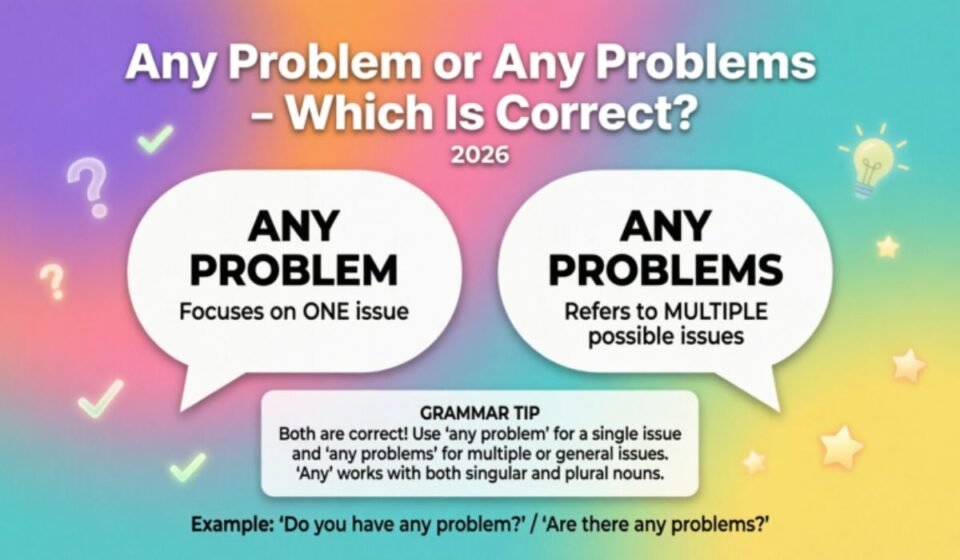
Here’s the short answer before we go any further: both “any problem” and “any problems” are grammatically correct. The real difference lies in context, tone, and how many issues you’re actually referring to. In this guide, we’ll break down exactly when to use each form, look at the grammar rules behind them, walk through real examples, and clear up the common mistakes people make with any problem or any problems in everyday writing and speech.
By the end, you’ll never have to second-guess this phrase again.
What Does “Any Problem” Mean?
“Any problem” uses the singular noun “problem.” It typically refers to one specific, unspecified issue rather than several. You’ll usually see it in formal writing, technical instructions, legal language, or hypothetical statements where the focus is on a single potential concern.
For example:
- “If you experience any problem with the device, contact our support team.”
- “Is there any problem with this proposal?”
In both cases, the speaker isn’t necessarily expecting multiple issues — they’re asking about the possibility of one general problem existing. This is why “any problem” often feels a bit more formal, precise, and buttoned-up compared to its plural counterpart.
Grammatically, “problem” is a countable noun, so it can take the singular form when paired with “any.” This construction is especially common in written English, customer service scripts, and professional emails where a neutral, controlled tone matters.
What Does “Any Problems” Mean?
“Any problems” uses the plural noun “problems,” and it implies the possibility of multiple issues — or simply a more open-ended, conversational way of asking about trouble in general. This version dominates everyday speech because it feels natural, casual, and welcoming.
Examples include:
- “Are there any problems I should know about?”
- “Let me know if you run into any problems.”
Notice how these sentences don’t necessarily mean there are multiple problems — they’re just phrased in a way that sounds more relaxed and commonly used in spoken English. Many native speakers default to “any problems” simply because it rolls off the tongue more easily, even when only one issue might come up.
In short: “any problems” leans casual and broad, while “any problem” leans formal and specific. Neither is wrong — they just serve different purposes.
ALSO READ:https://hexowaves.com/input-or-imput/
Any Problem or Any Problems Grammar Rules Explained
To really understand why both phrases work, it helps to look at how the word “any” functions in English grammar. “Any” is classified as a determiner — a word that introduces a noun and gives context about quantity, without specifying an exact number.
“Any” as a Flexible Determiner
Unlike words such as “a” or “one,” which strictly signal singular, “any” is flexible. It can pair with singular countable nouns, plural countable nouns, and even uncountable nouns. That flexibility is precisely why “any problem or any problems” both pass as grammatically sound — “any” simply doesn’t force a single number choice the way other determiners do.
“Problem” Is a Countable Noun
“Problem” behaves like typical countable nouns such as “book,” “idea,” or “task.” You can have one problem, two problems, or a dozen problems. Because it’s countable, it naturally takes both a singular and plural form, and “any” is happy to attach to either.
Subject-Verb Agreement Still Matters
Even though both forms are acceptable, the surrounding sentence must agree in number. This is where many writers slip up.
| Sentence Type | Singular Form | Plural Form |
| Question | Is there any problem? | Are there any problems? |
| Conditional | If there is any problem… | If there are any problems… |
| Statement | You don’t have any problem here. | You don’t have any problems here. |
Mixing these up — for example, writing “Is there any problems?” — creates a subject-verb agreement error. The verb always needs to match the noun it’s paired with, singular with singular, plural with plural.
When to Use “Any Problem” vs “Any Problems”
Choosing between any problem or any problems usually comes down to three factors: formality, number of issues implied, and natural sentence flow. Here’s a quick breakdown to help you decide in any situation.
| Situation | Recommended Form | Why |
| Formal or legal writing | Any problem | Sounds precise, controlled, and professional |
| Casual conversation | Any problems | Feels natural and matches everyday speech |
| Technical support scripts | Any problem | Focuses on a single possible fault |
| Customer service check-ins | Any problems | Open-ended, invites multiple responses |
| Academic or business writing | Any problem | Keeps tone formal and focused |
| Texting or informal emails | Any problems | Matches relaxed, conversational tone |
| General troubleshooting questions | Either | Both work; plural is more common |
As a simple rule of thumb: if you’re asking about one clear, singular issue in a formal setting, go with “any problem.” If you’re speaking casually or expecting the possibility of several concerns, “any problems” is usually the safer, more natural-sounding choice.
It also helps to think about your audience. Business reports, contracts, and instruction manuals tend to favor the singular form because it sounds more deliberate and exact. Meanwhile, everyday emails, chat messages, and spoken English lean toward the plural because it feels friendlier and less rigid.
Common Mistakes with “Any Problem” and “Any Problems”
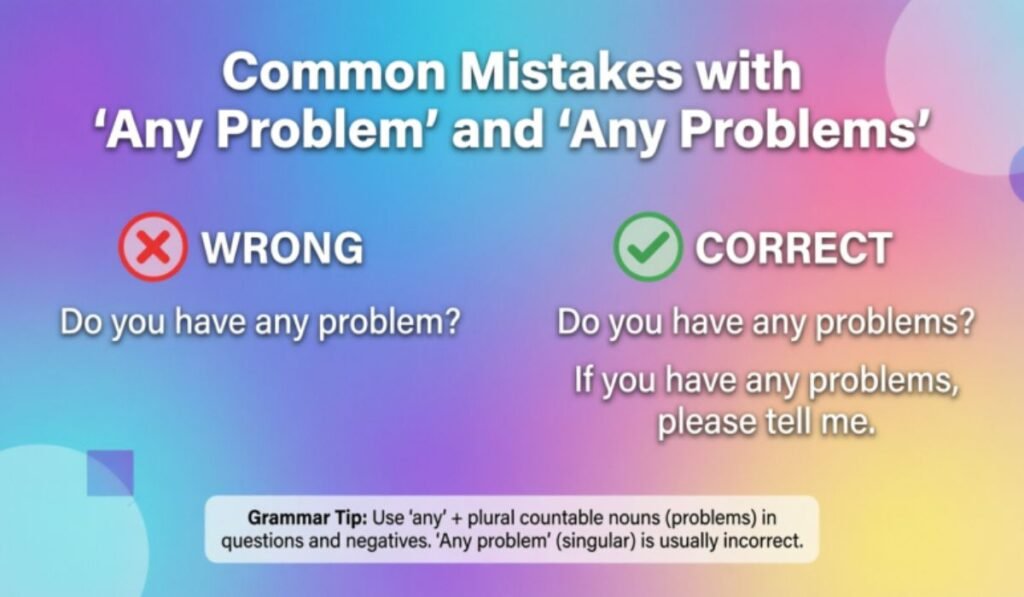
Even confident writers stumble over this phrase from time to time. Here are the most frequent errors people make, along with quick fixes.
- Mismatched verb and noun number Wrong: “Is there any problems with the order?” Right: “Are there any problems with the order?” or “Is there any problem with the order?”
- Adding an unnecessary article before “any” Wrong: “Do you have a any problem?” Right: “Do you have any problem?” — “any” already functions as the determiner, so no extra article is needed.
- Using the singular form where the plural sounds more idiomatic Wrong (awkward): “If there is any problem, contact us.” Better: “If there are any problems, contact us.” — This version sounds more natural in customer-facing writing.
- Confusing “problem” with uncountable nouns Some writers mistakenly treat “problem” like an uncountable noun (such as “advice” or “information”), forgetting that it needs a singular or plural form depending on context.
- Overusing the plural in formal writing While “any problems” is common in speech, using it excessively in formal documents can sound slightly less polished than the singular alternative.
- Forgetting context clues Choosing a form without considering whether you mean one issue or several can make your sentence sound vague or mismatched with the rest of your message.
Avoiding these small slip-ups instantly makes your writing sound more polished, whether you’re drafting a business email or answering a customer’s question.
Examples of “Any Problem or Any Problems” in Sentences
Seeing the phrase in action makes the distinction much clearer. Below are practical examples across different tones and settings.
Formal / Professional Examples
- “Please inform us immediately if you notice any problem with the shipment.”
- “The committee found no evidence of any problem with the proposed budget.”
- “Contact your supervisor should any problem arise during the audit.”
Casual / Conversational Examples
- “Hey, did you have any problems finding the place?”
- “Let me know if you have any problems setting up the app.”
- “No worries, I didn’t run into any problems at all.”
Customer Support Examples
- “Are you experiencing any problems with your account today?”
- “If you face any problem during checkout, our team is here to help.”
- “We want to make sure you don’t have any problems with your new device.”
Question Form Examples
| Question | Form Used | Context |
| Is there any problem with my application? | Singular | Formal inquiry |
| Are there any problems I should fix first? | Plural | Casual/technical |
| Do you see any problem with this plan? | Singular | Direct, focused question |
| Did you face any problems during the trip? | Plural | Everyday conversation |
These examples show that both any problem and any problems can appear naturally across different writing styles — the trick is simply matching the form to your tone and the number of issues you’re addressing.
Why This Grammar Point Confuses So Many People
English learners and even native speakers get tripped up here because “any” doesn’t follow the same strict rules as other determiners like “a,” “an,” or “one.” Since “any” can pair with both singular and plural countable nouns, our brains sometimes default to whichever version we hear more often — which is usually “any problems,” since it’s more common in spoken English.
Another reason for the confusion is that both versions genuinely sound correct in casual speech. Unless you’re paying close attention to subject-verb agreement or formal writing conventions, it’s easy to use them interchangeably without noticing a real difference. That’s completely normal — English is full of these small flexible spots where more than one form is acceptable.
The good news is that once you understand the underlying grammar rule — that “any” simply reflects the number of the noun that follows it — the rest becomes intuitive. You’ll start noticing which version fits naturally based on context, without having to think twice.
Quick Recap: Any Problem or Any Problems
- Both any problem and any problems are grammatically correct.
- “Any problem” is singular, more formal, and typically refers to one general issue.
- “Any problems” is plural, more casual, and often implies multiple possible issues.
- Subject-verb agreement must match: “is” pairs with “problem,” while “are” pairs with “problems.”
- Context and tone — not strict grammar rules — usually decide which version fits best.
FAQs About Any Problem or Any Problems
Is “any problem” or “any problems” grammatically correct? Both are correct. The choice depends on whether you’re referring to one issue or several, and on how formal your writing needs to be.
Which one is more commonly used in everyday speech? “Any problems” is more common in casual conversation because it sounds natural and open-ended.
Can I use “any problem” in a business email? Yes. “Any problem” works well in formal or professional writing since it sounds precise and controlled.
Is “Is there any problems?” correct? No. This mismatches a singular verb with a plural noun. Use either “Is there any problem?” or “Are there any problems?”
Does “any” always require a plural noun? No. “Any” can pair with singular, plural, or uncountable nouns depending on context.
What’s the safest choice if I’m unsure which to use? When in doubt, “any problems” is generally safer for everyday writing, while “any problem” suits formal or single-issue contexts.
Do native speakers notice the difference? Most native speakers use both interchangeably without much thought, though careful writers do adjust based on formality and number.
Conclusion
At the end of the day, the debate over any problem or any problems isn’t really about right versus wrong — it’s about matching your words to your meaning and tone. Use “any problem” when you’re referring to a single, general issue, especially in formal or written communication. Reach for “any problems” when you’re speaking casually or acknowledging the possibility of multiple concerns.
Once you understand how “any” works as a flexible determiner and remember to keep your subject and verb in agreement, choosing between these two phrases becomes second nature. Whether you’re writing a customer support message, a business report, or just checking in with a friend, you’ll now know exactly which form fits — and why.

Henry Parker is an English language writer with several years of experience helping learners understand grammar and improve their writing. He enjoys breaking down confusing grammar rules into simple explanations and practical examples. Through his work at HexoWaves, Henry shares useful tips on grammar, vocabulary, sentence structure, and everyday English.