
Have you ever paused mid-sentence, unsure whether to type “input” or “imput”? You’re not alone. This tiny spelling mix-up trips up students, professionals, and even experienced writers every single day. The good news is that the answer is simple, and once you understand why the confusion happens, you’ll never make the mistake again.
In this guide, you’ll learn the correct spelling, the reason so many people get it wrong, real usage examples, and easy memory tricks that make the right choice automatic. By the end, “input or imput” won’t be a question you ever have to ask again.
The Correct Spelling: “Input” (Not “Imput”)
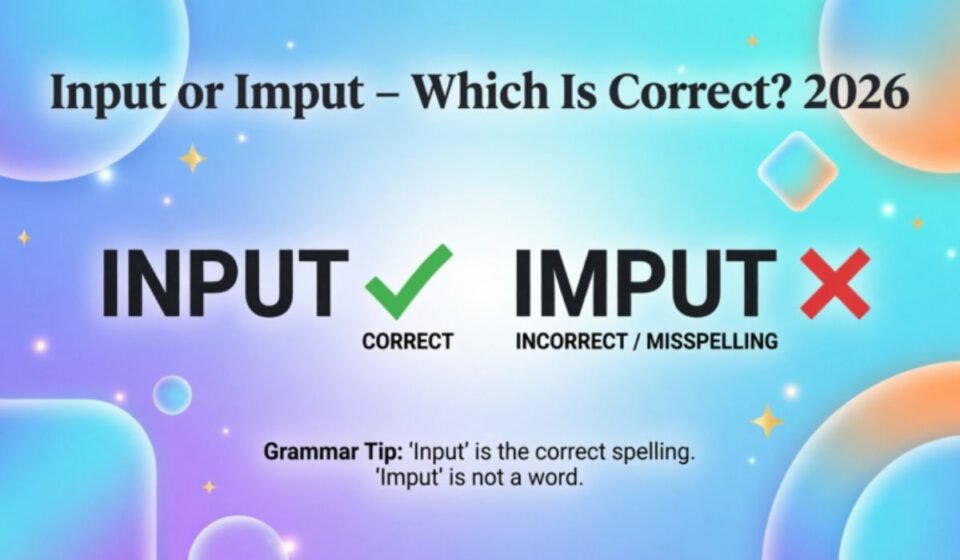
Let’s clear this up right away: “input” is the only correct spelling in English. “Imput” is a common misspelling that does not appear in any recognized dictionary, including Merriam-Webster and Oxford Languages.
The word input is built from two familiar parts:
- In – meaning “into” or “inside”
- Put – meaning “to place”
Put them together, and input literally means “to put something in.” That’s exactly why input is used to describe data entered into a computer, ideas contributed to a discussion, or feedback shared during a project.
“Imput,” on the other hand, has no history, no dictionary entry, and no accepted use in formal or casual writing. It’s simply a slip of the tongue (or the keyboard) that got typed instead of the real word.
| Spelling | Correct? | Found in Dictionaries? | Common Use |
| Input | ✅ Yes | Yes | Standard English word |
| Imput | ❌ No | No | Misspelling of “input” |
If you remember nothing else from this article, remember this: whenever you’re debating input or imput, the answer is always input.
ALSO READ:https://hexowaves.com/thats-vs-thats/
Why Do People Misspell “Input” as “Imput”?
If input is so clearly correct, why does “imput” show up so often in emails, social media posts, and even professional documents? The answer comes down to how our mouths and brains handle sound.
1. Sound Blending (Assimilation)
When you say “input” quickly, your tongue and lips naturally adjust to make the word easier to pronounce. The “n” sound sits close to the “p” sound that follows it, and your mouth often shortcuts this by blending them into an “m” sound. Linguists call this phenomenon assimilation, and it’s the same reason words like “impossible” and “immature” use “m” before “p” or “m.”
Because input doesn’t follow that same im- pattern, but sounds like it does when spoken fast, people end up spelling what they hear rather than what’s actually correct.
2. Keyboard Proximity
On a standard keyboard, the letters “m” and “n” sit right next to each other. Fast typists, especially on mobile devices, often hit the wrong key without noticing, turning input into imput in a split second.
3. Pattern Confusion with “Im-” Words
English has plenty of words that start with “im-,” such as:
- Impossible
- Impure
- Immature
- Imperfect
Because these words are so common, some writers assume input might follow the same rule. It doesn’t. The “im-” prefix typically means “not” or “into,” but input isn’t built from that prefix at all — it’s simply “in” plus “put.”
4. Autocorrect and Spell-Check Gaps
Not every spell-checker catches this error, especially older or basic text tools. Since “imput” isn’t a real word but can still slip past weaker grammar tools, the mistake spreads and starts to look more familiar than it should.
Input vs Imput
Here’s a side-by-side look at how these two words compare when you break them down.
| Feature | Input | Imput |
| Correct spelling | Yes | No |
| Dictionary entry | Yes (Merriam-Webster, Oxford) | No |
| Word origin | “in” + “put” | Not a real word |
| Part of speech | Noun and verb | None |
| Used in professional writing | Yes | Never |
| Common cause | N/A | Mispronunciation, typos |
The takeaway is straightforward: input is a legitimate, dictionary-approved word with a long history in the English language, while imput is nothing more than a spelling slip that spread through casual speech and fast typing.
How to Use “Input” Correctly
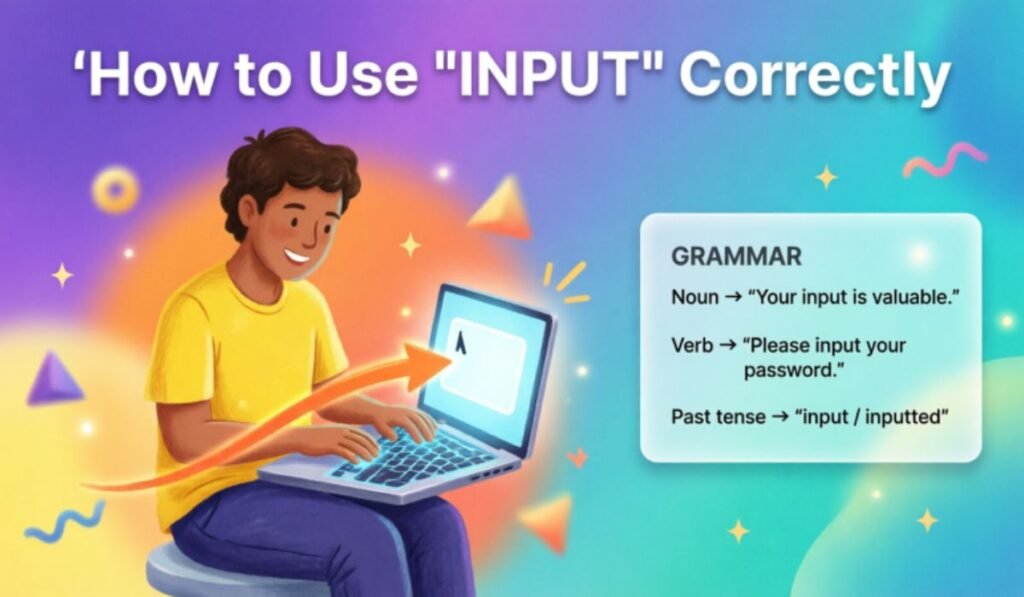
Input is a flexible word because it works as both a noun and a verb. Understanding each use will help you apply it correctly in any sentence.
Input as a Noun
As a noun, input refers to something that is contributed, entered, or provided — this could be data, ideas, effort, or feedback.
Examples:
- “We need your input before finalizing the report.”
- “The software requires manual input from the user.”
- “Employee input shaped the new company policy.”
In this form, input often pairs with words like “provide,” “give,” “request,” or “collect.”
Input as a Verb
As a verb, input means to enter or feed information into a system, typically a computer, database, or device.
Examples:
- “Please input your username and password.”
- “She input the sales figures into the spreadsheet.”
- “Researchers input the data before running the analysis.”
A common question here is about the past tense. Both “input” and “inputted” are grammatically accepted, but usage varies:
- Input – more common in American English and technical writing (“I input the numbers yesterday.”)
- Inputted – more traditional and still used in British English (“She inputted the details into the form.”)
Either version is correct, but “input” tends to sound more modern and streamlined, especially in tech and business contexts.
Common Phrases and Collocations with “Input”
Input shows up constantly across business, education, and technology. Here are some of the most frequent phrases you’ll come across:
- Employee input
- Customer input
- User input
- Data input
- Manual input
- Valuable input
- Input field
- Input device
- Provide input
- Request input
- Collect input
- Input and output
These collocations are worth learning because they show up in professional emails, technical manuals, academic writing, and everyday conversation. Recognizing them helps reinforce the correct spelling every time you use the word.
Input vs Imput – Detailed Comparison
To fully settle the input or imput debate, let’s break the comparison down even further, covering origin, grammar behavior, and real-world usage.
| Category | Input | Imput |
| Meaning | Data, ideas, or effort put into something | No meaning — not a real word |
| Grammar role | Noun and verb | Not applicable |
| Formal writing | Fully accepted | Never accepted |
| Academic use | Common in research, reports, and studies | Not used |
| Technology context | Standard term (input device, input field) | Not used |
| Regional variation | Same in US and UK English | Not a recognized variant anywhere |
| Root words | “in” + “put” | No established root |
Notice that input isn’t just correct — it’s deeply embedded in academic, technical, and professional vocabulary. Imput, by contrast, has no legitimate role anywhere in the English language. It’s purely the result of mispronunciation and quick typing, not an alternate or regional spelling.
Quick Tips to Remember the Correct Spelling
If you still find yourself hesitating between input or imput, these simple tricks will help make the correct spelling stick for good.
- Break it down. Remember that input = “in” + “put.” You are putting something “in,” not “im.”
- Compare it to “into.” You wouldn’t write “imto” instead of “into,” so don’t write “imput” instead of “input.”
- Say it slowly. Pronouncing the word as two clear syllables — in-put — helps your brain match the sound to the correct spelling.
- Use a memory trick. Picture data being typed “in” to a computer. The visual of information going “in” reinforces the “n” spelling.
- Practice with repetition. Typing “input” a few times in a row builds muscle memory, especially if you tend to type quickly.
- Trust the dictionary. If you’re ever unsure, a quick dictionary check will confirm that input is correct and imput is not.
With these habits, choosing between input or imput becomes second nature rather than a guessing game.
Why This Small Spelling Mistake Matters
You might think a single misspelled word isn’t a big deal, but in professional and academic writing, small errors add up. Using “imput” instead of “input” can:
- Make your writing look rushed or unedited
- Reduce credibility in emails, reports, and resumes
- Confuse readers who expect standard English spelling
- Signal a lack of attention to detail in formal communication
On the other hand, consistently using input — the correct, dictionary-approved spelling — helps your writing come across as polished, professional, and easy to trust. Whether you’re drafting a business proposal, a school assignment, or a quick text message, the extra second it takes to double-check this word is always worth it.
Frequently Asked Questions
Is “imput” ever correct in English? No. “Imput” is never correct. It is always a misspelling of “input,” regardless of context or region.
What does “input” mean? Input refers to data, ideas, effort, or information that is entered or contributed into a system, discussion, or process.
Can “input” be used as a verb? Yes. As a verb, input means to enter data or information into a system, such as a computer or form.
What is the past tense of “input”? Both “input” and “inputted” are accepted. “Input” is more common in American English, while “inputted” is more traditional in British English.
Why do people type “imput” instead of “input”? It usually happens due to fast pronunciation blending the “n” and “p” sounds, keyboard typos, or confusion with words that genuinely start with “im-.”
Is “input” a noun or a verb? Input works as both. As a noun, it means information or contribution; as a verb, it means to enter data into a system.
Does British English spell it differently? No. Both American and British English use the same spelling: input. Only the preferred past tense form (“input” vs. “inputted”) tends to vary slightly.
Is there a plural form of “input”? Yes. The plural is “inputs,” as in “The project required multiple data inputs.”
Conclusion
When it comes to input or imput, there’s no real debate — input is the only correct spelling, backed by dictionaries, grammar guides, and everyday professional use. “Imput” is simply a common misspelling caused by how the word sounds when spoken quickly, plus the occasional keyboard slip.
Now that you understand the origin of input, how to use it as both a noun and a verb, and the simple tricks to remember its spelling, you’re fully equipped to use it correctly every time. The next time you catch yourself typing imput, pause, remember that input means “in” plus “put,” and let your writing reflect the polish and precision it deserves.

Henry Parker is an English language writer with several years of experience helping learners understand grammar and improve their writing. He enjoys breaking down confusing grammar rules into simple explanations and practical examples. Through his work at HexoWaves, Henry shares useful tips on grammar, vocabulary, sentence structure, and everyday English.