
Have you ever typed “ofcourse” and wondered if it was actually correct? You’re not alone. This tiny spacing mistake is surprisingly common, especially when people type quickly. The correct of course spelling uses two separate words. “Ofcourse” may look natural, but it isn’t the standard form in English. So, if you’re writing an email, school assignment, blog post, or professional message, knowing the difference can save you from an easy mistake.
The good news is that the rule is very easy to remember. “Of course” is a common phrase used to show agreement, certainty, or something obvious. You can use it in everyday conversations as well as formal writing. Just remember one simple pattern: of + course = of course. Once you spot the space, you’ll never need to second-guess this common spelling again.
What Does “Of Course” Mean?
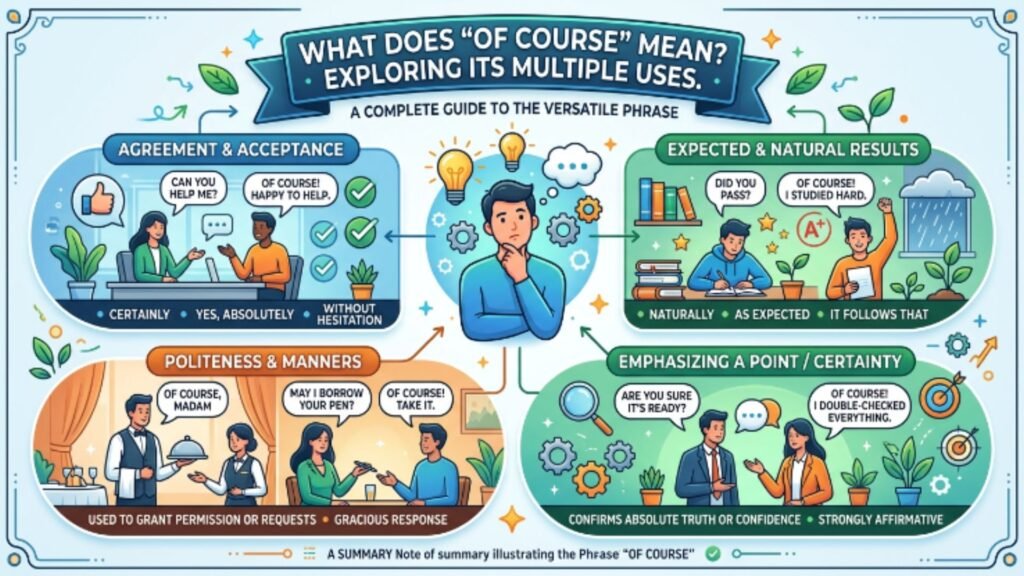
Of course is a common two-word phrase in Standard English. It usually shows agreement, certainty, or something that seems obvious.
The phrase can also add politeness to a reply. Its exact meaning depends on the situation and tone.
In everyday speech, of course can mean “certainly,” “naturally,” or “definitely.” It often tells someone that the answer feels obvious.
For example:
- “Can you help me?”
- “Of course!”
Here, the speaker agrees willingly and politely.
The phrase also works in formal writing, academic writing, and professional writing. It isn’t limited to casual conversation.
If you’re checking the of course spelling, remember one simple rule: write of course as two separate words.
Correct Meaning of “Of Course”
Of course can express several closely related ideas. The meaning changes slightly with context.
It may show:
- Agreement: “Of course, you can come with us.”
- Certainty: “Of course she knows the answer.”
- Obviousness: “Of course the sun rises in the east.”
- Politeness: “Of course, I’d be happy to help.”
You can often replace it with naturally, certainly, definitely, or without question.
Grammatically, of course works as an adverbial expression. It can modify a statement by adding certainty or emphasis.
The phrase contains a preposition, “of,” followed by the noun, “course.” Together, they form an idiomatic expression with a meaning that goes beyond the individual words.
That makes of course more than a simple word combination. It functions naturally as a two-word phrase.
Examples of “Of Course” in Sentences
Seeing the phrase in different situations makes the of course spelling easier to remember.
At the beginning of a sentence:
- “Of course, you can use my phone.”
- “Of course, we remember your birthday.”
In the middle of a sentence:
- “You can, of course, call me later.”
- “She was, of course, ready to help.”
As a complete response/reply:
- “Can I sit here?”
- “Of course!”
Here’s another everyday conversation:
Alex: “Will you send me the details?”
Sam: “Of course. I’ll send them tonight.”
In each example, of course stays separated.
You may see ofcourse in texts or social media posts. However, that form represents a spacing mistake in Standard English.
So whether you’re writing an email, assignment, caption, or business message, keep the two words apart.
Is “Ofcourse” a Real Word?
Ofcourse isn’t the standard spelling of the English phrase. Standard dictionaries recognize of course as the correct form.
For dictionary confirmation, resources such as the Merriam-Webster Dictionary use the two-word form.
The confusion usually comes from how the phrase sounds when people speak quickly. Natural pronunciation can make the two words seem connected.
Still, spoken sound doesn’t determine written spacing.
Think about other familiar examples:
- A lot, not alot
- At least, not atleast
- In fact, not infact
- As well, not aswell
These expressions contain separate words even when they sound closely connected.
Likewise, of course remains a two-word phrase.
You might encounter ofcourse in informal writing, messages, or online comments. Seeing it frequently doesn’t make it correct in formal or professional writing.
For your of course spelling, use the simple rule: write “of course,” never “ofcourse,” in Standard English.
Why Do People Write “Ofcourse” Instead of “Of Course”?
The mistake usually starts with sound and habit. When people say of course quickly, the words can blend together.
That natural pronunciation makes ofcourse look reasonable when someone types it.
Mobile typing adds another layer. People often write quickly on phones without checking every word.
Social media posts and casual messages also encourage shortcuts. Readers may understand the meaning even when the spacing isn’t correct.
Over time, repeated exposure can make the incorrect form look familiar.
However, familiarity doesn’t change the grammar rule.
In formal writing, academic writing, professional writing, and polished SEO content, use of course with a space.
A quick spellcheck can also catch the error. Tools such as Grammarly can help identify common writing mistakes during editing.
Common Reasons Behind the Mistake
Several everyday habits can lead people toward ofcourse.
1. Fast pronunciation
When people speak quickly, the phrase may sound almost like one unit. Non-native English speakers can find this especially confusing.
2. Mobile typing
Typing on a small screen encourages speed. Autocorrect may not always catch a spacing mistake.
3. Informal writing
People often overlook grammar in texts, comments, and social media posts. Once an incorrect form becomes common online, it can feel normal.
4. Confusion with compound words
English has many genuine compound words, such as:
- Notebook
- Football
- Sunflower
These words combine into one accepted spelling. Of course, however, isn’t a compound word.
5. Familiarity with other mistakes
People may already see alot, atleast, infact, or aswell online. That pattern can make ofcourse seem acceptable.
A simple check solves the problem:
Correct: “Of course, I’ll help.”
Incorrect: “Ofcourse, I’ll help.”
The key isn’t complicated. For correct of course spelling, keep the two words separate.
Of Course vs Ofcourse: Key Difference
The main difference is simple: of course is correct, while ofcourse is incorrect in Standard English.
Of course contains two separate words. It works as an adverbial expression that can show agreement, certainty, obviousness, or politeness.
Ofcourse joins those words together without a valid grammar rule. It usually appears because people type the phrase as quickly as they say it.
| Form | Correct? | Typical use |
| Of course | ✅ Yes | Formal and informal writing |
| Ofcourse | ❌ No | Common spacing mistake |
Consider this quick conversation:
Mia: “Can you help me with this?”
Jake: “Of course!”
The same rule applies to emails, assignments, blog posts, and social media posts.
Your of course spelling should always include a space. Although online writing may contain “ofcourse,” frequent use doesn’t make it a recognized compound word.
Quick Rule to Remember
Here’s the easiest rule: if you mean “certainly” or “naturally,” write “of course.”
Think of of course as a two-word phrase, not a compound word.
Compare it with other common expressions:
- A lot, not alot
- At least, not atleast
- In fact, not infact
- As well, not aswell
- Of course, not ofcourse
Genuine compound words work differently. For example, notebook, football, and sunflower have accepted one-word spellings.
A useful memory trick is to picture of and course as two separate building blocks. Keep them apart whenever you write the phrase.
If you’re unsure during mobile typing, pause for a quick spelling check.
Correct: “Of course, that’s fine.”
Incorrect: “Ofcourse, that’s fine.”
That small space keeps your writing clear and correct.
How to Use “Of Course” Correctly in Sentences
Of course can appear in several positions within a sentence. Its placement often changes the rhythm rather than its basic meaning.
You can use it to express agreement, certainty, or something obvious.
For example:
- “Of course, I’ll call you.”
- “You can, of course, join us.”
- “Of course!”
The phrase works in formal writing as well as informal writing. You’ll also see it in academic writing, professional writing, emails, and casual conversation.
The important point is consistency. Don’t switch to ofcourse simply because the phrase sounds connected when spoken.
Good sentence placement also helps your writing sound natural. In many cases, commas depend on whether of course acts as an interrupting expression or blends smoothly into the sentence.
Most importantly, remember the correct of course spelling whenever you write.
“Of Course” at the Beginning of a Sentence
Starting with of course often puts emphasis on agreement or certainty.
A comma commonly follows the phrase when it works as an introductory expression.
Examples:
- “Of course, you can stay here.”
- “Of course, we understand your concern.”
- “Of course, she knows the answer.”
- “Of course, I’ll send the file tonight.”
The tone can feel warm and reassuring.
Here’s a natural conversation:
Lena: “Can I ask you something?”
Tom: “Of course, what do you need?”
In this position, of course tells the listener that the request seems completely reasonable.
It can also introduce something obvious:
“Of course, the weather changed after the storm.”
When you begin a sentence this way, avoid writing ofcourse.
That version creates a spacing mistake and doesn’t follow Standard English conventions.
“Of Course” in the Middle of a Sentence
Placing of course in the middle can add emphasis without changing the main message.
Writers often use commas when the phrase interrupts the sentence.
Examples:
- “You can, of course, contact me tomorrow.”
- “She was, of course, excited about the news.”
- “The answer is, of course, quite simple.”
Read the sentence without the phrase:
“You can contact me tomorrow.”
It still makes complete sense.
That shows how of course can work as an interrupting adverbial expression.
Here’s another example:
Sara: “Are you coming to the meeting?”
David: “Yes. I can, of course, arrive early.”
This placement sounds natural in conversation and professional writing.
However, don’t add commas mechanically. The punctuation depends on how the phrase functions in the sentence.
The spelling itself never changes.
Whether the phrase appears at the beginning, middle, or elsewhere, write of course as two words.
“Of Course” as a Complete Response
Sometimes of course doesn’t need a longer sentence. It can stand alone as a complete response or reply.
This use often expresses agreement, willingness, or polite acceptance.
Example:
Emma: “Can I borrow your notes?”
Ryan: “Of course!”
The short response feels friendly and natural.
You can also use it in slightly different situations:
A: “Will you be there tonight?”
B: “Of course!”
A: “May I ask another question?”
B: “Of course.”
The meaning can range from certainly to naturally, depending on the speaker’s tone.
In a warm conversation, it can sound welcoming. With a sharp tone, however, it may sometimes suggest that something should have been obvious.
That makes context important.
Regardless of tone, the spelling stays unchanged.
Of course is correct. Ofcourse is not the standard form.
So when writing a quick reply, email, or social media message, keep that space.
Real-Life Example: How a Small Grammar Mistake Affected a Blog
A small spelling mistake can change how readers judge an entire article.
Imagine a grammar blog that repeatedly uses ofcourse instead of of course. Readers searching for the correct of course spelling may notice the error almost immediately.
A reader might think:
“If this article can’t spell the phrase correctly, can its grammar advice be trusted?”
That reaction can affect credibility, readability, and overall user experience.
A content team conducting a content audit could spot the problem quickly. The editors might replace every incorrect instance, improve sentence examples, and check the rest of the article for similar errors.
They could also review related mistakes such as:
- Alot → A lot
- Atleast → At least
- Infact → In fact
- Aswell → As well
The lesson goes beyond one phrase.
Clean SEO content should prioritize trustworthy information and human-first writing. Strong content quality can support reader confidence and engagement.
However, one spelling error shouldn’t be treated as an automatic ranking penalty. Search rankings depend on many factors.
Still, polished writing can improve how visitors experience a page. Better readability may encourage people to stay longer, while confusing errors can weaken trust.
That matters for bloggers, businesses, students, and professional writers alike.
The safest approach is simple: proofread carefully, use a reliable spellcheck tool, and always write of course as two words.
Grammar Rule Behind “Of Course”
The basic grammar rule is simple: write of course as two separate words.
In this phrase, of works as a preposition, while course is a noun. Together, they create an idiomatic expression with a meaning that differs from the individual words.
The phrase functions as an adverbial expression. It can add certainty, agreement, obviousness, or politeness to a statement.
For example:
- “Of course, I’ll help you.”
- “She can, of course, join us.”
- “Of course!”
The meaning often matches words such as:
- Naturally
- Certainly
- Definitely
- Without question
This grammar structure hasn’t changed simply because people often type the words together online.
Therefore, ofcourse doesn’t follow Standard English usage. It represents a spacing mistake rather than a new accepted spelling.
If you’re checking the of course spelling, remember that the phrase needs its space in formal, academic, and professional writing.
Why It Is Not a Compound Word
A compound word combines two words into one accepted word.
English has many familiar examples:
- Notebook
- Football
- Sunflower
These words have developed established one-word spellings.
Of course works differently. English treats it as a two-word phrase, not one compound word.
The words may sound connected during fast speech. That doesn’t change their written form.
For example:
“Of course I’ll come.”
When spoken quickly, the phrase can sound almost like one unit. Still, the correct written form keeps the space.
The same principle applies to other expressions. Their pronunciation doesn’t automatically determine their spelling.
So, don’t turn of course into ofcourse simply because you hear the phrase as one smooth sound.
The correct of course spelling remains two words in Standard English.
Similar Two-Word Expressions
English contains many phrases that people accidentally combine while typing.
Their words may sound closely connected. However, their standard written forms still require spaces.
Common examples include:
| Incorrect | Correct |
| Alot | A lot |
| Atleast | At least |
| Infact | In fact |
| Aswell | As well |
| Ofcourse | Of course |
These aren’t usually difficult vocabulary problems. They’re often simple spacing mistakes.
Consider this conversation:
Nina: “Did you finish the report?”
Mark: “Of course. I sent it this morning.”
The same idea applies to a lot:
“I learned a lot today.”
Not:
“I learned alot today.”
Learning these patterns can make your writing more consistent. It also helps non-native English speakers recognize common word-spacing errors.
When in doubt, check a trusted dictionary or spellcheck tool.
SEO and Writing Importance of Correct Spelling
Correct spelling supports clear and professional communication. Readers notice obvious mistakes, especially on websites that teach language.
Imagine finding an article about the of course spelling that repeatedly uses ofcourse. The error could make the page seem less reliable.
Good SEO content should focus on people first. Clear language improves readability and makes information easier to understand.
Correct spelling can also support:
- Credibility
- Readability
- User experience
- Trustworthy content
- Professional presentation
- Content quality
However, one spelling mistake doesn’t automatically destroy search rankings. Google evaluates many signals, and grammar alone doesn’t determine ranking positions.
The bigger issue involves reader perception.
If visitors repeatedly notice errors, they may lose confidence in the information. That can affect engagement and how they view the website.
For bloggers, proofreading remains a simple way to protect content quality.
2025–2026 Content Quality Trends
Modern content needs more than keywords. Readers want useful answers that feel clear, accurate, and genuinely helpful.
During 2025–2026, strong content strategies continue to emphasize helpful information, readability, user experience, and clear organization.
For grammar-focused websites, these qualities matter even more.
A useful article should:
- Answer the question quickly
- Explain the grammar clearly
- Provide natural examples
- Avoid unnecessary repetition
- Use accurate terminology
- Help readers solve the actual problem
E-E-A-T guidelines also encourage content that demonstrates experience, expertise, authoritativeness, and trustworthiness.
That doesn’t mean every article needs complicated language. Quite the opposite.
Simple explanations often create a better reading experience.
For example, saying “Of course is correct; ofcourse is not standard English” gives readers a clear answer immediately.
A content audit can then identify spelling errors, awkward sentences, outdated claims, and weak explanations.
Tools such as Grammarly can help with proofreading. Resources such as the Merriam-Webster Dictionary can also help confirm standard word forms.
The goal remains straightforward: create accurate, useful, human-first writing.
Why Bloggers Should Avoid “Ofcourse”
Bloggers should avoid ofcourse because it isn’t the standard written form.
A reader may understand the meaning without difficulty. Still, repeated mistakes can make an otherwise useful article look careless.
Consider a grammar website teaching spelling rules. If its own article repeatedly writes ofcourse, readers may question its credibility.
The problem becomes especially noticeable in:
- Formal writing
- Professional writing
- Academic writing
- SEO content
- School assignments
- Business emails
- Educational websites
Here’s a simple example:
Less polished:
“Ofcourse, you can contact us anytime.”
Polished:
“Of course, you can contact us anytime.”
The difference is tiny. The impression can be much larger.
Bloggers also shouldn’t assume that widespread internet usage makes a spelling correct. Social media posts often contain shortcuts that don’t follow Standard English.
A content audit can catch these errors before publication.
Likewise, spellcheck tools can flag many common mistakes during editing.
Correct of course spelling won’t guarantee better rankings or a lower bounce rate. However, accurate writing helps create a smoother user experience and stronger reader trust.
Easy Tricks to Remember the Correct Form
The easiest trick is to remember that of course behaves like other familiar two-word expressions.
Think:
Of course → A lot → At least → In fact → As well
Each phrase keeps its words separate.
Another useful trick involves the meaning. If you could replace the phrase with certainly or naturally, you’re probably looking for of course.
For example:
“Can I come with you?”
“Of course!”
You wouldn’t normally write certainly as one strange combined word. Keep the same mindset here.
You can also slow down when checking your writing.
Ask yourself:
“Are these two separate words?”
The answer is yes.
During mobile typing, take an extra second to review common phrases. Autocorrect doesn’t catch every spacing mistake.
Finally, remember the contrast:
- Correct: Of course
- Incorrect: Ofcourse
That simple visual distinction makes the of course spelling easy to remember.
Once the correct form becomes familiar, you’ll spot ofcourse immediately.
Think of It as a Phrase
A simple way to remember of course spelling is to think of it as a phrase, not one word.
Of course contains two separate words. They work together to express agreement, certainty, or something that feels obvious.
Think about this conversation:
Sam: “Can you help me with this?”
Lisa: “Of course!”
You wouldn’t combine the words when speaking about the phrase in your mind. Keep that same habit when writing.
Remember these examples:
- Of course — correct
- Ofcourse — incorrect
- A lot — correct
- Alot — incorrect
- At least — correct
- Atleast — incorrect
Some English words really are compounds, such as notebook, football, and sunflower. However, of course isn’t a compound word.
When you picture it as a complete two-word expression, the correct spelling becomes much easier to remember.
Read It Slowly
Reading of course slowly can help you notice the space between the words.
When people speak quickly, the phrase can sound almost like a single unit. That can make ofcourse feel natural when you’re typing.
Try breaking it into two parts:
of — course
Now say the complete phrase:
of course
This small habit can prevent a common spacing mistake.
For example:
“Of course, I’ll call you later.”
Read it slowly:
“Of … course, I’ll call you later.”
The space becomes easier to recognize.
This trick can also help with similar expressions:
- In fact
- As well
- At least
- A lot
- Of course
Consider this quick conversation:
Alex: “Are you sure?”
Ben: “Of course!”
If you’re unsure about the of course spelling, pause and read the phrase slowly before submitting your text.
A few seconds of attention can prevent an unnecessary error.
Use Grammar Tools
Grammar tools can help you catch ofcourse when you’re proofreading your writing.
A spellcheck program may flag the incorrect form. Grammar tools can also identify other spelling, punctuation, and grammar problems.
Useful resources include:
- Merriam-Webster Dictionary
- Grammarly
- Your browser’s spellcheck
- Word-processing software
- Built-in mobile autocorrect
However, don’t rely completely on automatic corrections.
Some tools may miss context-based mistakes. They may also suggest changes that don’t fit your intended meaning.
For example, check this sentence yourself:
“Ofcourse, I’ll send the document today.”
A careful review should change it to:
“Of course, I’ll send the document today.”
You can also search the dictionary when you’re uncertain about a word or phrase.
Grammar tools are best used as a second pair of eyes. Your own proofreading still matters.
Before publishing an article, email, or assignment, quickly check common spacing mistakes.
That extra review can make your writing cleaner and more professional.
Common Mistakes People Make
Many writers understand what of course means but still write it incorrectly.
The most common problem is removing the space and creating ofcourse.
This mistake often happens during fast typing. Mobile keyboards and informal online conversations can make it easier to overlook spacing.
Other common mistakes include:
- Writing ofcourse instead of of course
- Treating it like a compound word
- Copying incorrect internet usage
- Forgetting to proofread
- Assuming pronunciation determines spelling
- Using informal habits in professional writing
Here’s a quick example:
Wrong: “Ofcourse, that’s fine.”
Correct: “Of course, that’s fine.”
The meaning stays the same. The written form does not.
You may also see similar errors with alot, atleast, infact, and aswell.
These examples show why recognizing common two-word expressions matters.
The best approach is simple: learn the standard form and use it consistently.
Writing “Ofcourse” in Formal Emails
Formal emails require clear and professional language.
Writing ofcourse can make an otherwise polished message look rushed or poorly reviewed.
For example:
Less polished:
“Ofcourse, I can send the report by Friday.”
Correct:
“Of course, I can send the report by Friday.”
The correction is tiny, but it creates a cleaner impression.
Imagine this conversation between coworkers:
Maya: “Did you send the client response?”
Chris: “Yes. I checked the spelling before sending it.”
That final check is worth making before you send professional communication.
Pay special attention to:
- Business emails
- Job applications
- Client messages
- Cover letters
- Workplace reports
- Professional proposals
You don’t need complicated vocabulary to sound professional. Accurate spelling and clear sentences go a long way.
If you’re unsure about the of course spelling, use a dictionary or grammar tool before sending the email.
A quick proofreading pass can catch this simple mistake.
Using It in Academic Writing
Academic writing requires careful attention to spelling, grammar, and clarity.
Students may accidentally write ofcourse because they have seen the form in casual online communication.
However, academic work should follow Standard English.
For example:
Incorrect:
“Ofcourse, this result supports the main argument.”
Correct:
“Of course, this result supports the main argument.”
The same rule applies to essays, research papers, assignments, and exams.
Consider this classroom conversation:
Student: “Should I check my spelling before submitting?”
Teacher: “Of course. Proofreading is always useful.”
Before submitting school work, check common errors such as:
- Ofcourse → Of course
- Alot → A lot
- Atleast → At least
- Infact → In fact
- Aswell → As well
Academic writing doesn’t require every sentence to sound complicated. It simply needs to be clear, accurate, and appropriate for the subject.
Learning the correct of course spelling is one small step toward stronger written English.
Copying Informal Internet Usage
The internet is full of shortcuts, abbreviations, slang, and spelling mistakes.
You might see ofcourse in social media posts, comments, messages, or online discussions. Seeing it frequently doesn’t make it the standard spelling.
Online writing is often quick and casual.
People may type without checking:
- Spacing
- Punctuation
- Capitalization
- Grammar
- Spelling
For example:
Comment: “Ofcourse I’ll be there 😂”
The writer’s meaning is obvious. However, of course remains the standard written form.
Here’s a simple conversation:
Jay: “Why did you write ‘ofcourse’?”
Noah: “I see it online all the time.”
Jay: “True, but the standard spelling is ‘of course.’”
This distinction matters when moving from casual posts to professional or academic writing.
Social media habits shouldn’t automatically become formal writing habits.
When you switch contexts, take a moment to adjust your language.
That small change can make your writing clearer and more credible.
Mini Quiz: Of Course or Ofcourse?
Let’s test your understanding of the of course spelling.
Choose the correct option in each sentence.
1. “______, you can join us.”
- A) Ofcourse
- B) Of course
Answer: B) Of course
2. “She will, ______, understand the situation.”
- A) ofcourse
- B) of course
Answer: B) of course
3. “Can I borrow your notes?”
“______!”
- A) Ofcourse
- B) Of course
Answer: B) Of course
4. Which spelling is correct?
- A) Ofcourse
- B) Of course
Answer: Of course
5. Which sentence is correct?
- A) “Ofcourse, I’ll help you.”
- B) “Of course, I’ll help you.”
Answer: B
Here’s one final memory tip:
Of + course = two words.
If you can remember that simple pattern, you’ll avoid this common spelling mistake in emails, school work, articles, and everyday writing.
1. Which spelling is correct?
Which spelling follows Standard English?
- A) Ofcourse
- B) Of course
- C) Off course
- D) Of-cource
Correct answer: B) Of course
The standard of course spelling uses two separate words. Ofcourse is a common spacing mistake, while off course has a different meaning.
For example:
“Of course, I’ll help you.”
Here, the phrase shows agreement or willingness.
Consider this conversation:
Emma: “Can you check my homework?”
Liam: “Of course!”
Remember that pronunciation doesn’t change the written form. The phrase may sound connected when spoken quickly, but you should still write it as two words.
If you’re writing an email, assignment, article, or social media post, use of course.
A simple visual reminder works well:
OF + COURSE = OF COURSE
Keep the space, and you’ll have the correct form.
2. Fill in the blank:
Complete this sentence:
“______, you can ask me another question.”
Which option fits correctly?
- A) Ofcourse
- B) Of course
- C) Of-course
- D) Offcourse
Correct answer: B) Of course
The sentence expresses willingness and agreement.
“Of course, you can ask me another question.”
The of course spelling always uses two words in Standard English.
Here’s a quick conversation:
Sara: “Can I ask one more thing?”
Daniel: “Of course!”
The phrase can appear at the beginning, middle, or end of a sentence.
For example:
- “Of course, I’ll call you.”
- “You can, of course, stay here.”
- “I’ll help you, of course.”
Don’t let fast pronunciation confuse you. When people speak naturally, of course can sound like one connected unit.
Written English follows the standard spelling instead.
If you remember of + course, you’ll usually choose the right answer.
3. True or False?
Statement: “Ofcourse” is the standard spelling of the phrase.
Answer: False.
The correct spelling is of course.
It contains two separate words. Writing them together creates a common spacing mistake.
For example:
- ❌ “Ofcourse, that’s fine.”
- ✅ “Of course, that’s fine.”
The phrase often expresses certainty, agreement, or obviousness.
Consider this conversation:
Mike: “Are you coming with us?”
Anna: “Of course!”
Even when of course stands alone as a response, the space remains.
The same rule applies in different types of writing:
- Formal emails
- Academic assignments
- Blog articles
- Business messages
- Everyday conversations
The internet sometimes contains ofcourse because people type quickly or casually. However, frequent online usage doesn’t make it the standard form.
When checking your of course spelling, look for the space between the two words.
That’s the easiest way to catch this error.
4. Which one should you avoid in professional writing?
Which form should you avoid in a professional email?
- A) Of course
- B) Ofcourse
- C) Both forms
- D) Neither form
Correct answer: B) Ofcourse
Professional writing should use the standard of course spelling.
For example:
❌ “Ofcourse, I’ll send the report today.”
Instead, write:
✅ “Of course, I’ll send the report today.”
The difference looks small. Still, repeated spelling mistakes can make a message appear less polished.
Here’s a workplace example:
Manager: “Can you send the document by noon?”
Employee: “Of course. I’ll send it shortly.”
This version looks natural and professional.
You should be especially careful when writing:
- Job applications
- Client emails
- Business reports
- Cover letters
- Professional proposals
- Workplace messages
One mistake won’t automatically ruin your credibility. However, proofreading helps create clearer and more trustworthy content.
Before pressing Send, quickly scan for common spacing errors.
5. Complete the sentence:
Choose the correct word group:
“She will, ______, understand your concern.”
- A) ofcourse
- B) of course
- C) off course
- D) of-cource
Correct answer: B) of course
The complete sentence is:
“She will, of course, understand your concern.”
Here, of course appears in the middle of the sentence.
It adds a sense of certainty or obviousness.
Notice that commas surround the phrase in this example. Punctuation can depend on how the expression functions in a sentence, but the spelling doesn’t change.
Try another example:
“You can, of course, call me tomorrow.”
Here’s a short conversation:
Nora: “Will he understand?”
Ethan: “Yes. He will, of course, understand.”
The important point is simple: keep of and course separate.
If you’re unsure about the of course spelling, remove the surrounding words mentally.
You should still see:
of course
Not:
ofcourse
That quick check can prevent many unnecessary writing errors.
6. Which phrase is grammatically correct?
Choose the grammatically correct phrase:
- A) Ofcourse
- B) Of course
- C) Of-course
- D) Of cource
Correct answer: B) Of course
Of course is the standard two-word expression.
It commonly functions as an adverbial expression. Depending on the context, it can mean certainly, naturally, or without question.
For example:
“Of course, you’re welcome to stay.”
Or:
“I can, of course, explain it again.”
You can also use it as a complete response:
Jack: “May I come in?”
Rose: “Of course!”
The phrase works in both informal and formal contexts.
However, the spelling stays the same.
- Casual conversation: Of course!
- Text message: Of course!
- Academic writing: Of course
- Professional email: Of course
Don’t confuse accepted compound words with this phrase. Words such as notebook and football are written as one word.
The correct of course spelling keeps the two words apart.
7. Quick Check!
Let’s finish with a quick review.
Choose the correct answer for each sentence.
1. “______, I’ll help you.”
- A) Ofcourse
- B) Of course
Answer: Of course
2. “She can, ______, join us.”
- A) ofcourse
- B) of course
Answer: of course
3. “Can you stay longer?”
“______!”
- A) Ofcourse
- B) Of course
Answer: Of course
4. Which spelling should you use in an essay?
- A) Ofcourse
- B) Of course
Answer: Of course
5. True or false: Ofcourse is a standard compound word.
Answer: False
The main lesson is easy to remember:
Of course = correct
Ofcourse = incorrect
If you remember that simple distinction, you’ll use the right of course spelling in emails, school work, professional writing, and everyday communication.
Conclusion
In conclusion, the of course spelling is easy to remember. Always write of course as two words. Avoid writing ofcourse in your sentences. The correct of course spelling works in casual chats, emails, essays, and professional writing. It can show agreement, certainty, or something obvious. A simple space makes all the difference. If you ever doubt the of course spelling, pause and check your sentence. You can also use a dictionary or spellcheck tool for extra confidence.
The best way to remember the of course spelling is to think of two separate words. Keep of and course apart. This habit can help you avoid a common spacing mistake. Whether you’re writing a blog, message, assignment, or business email, use the correct of course spelling every time. Remember this quick rule: of + course = of course. Once you learn the pattern, the of course spelling becomes simple and natural.
FAQs
Q1: Is “ofcourse” ever correct?
No, ofcourse is not standard English; use of course instead in all normal writing.
Q2: Why do people type “ofcourse”?
People often type ofcourse because fast speech, typing habits, and autocorrect can make both words seem connected.
Q3: Is “of course” formal or informal?
Of course works in both formal and informal writing, making the correct of course spelling widely useful.
Q4: Can I use “of course” in academic writing?
Yes, of course is acceptable in academic writing when it fits the sentence and supports your intended meaning.
Q5: Does Google recognize “ofcourse”?
Google may understand ofcourse as a search query, but that doesn’t make it correct Standard English spelling.
Q6: What is the easiest way to remember the correct spelling?
Remember the of course spelling as two words: of plus course, never ofcourse in standard English.

Henry Parker is an English language writer with several years of experience helping learners understand grammar and improve their writing. He enjoys breaking down confusing grammar rules into simple explanations and practical examples. Through his work at HexoWaves, Henry shares useful tips on grammar, vocabulary, sentence structure, and everyday English.