
Have you ever typed “I’m sooo excited” in a text, then paused and wondered if you’d just made a grammar mistake? You’re not alone. The debate over soo vs so trips up more writers than you’d expect, especially now that texting and social media have blurred the line between casual speech and written English.
Here’s the short version: so is a real, dictionary-approved English word with several grammatical jobs. Soo is not a standard word at all — it’s a stretched-out spelling people use to show emotion. But there’s a lot more nuance behind that simple rule, and understanding it will save you from looking careless in the wrong context.
This guide breaks down soo vs so in plain language, with real examples, a comparison table, and clear advice on when each form belongs. By the end, you’ll never second-guess yourself again.
Understanding soo vs so isn’t just a grammar exercise — it’s a communication skill. The words themselves are simple, but the way people react to them isn’t. A single extra letter can shift how confident, casual, or careless your writing appears to someone reading it for the first time. That’s exactly why so many people search for soo vs so before hitting send on an important message.
“So” – Why It’s Always Correct
“So” earns its place in the dictionary because it does real grammatical work. It isn’t filler — it’s one of the hardest-working small words in English.
Here are the main jobs “so” performs:
- Intensifier/adverb – “She is so talented.”
- Conjunction – “It was raining, so we stayed inside.”
- Discourse marker – “So, where should we start?”
- Substitute for a previous statement – “I think so.”
Because “so” appears in formal grammar guides, style manuals, and every major dictionary, it’s safe in absolutely any context — emails, essays, resumes, presentations, and everyday conversation. That versatility is exactly why the soo vs so comparison exists in the first place: people stretch a word that already does so much, just to add extra feeling.
Understanding “So” in Everyday Grammar
Before diving deeper into soo vs so, it helps to see just how much “so” actually does in a sentence. Most people use it dozens of times a day without thinking about its grammatical role.
- As an adverb of degree: “The line was so long we almost left.” Here, “so” intensifies “long,” much like “very” would.
- As a conjunction: “I was hungry, so I ordered food.” This use links cause and effect.
- As a discourse marker: “So, what do you think?” This version opens or redirects a conversation.
- As a substitute phrase: “Is it going to rain?” “I believe so.” Here, “so” replaces an entire clause.
Because “so” handles all of these jobs correctly, it never needs an extra letter to function. That’s the core reason the soo vs so comparison always favors “so” in serious writing — it’s already doing everything grammar requires.
ALSO READ:https://hexowaves.com/day-well-spent/
The Origins of “Soo” in Digital Communication
“Soo” didn’t come from a grammar rule. It came from the way people talk. When someone says “soooo tired” out loud, they naturally draw out the vowel sound to show how tired they really are. Texting simply carried that spoken habit into writing.
This pattern picked up speed with early-2000s instant messaging and exploded once social media made casual, emotionally expressive writing the norm. Today, “soo” (and its longer cousins like “soooo”) is common in:
- Text messages between friends
- Social media captions and comments
- Casual blog posts and forum chats
- Marketing copy aimed at a younger, informal audience
It’s a style choice, not a grammar rule — and that distinction matters a lot when comparing soo vs so.
Is “Soo” a Real Word or Just Internet Slang?
Technically, no — “soo” is not a real word. You won’t find it listed in Merriam-Webster, Oxford, or Cambridge dictionaries as a standard entry. Linguists generally describe it as a nonstandard spelling variant rather than a new word with its own meaning.
What “soo” does have is recognized usage. Millions of people use it every day, and its meaning is universally understood: extra emphasis, extra feeling, extra drama. That’s why it survives in casual writing even though it fails every formal grammar check.
The Urban Dictionary Definition
On Urban Dictionary, “soo” is generally described as an exaggerated, emotionally charged version of “so,” used to intensify a statement — for example, “soo cute” or “soo done with this.” Definitions there emphasize tone over meaning: the extra letter doesn’t change what you’re saying, only how loudly you seem to be saying it. Because Urban Dictionary is crowdsourced slang, it confirms what grammar sites already agree on: “soo” is a stylistic tool, not standard vocabulary.
Soo vs. So – Key Differences
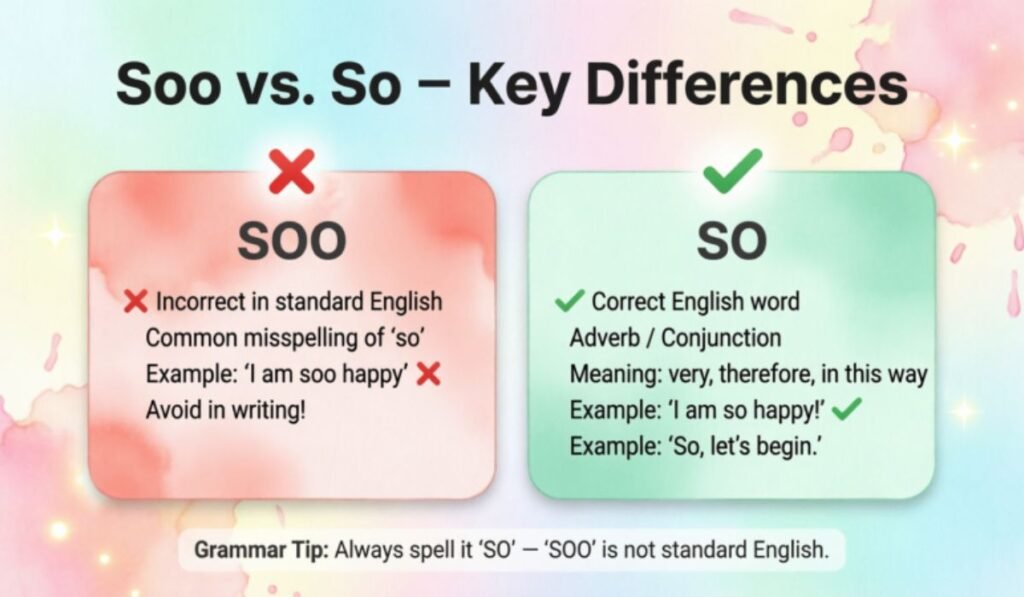
The cleanest way to understand soo vs so is to see them side by side. One extra letter changes almost everything about how a sentence lands.
| Feature | “So” | “Soo” |
| Dictionary status | Standard English word | Not a recognized dictionary word |
| Grammatical role | Adverb, conjunction, intensifier | None — purely stylistic |
| Best used in | Formal and everyday writing | Texts, captions, casual chats |
| Changes meaning? | Yes, depending on context | No — only changes tone |
| Signals | Clarity, correctness | Emotion, exaggeration, warmth |
| Risk in professional writing | None | High — looks careless |
| Common examples | “So, let’s begin.” / “I studied, so I passed.” | “That’s soo cute!” / “I’m soo tired.” |
The pattern is consistent everywhere you look: “so” carries the grammar, and “soo” carries the feeling.
The Emotional Impact Difference
This is the heart of the soo vs so debate. “So” is neutral — it does its job without asking for attention. “Soo” is loud on purpose. It mimics the way your voice would rise or stretch if you said the sentence out loud.
Compare these two:
- “I am so grateful for this opportunity.” — Polished, sincere, professional.
- “I am soo grateful for this opportunity.” — Warmer, more casual, slightly less composed.
Neither sentence is factually different. The idea is identical. What changes is how much emotional volume the reader hears in their head. That’s the entire function of the extra “o” — it’s punctuation for feeling, not a change in meaning.
When Context Changes Everything
The same sentence can be perfectly fine or completely wrong depending on where it appears. A text to your best friend that says “I’m soo done with today” reads as relatable and funny. The same line in a work email reads as unprofessional.
This is why soo vs so isn’t really about right or wrong in an absolute sense — it’s about matching the word to the setting. Ask yourself:
- Who is reading this?
- What’s my relationship with them?
- Does this writing need to be taken seriously?
If the answers point toward formality, “so” is the only safe choice. If the setting is relaxed and personal, “soo” can add color without doing any real harm.
When to Use “So” (And When to Avoid “Soo”)
As a rule of thumb, default to “so” unless you have a specific, informal reason to stretch it. Here’s a simple breakdown:
Use “so” when:
- Writing emails, reports, or business documents
- Completing academic assignments or research papers
- Drafting resumes, cover letters, or professional bios
- Writing anything that will be read by someone you don’t know well
- You need the sentence to carry a precise grammatical meaning
“Soo” may be acceptable when:
- Texting close friends or family
- Commenting on social media posts
- Writing casual captions meant to sound personal
- Matching a brand’s deliberately informal voice
The Credibility Factor
Word choice quietly signals competence. When a reader spots “soo” in a formal document, it doesn’t just look like a typo — it raises questions about attention to detail, education, and professionalism. That reaction happens in seconds, often without the reader even realizing why they’ve formed a negative impression.
This is the biggest practical reason the soo vs so distinction matters. In a resume, cover letter, client email, or academic paper, “soo” can undo an otherwise strong piece of writing. The fix costs nothing — it’s one letter — but the impact of getting it wrong is disproportionately large.
When “Soo” Actually Works (Social Media & Casual Texts)
There are situations where “soo” genuinely does its job better than “so” ever could. In fast, emotional, informal communication, “soo” adds a layer of tone that plain grammar can’t express:
- Texting: “I’m soo down for tacos tonight!” feels more enthusiastic than the plain version.
- Social captions: “This sunset is soo unreal 😍” mimics the excitement of saying it out loud.
- Comment sections: “Soo true, I felt this in my soul” reads as relatable and human.
In these spaces, correctness takes a back seat to connection. Readers aren’t grading grammar — they’re reading tone. That’s the one place where soo vs so genuinely comes down to personal or brand voice rather than a hard rule.
How Brands Use “Soo” Strategically
Marketers understand the soo vs so distinction better than almost anyone, because tone directly affects engagement, and getting the soo vs so balance right can make copy feel authentic instead of scripted. Brands that want to sound approachable, youthful, or fun often lean into deliberately informal spelling.
Common examples of this strategy include:
- Fast-food and beverage brands using playful, exaggerated captions on social media
- Beauty and lifestyle influencers writing things like “this serum is soo good” to sound like a genuine recommendation rather than scripted copy
- Startups and DTC brands using casual language to build a friendly, relatable identity
This works because the exaggeration signals authenticity. A stretched “soo” doesn’t sound like advertising — it sounds like a friend texting you. But even brands that use “soo” in captions will switch back to “so” in press releases, investor communications, and formal statements. That contrast itself proves the rule: informal spelling is a tone choice, reserved for informal channels.
A Quick Side-by-Side Summary
To make the soo vs so rule easy to remember, keep this simple filter in mind:
| Situation | Correct Choice | Why |
| Business email | So | Maintains professionalism |
| Text to a friend | Either works | Tone-dependent, not grammar-dependent |
| Academic essay | So | Formal writing standards apply |
| Instagram caption | Soo (optional) | Adds warmth and personality |
| Resume or cover letter | So | Protects credibility |
| Social media ad copy | Soo (brand-dependent) | Matches casual brand voice |
Common Mistakes People Make with Soo vs So
Even after learning the soo vs so rule, writers still slip up. Here are the most frequent mistakes:
- Using “soo” out of habit, not intention. If you’re not consciously choosing it for tone, default to “so.”
- Overusing “soo” in casual writing. One extra letter adds emphasis; three or four sentences in a row full of “soo” starts to look messy rather than expressive.
- Assuming “soo” changes meaning. It doesn’t. “I’m so tired” and “I’m soo tired” describe the same state — only the emotional volume changes.
- Forgetting the audience. A message perfectly fine for a friend can damage your image in front of a client or professor.
- Using “soo” in searchable, permanent content. Blog posts, reports, and portfolios are read by strangers who don’t know your personal texting style — stick with “so” here.
How to Decide: A Simple Soo vs So Checklist
If you’re still unsure which form fits your message, run through this quick checklist before you type:
- Is this going to a stranger, client, teacher, or boss? Use “so.”
- Will this be read by more than one person, now or later? Use “so.”
- Is this a private, casual message to someone who knows your tone? “Soo” is fine.
- Am I trying to show excitement, sarcasm, or exaggeration? “Soo” can help.
- Does correctness matter more than personality here? Choose “so” every time.
Running through this soo vs so checklist takes only a few seconds, but it prevents the kind of small mistake that can quietly undercut an otherwise strong message. Most professional writers apply this filter automatically once they’ve internalized the difference.
Why the Soo vs So Debate Keeps Growing
Language has always adapted to new technology, and the soo vs so discussion is really just the latest chapter in that story. Before texting, people didn’t need a written way to show vocal emphasis — tone of voice did that job automatically. Now that so much communication happens through text instead of speech, writers have had to invent visual shortcuts for emotion, and stretching letters is one of the simplest ones available.
That’s also why this comparison keeps resurfacing in search results every year. New generations of writers run into the same question: is “soo” acceptable, or does it look wrong? The answer hasn’t changed, even as digital communication keeps evolving. “So” remains the grammatically correct form, while “soo” continues to thrive as an informal, emotionally driven variant used mostly in texting and social spaces.
Final Verdict: Soo vs So
When it comes down to it, the soo vs so debate isn’t really close. “So” is the correct, standard English word for every serious or professional context. “Soo” is a stylistic, emotionally expressive spelling that belongs strictly in casual, personal communication — texts, captions, and comment sections where tone matters more than grammar.
If you remember nothing else, remember this: “so” changes meaning, and “soo” only changes feeling. Choose based on who’s reading and how seriously that writing needs to be taken.
Frequently Asked Questions About Soo vs So
These quick answers cover the most common questions people ask about soo vs so, so you can find the exact detail you need without rereading the full guide.
Is “soo” a real word? No. “Soo” isn’t listed in standard dictionaries — it’s an informal, stretched spelling of “so” used for emotional emphasis.
Is it grammatically correct to use “soo”? No. “Soo” has no grammatical function; it’s a stylistic choice used only in casual, informal writing.
Can I use “soo” in a text message? Yes. Texting friends or family is exactly where “soo” fits best, since it adds warmth and tone.
Should I ever use “soo” in an email? Only in very casual emails to close friends. Avoid it completely in business or professional emails.
Does “soo” mean something different from “so”? No. Both express the same idea — “soo” simply adds extra emotional emphasis, not a new meaning.
Why do people stretch words like “so” into “soo”? It mimics how spoken emphasis sounds, letting written text carry some of the tone that speech naturally has.
Is “soo” acceptable on social media? Yes, it’s widely used and understood on platforms like Instagram, TikTok, and Twitter/X for casual, expressive posts.
Will using “soo” hurt my credibility at work? Yes, in formal settings it can make writing look careless, so it’s best avoided in resumes, reports, and professional emails.
Is “soo” the same in British and American English? Yes, the informal use of “soo” for emphasis is common across English-speaking regions, since it’s a texting trend rather than a regional grammar rule.
What’s the simplest rule for choosing between soo and so? Use “so” for anything formal or professional, and reserve “soo” for casual, personal messages where tone matters more than correctness.

Henry Parker is an English language writer with several years of experience helping learners understand grammar and improve their writing. He enjoys breaking down confusing grammar rules into simple explanations and practical examples. Through his work at HexoWaves, Henry shares useful tips on grammar, vocabulary, sentence structure, and everyday English.