

You’ve probably typed it fast and wondered for a second. Should it be “as well” or “aswell”? You’re not the only one asking. This mix-up shows up in emails, texts, and even client reports all the time.Here’s the short answer: as well is the only correct spelling. “Aswell” is not a real word in standard English, no matter how often you see it online.
Stick with two words, always.Now let’s get into why that’s the rule, where people go wrong, and how to use “as well” like you actually know what you’re doing.
What Does “As Well” Mean?
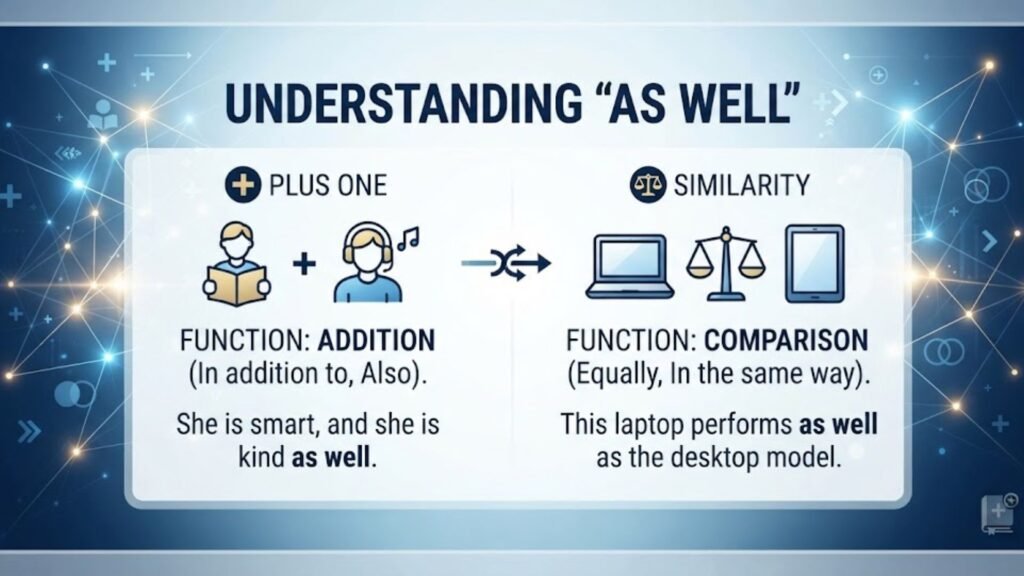
“As well” means the same thing as also or too. You use it to add extra information to something you already said. Think of it as a way to tag on one more detail without sounding repetitive.
It usually comes at the end of a sentence, which is one reason people rush and squeeze it into one word. But grammatically, it’s still two separate words doing two separate jobs, “as” and “well,” working together as one phrase.
This phrase fits into casual writing and professional writing equally well. That flexibility is exactly why it shows up so often in blog posts, emails, and everyday conversation.
Examples of “As Well”
- I ordered pizza, and I got ice cream as well.
- She plays football, and she’s into cricket as well.
- Can you bring your notebook as well?
- He speaks Spanish and English as well.
Notice the pattern? Each sentence adds something extra at the end. That’s the whole job of this phrase, no more, no less.
Is “Aswell” a Real Word?
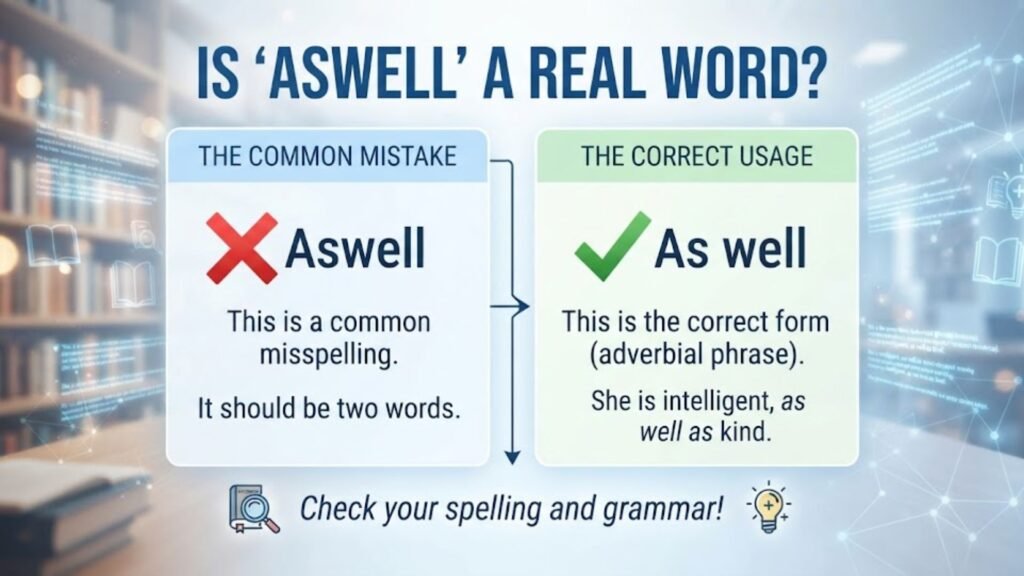
No, it isn’t. Check any major dictionary and you won’t find “aswell” listed as a standard English word. It’s simply a misspelled word, one that happens because of how we type, not how we think.
Language authorities and grammar guides agree on this point without exception. If you search for “aswell” in a proper dictionary, you’ll either get redirected to “as well” or find nothing at all.
Why People Write “Aswell”
Fast typing is the main culprit here. When you’re texting or dashing off a quick message, your fingers move faster than your brain checks spelling. Add autocorrect issues into the mix, and “aswell” slips through more than it should.
Internet slang and informal texting habits have also normalized shortcuts like this one. We see combined words everywhere in casual chats, so our brains start treating “as well” the same way, even though it doesn’t follow that pattern.
Quick Answer
If you remember nothing else from this article, remember this: “as well” is always two words. “Aswell” is a spelling mistake, full stop. There’s no context where the combined version is accepted.
As Well vs Aswell: The Main Difference
The difference comes down to word spacing. “As well” is a two-word phrase, while “aswell” tries to be a compound word. English does create compound words sometimes, think “however” or “wherever,” but “as well” was never meant to merge that way.
This isn’t just a technicality either. Getting it right affects how readers perceive your writing quality, and small errors like this chip away at your reader trust faster than you’d think.
Why “As Well” Stays Separate
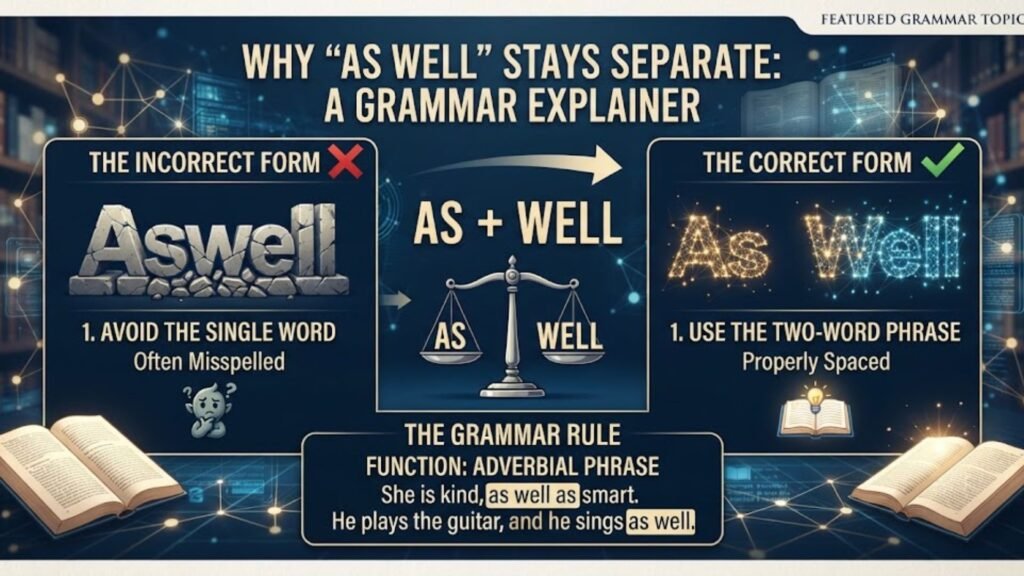
Compare it to similar phrases: as soon as, as far as, as long as. None of these merge into single words, and “as well” follows the exact same grammatical role. The word “as” functions as its own unit in all these expressions.
If you wouldn’t write “assoonas” or “aslongas,” there’s no logical reason to write “aswell.” The pattern is consistent across the entire language, and that consistency is what makes English grammar predictable once you see it.
Common Sentence Comparison
| Incorrect | Correct |
| I’ll come aswell. | I’ll come as well. |
| She wants pizza aswell. | She wants pizza as well. |
| We’re going aswell. | We’re going as well. |
Seeing them side by side makes the fix obvious. Once you notice the pattern, you’ll catch yourself before hitting send.
How to Use “As Well” Correctly in Sentences
Using “as well” correctly isn’t complicated once you know where it belongs. It slots into a sentence naturally, almost like an afterthought that adds value rather than clutter.
The trick is placement and frequency. Put it in the wrong spot and the sentence sounds clunky. Overuse it and your writing starts to feel repetitive, which hurts sentence flow more than people realize.
Use “As Well” at the End
The most natural sentence position for “as well” is at the end. “I like coffee, and I like tea as well.” This keeps the sentence sounding smooth and matches how native speakers actually talk.
Placing it anywhere else, like the beginning, tends to sound awkward unless you’re going for a specific stylistic effect. Stick to the end unless you have a good reason not to.
Use “As Well” in Formal Writing
Yes, “as well” fits into formal English just fine. It works in academic writing, business writing, and professional communication without sounding out of place. Unlike some casual expressions, this one carries a neutral tone that suits almost any setting.
That said, some writers prefer “in addition” or “additionally” for extra-formal documents. Both options work, but “as well” tends to read a little more natural and a little less stiff.
Avoid Overusing It
Even a correct phrase gets annoying if you lean on it too much. If every sentence in your paragraph ends with “as well,” readers will notice the repetition immediately. Mix it up with “too” or “also” to keep your sentence variety intact.
- Use “as well” once per paragraph, not every sentence.
- Swap in “too” for shorter, punchier sentences.
- Save “in addition” for longer, more formal points.
Common Grammar Mistakes Related to “As Well”
This phrase seems simple, but it trips people up in more ways than you’d expect. Beyond the spelling issue, there are placement and confusion errors worth knowing about too.
Understanding these common grammar mistakes helps you avoid looking careless in client articles, social media captions, or anything else with your name on it.
Writing It as One Word
We’ve covered this one already, but it deserves repeating because it’s the most frequent typing mistake tied to this phrase. “Aswell” simply isn’t accepted anywhere in written English, casual or formal.
Wrong Placement in Sentences
Some writers try to stuff “as well” into the middle of a sentence where it doesn’t belong. “I as well like pizza” sounds off to any native speaker. The natural spot is almost always at the end, right after the main point.
Confusing It With “Also” and “Too”
These three words mean similar things, but they’re not always interchangeable in terms of placement. “Also” usually goes near the beginning or middle of a sentence, “too” and “as well” go at the end. Mixing up the placement rules, even with the right word, still sounds unnatural.
“As Well” in British vs American English
Grammar rules for this phrase don’t really shift across the pond, but usage habits do vary slightly. Both British speakers and American speakers use “as well” constantly, just with small differences in frequency and tone.
British English
British English leans on “as well” quite heavily in everyday conversation, sometimes even more than “also.” It carries a slightly more polished feel in British usage, showing up often in polite requests and casual chats alike.
American English
American English tends to favor “too” a bit more in casual speech, saving “as well” for professional writing or slightly more polished contexts. Both are correct, and both are widely understood across worldwide English, so you can’t really go wrong choosing either.
Real-Life Example: How One Small Grammar Mistake Affected Professional Writing
A friend of mine, a freelance content writer, once sent a pitch to a potential client with “aswell” typed twice in the opening paragraph. The client never replied. She later found out through a mutual contact that the client’s team flagged the email for “sloppy writing” before even reading the pitch itself.
That’s the thing about small errors, they don’t just look bad in isolation. They quietly damage your professional credibility before anyone even judges your actual ideas. One misspelled word cost her a project that would’ve paid well and led to more work down the line.
She fixed her habit after that by proofreading every message twice, and it made a noticeable difference in how clients responded to her business content. Small fix, real result.
Why Correct Grammar Still Matters in 2026
You might think grammar rules are old news in a world full of voice typing and AI assistants. They’re not. If anything, grammar accuracy matters more now because readers have less patience for sloppy content and more options to click away from it.
Whether you’re a student, a business owner, or a job applicant, your writing represents you before you even get a chance to speak. A grammar mistake in an application or a proposal can undo hours of good work in seconds.
Why Search Engines Care About Readability
Google’s helpful content systems reward content that’s clear, useful, and easy to read. Readability signals like correct grammar and natural sentence flow play into how search engines assess content quality and user experience.
This isn’t about robotic keyword stuffing anymore. It’s about writing that genuinely helps the reader, which naturally improves SEO performance and search engine rankings over time. Clean grammar builds trust signals that both readers and algorithms pick up on.
Easy Trick to Remember the Correct Form
Struggling to remember which spelling is right? Here’s a trick that sticks better than any rule you’ll read in a textbook.
If “Well” Means “Also,” Keep It Separate
Ask yourself: can I swap “well” for “also” or “too” and keep the same meaning? If yes, the phrase is functioning as an adverbial phrase, and it must stay as two words. This tiny mental check works every single time.
Quick Memory Formula
Think of “as well” like “as soon” or “as far.” You’d never combine those into “assoon” or “asfar,” right? Apply that same logic here, and you’ll never second-guess the spelling again.
As Well vs Also vs Too
These three carry similar meanings but different sentence tones and placements. Knowing when to use each one makes your writing sound more natural and less repetitive.
- Also: works best near the start or middle of a sentence. “I also like tea.”
- Too: short, casual, and goes at the end. “I like tea too.”
- As well: slightly more polished, also goes at the end. “I like tea as well.”
Which One Should You Use?
For casual conversation, “too” feels the most relaxed and natural. For business writing or slightly more polished pieces, “as well” strikes a balanced professional tone. “Also” works well when you want to introduce the addition earlier in the sentence rather than tacking it on at the end.
There’s no strict rule forcing you to pick one over the others. Context and rhythm should guide your choice more than any hard rule.
Best Writing Tips to Avoid Grammar Mistakes
Fixing one mistake is good. Building habits that catch future ones is better. Here are a few practical writing improvement habits worth adopting.
Proofread Slowly
Reading your own writing at normal speed makes it easy to miss small errors like “aswell.” Slow down, read line by line, and your eyes will catch what your brain glossed over the first time.
Use Grammar Tools
Tools like Grammarly and Hemingway Editor catch spacing and spelling issues before they reach your reader. Even Google Docs Spell Check flags “aswell” as incorrect, so there’s really no excuse for it slipping through.
Read Professional Content
Reading well-edited articles, whether from HubSpot or established publications, trains your brain to recognize correct English patterns naturally. The more quality writing you read, the more your own writing improves without even trying.
Mini Quiz: As Well or Aswell
Test yourself. No pressure, just a quick way to see if this stuck.
Quiz 1: Which One Is Correct?
“I’m coming ___ (as well / aswell).” Answer: as well.
Quiz 2: Spot the Mistake
“She likes coffee aswell.” What’s wrong here? The word “aswell” should be split into “as well.”
Quiz 3: What Does “As Well” Mean?
It means “also” or “too,” used to add extra information to a sentence.
Quiz 4: Formal or Informal?
Is “as well” appropriate in formal writing? Yes, it fits comfortably into both formal English and informal English.
Quiz 5: Fill in the Blank
“He plays guitar and sings ___.” Answer: as well.
Quiz 6: Grammar Check
True or false: “Aswell” appears in major dictionaries. False, it does not.
Quiz 7: Quick Choice
Pick the correct spelling: “as well” or “aswell”? Always as well.
Quiz 8: Similar Meaning
Name two words with a similar meaning to “as well.” Also and too.
Quiz 9: Sentence Position
Where does “as well” usually go in a sentence? At the end of a sentence.
Quiz 10: True or False
“As well” can be written as one word in casual texting and still be correct. False, it’s still incorrect in any context.
Quiz 11: Final Challenge
Rewrite this correctly: “We ordered dessert aswell.” Correct version: “We ordered dessert as well.”
FAQs
Q1: Is “aswell” ever correct?
No. In standard English, “aswell” is never considered correct. It’s a spelling error regardless of context, formal or casual.
Q2: Should “as well” always be two words?
Yes, always. There’s no situation, formal or informal, where combining it into one word becomes acceptable.
Q3: Can I use “as well” in formal writing?
Absolutely. It fits naturally into academic writing, business content, and other professional formats without sounding out of place.
Q4: What is another word for “as well”?
Also, too, and in addition all serve as solid alternative words with a similar meaning.
Q5: Why do people write “aswell”?
Mostly due to fast typing, autocorrect errors, and habits picked up from internet writing and informal texting.
Q6: Is “as well” more formal than “too”?
Slightly, yes. “As well” tends to sound a touch more polished, though both are widely accepted in most settings.
Q7: Does Google care about grammar mistakes?
Indirectly, yes. Google’s helpful content systems favor clear, well-written content, and grammar accuracy contributes to overall readability and content engagement.
Conclusion
So, as well or aswell? By now the answer should feel obvious: “as well” wins every single time. It’s the only correct form recognized across standard dictionaries, grammar guides, and everyday professional communication.
Small grammar habits like this one shape how readers see you, whether you’re writing a quick text or a client-facing report. Get this one right, and you’re already ahead of a surprising number of writers online.
Next time your fingers try to rush “aswell” out of habit, pause for half a second. Split it into two words, keep your writing polished, and let your content quality speak for itself.

Henry Parker is an English language writer with several years of experience helping learners understand grammar and improve their writing. He enjoys breaking down confusing grammar rules into simple explanations and practical examples. Through his work at HexoWaves, Henry shares useful tips on grammar, vocabulary, sentence structure, and everyday English.