Have you ever paused mid-sentence, unsure whether to type “thats” or “that’s”? You’re not alone. This one tiny apostrophe trips up native speakers, students, and even professional writers on a daily basis.
The good news is that the rule behind this mix-up is actually simple once you see it clearly. In this guide, you’ll learn exactly which form is correct, why the apostrophe matters so much, and how to stop second-guessing yourself every time you write.
By the end of this article, you’ll have a foolproof method for choosing correctly, every single time.
The Short Answer: “Thats” vs “That’s”
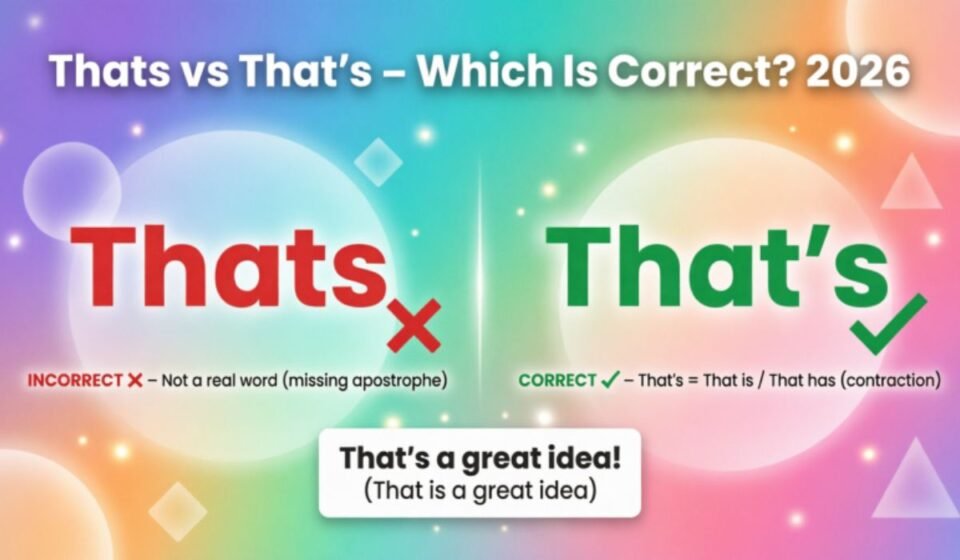
“That’s” is correct. “Thats” is not a real word in English.
“That’s” is a contraction, meaning it combines two words into one shorter form using an apostrophe. Specifically, “that’s” stands in for either:
- That is — “That’s a great idea.”
- That has — “That’s been on my mind all week.”
“Thats,” on the other hand, has no meaning and no place in standard English grammar. It doesn’t appear in any dictionary, and you won’t find it in professionally edited writing. If you ever see “thats” without an apostrophe, it’s simply a typo or a misunderstanding of how contractions work.
Here’s a quick comparison to make the difference crystal clear:
| Form | Correct? | What It Means | Example Sentence |
| That’s | ✅ Yes | That is / That has | That’s exactly what I needed. |
| Thats | ❌ No | Nothing — not a real word | ~~Thats exactly what I needed.~~ |
If you remember nothing else from this article, remember this: whenever you mean “that is” or “that has,” the apostrophe is non-negotiable.
What Does “That’s” Mean?
“That’s” is a contraction, which is simply a shortened way of combining two words into one. English speakers use contractions constantly to make speech and writing sound more natural and less formal.
The apostrophe in a contraction always marks a spot where letters have been removed. In the case of “that’s,” the apostrophe replaces the missing letters from either “is” or “has,” depending on the sentence.
This is exactly why “thats” doesn’t work — dropping the apostrophe removes the signal that tells readers a letter is missing, and the word simply falls apart in meaning.
“That’s” carries two distinct meanings, and understanding both will help you use it with total confidence.
“That’s” as “That Is”
The most common use of “that’s” is as a short form of “that is.” This version is used to point out, describe, or confirm something in the present tense.
Examples:
- That’s a beautiful sunset. (That is a beautiful sunset.)
- That’s not what I meant. (That is not what I meant.)
- That’s the restaurant we talked about. (That is the restaurant we talked about.)
Notice how naturally “that is” fits into each sentence. This is your first clue for testing whether “that’s” is being used correctly.
“That’s” as “That Has”
The second, slightly less obvious use of “that’s” is as a short form of “that has.” This version usually shows up in the present perfect tense, describing something that started in the past and connects to the present.
Examples:
- That’s been a long day. (That has been a long day.)
- That’s caused a lot of confusion. (That has caused a lot of confusion.)
- That’s changed everything for our team. (That has changed everything for our team.)
Many writers miss this second meaning entirely, assuming “that’s” only ever means “that is.” Knowing both uses will help you understand sentences more accurately and write with more precision.
READ MORE:http://hexowaves.com/soo-vs-so/
How to Remember the Difference Between “Thats” and “That’s”
You don’t need to memorize a long list of grammar rules to get this right. A couple of simple mental tricks will make the choice automatic.
1. Use the Expansion Test
Whenever you’re unsure, try expanding “that’s” into its full form.
- Say the sentence with “that is” instead.
- If it doesn’t work, try “that has.”
- If either version makes sense, the apostrophe is required — you need “that’s,” not “thats.”
For example: “That’s my favorite movie” expands to “That is my favorite movie,” which makes perfect sense. That confirms the apostrophe is needed.
2. Remember What the Apostrophe Represents
Think of the apostrophe as a placeholder for missing letters. In “that’s,” it’s standing in for the “i” in “is” or the “ha” in “has.”
Picture a tiny gap where those letters used to be. That visual can help the rule stick in your memory.
3. Say It Out Loud
If you naturally hear yourself saying “that is” or “that has” when reading a sentence aloud, that’s your signal that an apostrophe belongs there.
4. Remember: “Thats” Never Exists Alone
Unlike some words that have multiple accepted spellings, “thats” has zero valid uses in standard English. There is no context — formal, casual, academic, or conversational — where dropping the apostrophe is correct.
Here’s a simple reference table to keep nearby:
| Trick | How It Works |
| Expansion Test | Replace “that’s” with “that is” or “that has.” If it still makes sense, keep the apostrophe. |
| Missing Letter Rule | The apostrophe always marks a dropped letter — no apostrophe means no missing letter, which means no contraction. |
| Read Aloud | If you say “that is” or “that has” naturally, write “that’s.” |
| No Exceptions Rule | “Thats” is never correct, in any writing style. |
Once these tricks become second nature, you’ll stop hesitating and start writing “that’s” correctly without even thinking about it.
When to Use “That’s” in Your Writing
Knowing that “that’s” is correct is only half the picture. Understanding when and where to use it will make your writing sound natural, professional, and clear.
In Everyday Conversation and Casual Writing
“That’s” fits comfortably into texts, emails, social media posts, and everyday conversation. It keeps your tone friendly and approachable.
- That’s so kind of you.
- That’s hilarious!
- That’s the plan for tomorrow.
In Professional and Business Writing
Contractions like “that’s” are widely accepted in modern professional communication, especially in emails, blog posts, and marketing copy, where a conversational tone builds connection with readers.
- That’s why our team recommends this approach.
- That’s a strong argument for the new policy.
If you’re writing something highly formal, such as a legal document or academic paper, you may choose to spell out “that is” or “that has” in full. But for the vast majority of writing — including business communication — “that’s” works perfectly well.
In Descriptive and Explanatory Sentences
“That’s” is especially useful when explaining, clarifying, or confirming an idea:
- That’s the reason the project was delayed.
- That’s not quite what the data shows.
- That’s an interesting way to look at it.
A Quick Checklist Before You Hit Publish
Before you finish any piece of writing, run through this quick checklist:
- Did you mean “that is” or “that has” anywhere in your sentence?
- If yes, did you include the apostrophe?
- Did you double-check by expanding the contraction mentally?
- Did you avoid writing “thats” anywhere in your text?
If you can answer yes to all four, you’re using “that’s” correctly and consistently.
Common Mistakes People Make With “Thats” vs “That’s”
Even careful writers slip up occasionally. Here are the most frequent reasons “thats” appears where “that’s” should be:
- Typing too quickly, especially in texts, chats, or social media, where apostrophes sometimes get skipped.
- Autocorrect errors, particularly on mobile keyboards that sometimes fail to add the apostrophe automatically.
- Confusion with possessives, since some learners mistakenly think apostrophes only apply to ownership (like “the dog’s bone”), not contractions.
- Non-native speakers learning contractions, who may not yet be familiar with how apostrophes represent missing letters.
- Simple habit or oversight, especially when writing in a hurry without proofreading.
The fix for all of these is the same: slow down for a moment, run the expansion test, and add the apostrophe where it belongs.
“That’s” vs Similar Words: A Quick Comparison
Because English has several similar-looking words, it helps to see “that’s” next to its close relatives.
| Word | Type | Meaning | Example |
| That’s | Contraction | That is / That has | That’s a nice idea. |
| Thats | Not a word | No meaning | ~~Thats a nice idea.~~ |
| Thatz | Slang / informal texting | Informal for “that’s” | Avoid in standard writing |
| That | Pronoun / conjunction | Refers to something | That book is mine. |
| Thats’ | Incorrect | Not a valid word or possessive form | Never used in English |
This table makes it easy to see, at a glance, why “that’s” stands alone as the only grammatically correct option.
Why Getting This Right Matters
You might wonder if one small apostrophe really makes that much difference. In practice, it does — for a few important reasons:
- Credibility: Small grammar mistakes can make readers question the accuracy of your content, even if the ideas themselves are solid.
- Clarity: Missing punctuation can occasionally cause readers to pause or misread a sentence, slowing down comprehension.
- Professionalism: In emails, resumes, reports, and articles, correct grammar reflects attention to detail.
- SEO and readability: Search engines and readers alike favor clean, well-edited content, which keeps people engaged longer.
Mastering small details like “that’s” versus “thats” is one of the easiest ways to instantly improve the overall polish of your writing.
Practice Examples: Test Yourself
Try filling in the blank with the correct form before checking the answer below each sentence.
- ______ the best pizza place in town. Answer: That’s (That is the best pizza place in town.)
- ______ been a difficult month for everyone. Answer: That’s (That has been a difficult month for everyone.)
- I think ______ a fair point to make. Answer: That’s (That is a fair point to make.)
- ______ changed how I think about the project. Answer: That’s (That has changed how I think about the project.)
If you got all four correct, you’ve already mastered the rule.
Frequently Asked Questions
Is “thats” ever correct in English? No. “Thats” has no valid use in standard English. The correct form is always “that’s.”
What does “that’s” stand for? “That’s” is a contraction for either “that is” or “that has,” depending on the sentence.
How can I quickly check if I’m using “that’s” correctly? Expand it to “that is” or “that has.” If the sentence still makes sense, the apostrophe belongs there.
Is it okay to use “that’s” in formal writing? Yes, in most professional and business contexts. For highly formal documents, you may prefer to spell out “that is” or “that has.”
Why do people write “thats” by mistake? Usually due to fast typing, autocorrect errors, or confusion about how apostrophes work in contractions.
Is “thats” a typo or a grammar error? It’s considered a spelling and grammar error, since “thats” isn’t a recognized word in English.
Does the apostrophe in “that’s” show possession? No. In this case, the apostrophe marks a contraction, not possession. “That’s” never functions as a possessive form.
Conclusion
The difference between “thats” and “that’s” comes down to a single apostrophe — but that apostrophe carries real weight. “That’s” is the only correct form, standing in for “that is” or “that has,” while “thats” simply doesn’t exist in proper English.
The next time you’re unsure, run the quick expansion test: swap in “that is” or “that has,” and see if the sentence still holds up. If it does, you know exactly where that apostrophe belongs.
With this simple trick in your back pocket, you’ll never have to second-guess “that’s” versus “thats” again — and that’s one small grammar win that makes a real difference in how clear, credible, and polished your writing sounds.

Henry Parker is an English language writer with several years of experience helping learners understand grammar and improve their writing. He enjoys breaking down confusing grammar rules into simple explanations and practical examples. Through his work at HexoWaves, Henry shares useful tips on grammar, vocabulary, sentence structure, and everyday English.