
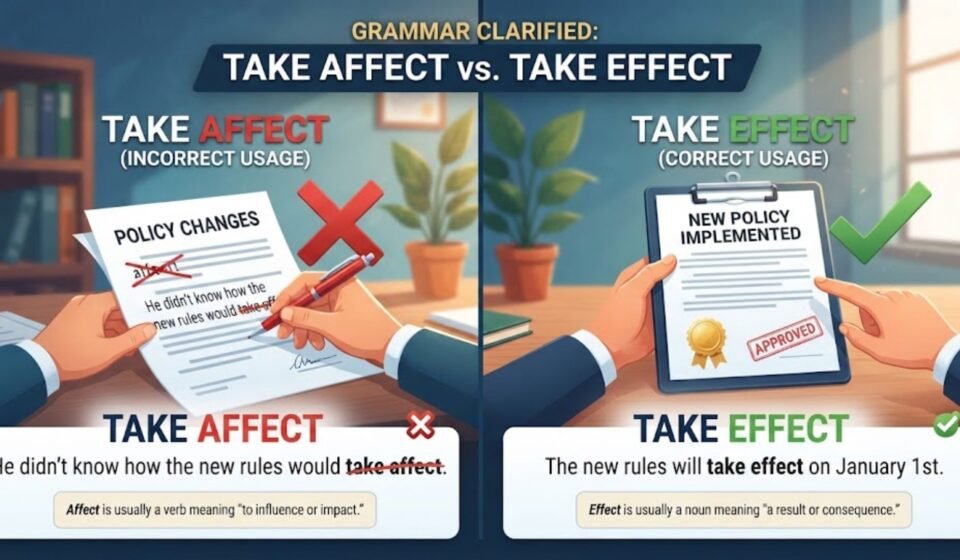
You just typed an email. Your new policy will “take affect” next Monday. Something feels off, right?Here’s the short answer. The correct phrase is take effect, not take affect. That’s it. That’s the rule.But knowing the answer isn’t the same as knowing why.
So let’s dig into the grammar rule, the real reason people mix these up, and how you can stop making this mistake for good. Stick around, because by the end you’ll never second guess this one again.
What Is the Correct Phrase: Take Effect or Take Affect?
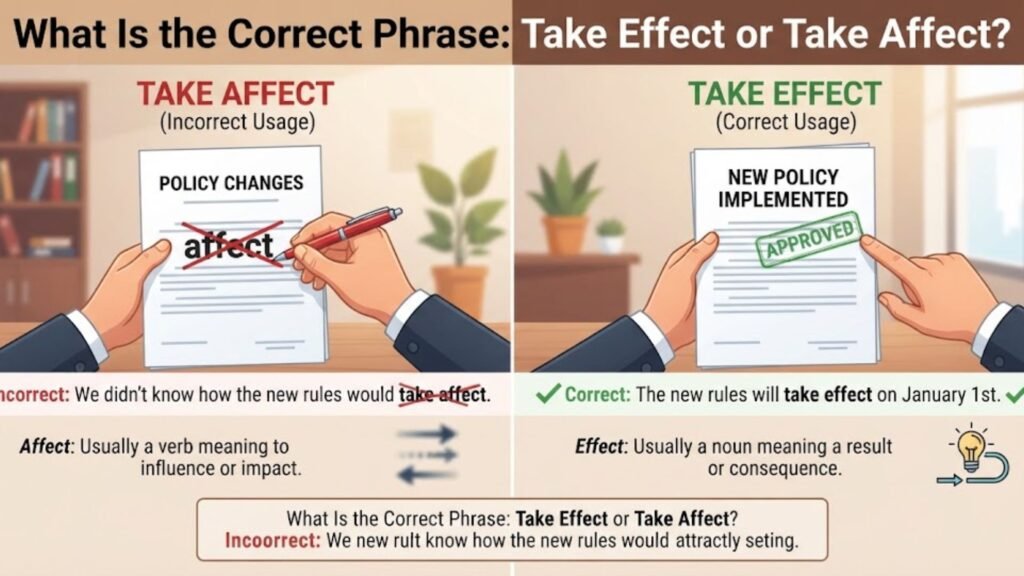
Take effect is the standard English expression. It means something starts working, becomes active, or begins producing results. A law takes effect. A medication takes effect. A new company policy takes effect.
“Take affect” isn’t a recognized phrase in standard English. It shows up constantly in emails and blog posts, but it’s simply a grammar error, one born from confusing two words that sound almost identical.
Think about it like flipping a switch. When you flip it, the light turns on. That’s what take effect meaning really points to, something switching from off to on, from inactive to active.
Examples of “Take Effect”
- The new tax law will take effect on January 1.
- Her resignation takes effect immediately.
- The software update will take effect after restarting your device.
- This price change took effect last month.
Notice the pattern? Every single example involves something starting or becoming operational. That’s the thread tying all of this together.
Is “Take Affect” Ever Correct?
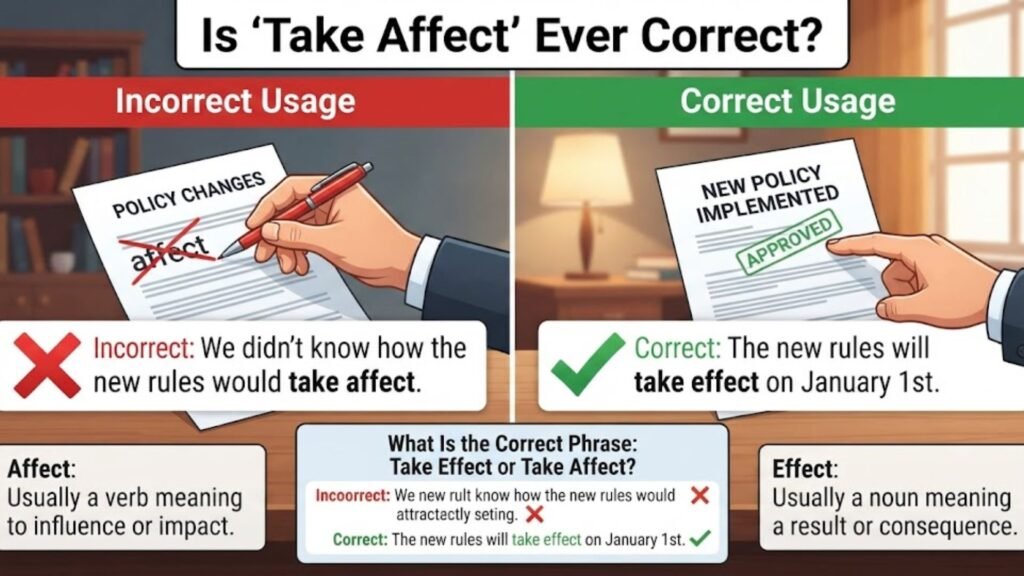
No. Not in a single legitimate context. You won’t find “take affect” in Merriam-Webster, Cambridge Dictionary, or any respected style guide. It’s not slang, it’s not regional, and it’s not an accepted variation. It’s just wrong.
That said, don’t feel bad if you’ve written it before. This is one of the most commonly confused words in the English language, and even sharp writers slip up occasionally.
Understanding the Difference Between Affect and Effect
Here’s where the real confusion starts. Affect and effect look like twins, sound almost identical when spoken, and yet they play completely different roles in a sentence.
Once you separate what each word actually does, the fog clears fast. One is about doing something. The other is about what happens as a result.
Affect Meaning
Affect is usually a verb. It means to influence or to change something. When bad weather affects your travel plans, it’s messing with them, delaying you, rerouting you, causing problems.
A few quick examples: lack of sleep can affect performance. Rainfall can affect crop production. Stress can affect mental health. In every case, affect is the action happening to something else.
Effect Meaning
Effect is almost always a noun. It’s the result, the outcome, the consequence of an action. The effect of exercise on your body. The effect of a marketing campaign on sales. The effect something has.
So here’s the shortcut. If you need a verb, reach for affect. If you need a noun, reach for effect. Simple as that.
Why “Take Effect” Works
This is why “take effect” makes grammatical sense and “take affect” doesn’t. In this phrase, effect functions as a noun, the thing being taken on or triggered. You’re not “affecting” anything here, you’re describing a policy or law becoming operational. That’s a noun’s job, and effect fills it perfectly.
Take Effect Meaning in Everyday English
You’ll bump into this phrase far more often than you’d think. It shows up in news headlines, workplace memos, prescription labels, and app update notifications. Let’s walk through where it pops up most.
Laws and Regulations
Governments love this phrase. New tax legislation always seems to take effect on January 1. Regulatory changes get announced months ahead but only take effect on a specific date. This gives citizens and businesses time to prepare.
Medicine and Healthcare
Ever asked a pharmacist how long a painkiller takes to work? You’re really asking when it will take effect. Some medications take effect within thirty minutes, others need several weeks to build up in your system, like certain antidepressants or long-term treatments.
Business and Workplace Policies
HR departments send these emails constantly. “The updated attendance policy will take effect next Monday.” Or “Salary adjustments will take effect starting next month.” Getting this phrase right in a company-wide email matters more than you’d guess, and we’ll get into why shortly.
Technology and Software
Restart your laptop after an update and notice how changes suddenly work? That’s a software patch that will take effect after restarting. Some settings changes apply instantly, others need logging out first before they take effect automatically.
Take Effect vs Take Affect: Quick Comparison Table
| Phrase | Correct? | Function | Example |
| Take effect | Yes | Effect = noun | The law will take effect Monday. |
| Take affect | No | Not a real phrase | Never use this. |
| Affect (verb) | Yes | Describes action | Rain affects the game. |
| Effect (noun) | Yes | Describes result | The effect was immediate. |
Simple Rule to Remember
If you’re ever stuck mid sentence, pause and ask: am I describing an action, or a result? Action means affect. Result means effect. And since “take effect” is always about something becoming active, effect wins every time.
Why Do People Confuse Take Effect and Take Affect?
This mix up isn’t random. There are real reasons so many people, including native speakers, trip over this one repeatedly.
Similar Pronunciation
Say both words out loud. Affect and effect practically blend together in casual speech. The vowel sounds are nearly identical, especially when you’re talking fast or not enunciating clearly. Your ears simply don’t catch the difference most of the time.
Affect and Effect Are Commonly Mixed Up
Beyond pronunciation, these words are just inherently tricky. They’re two of the most commonly confused words in English, sitting right alongside “their/there” and “your/you’re” on every grammar teacher’s list of pet peeves.
Autocorrect Doesn’t Always Help
Here’s an uncomfortable truth. Autocorrect and spell check tools often miss this error entirely, because “affect” is a real, correctly spelled word. Your phone won’t flag it, since it’s not checking meaning, just spelling. That gives people a false sense of confidence.
Lack of Grammar Awareness
Honestly, a lot of this comes down to never being taught the distinction clearly in school. Grammar rules like this one often get glossed over, so people just guess based on what sounds right, and guessing gets you it wrong about half the time.
Real-Life Example: How One Small Grammar Mistake Changed a Professional Email
A friend of mine works in HR at a mid-sized tech company. She once sent a company-wide email announcing that new healthcare benefits would “take affect” the following month.
Small mistake, right? Except dozens of employees replied asking for clarification, a few made jokes in the company Slack, and her manager gently pulled her aside about it. Nothing catastrophic happened, but it dented her credibility a little that week, and she felt it.
That’s the real cost of grammar mistakes in professional communication. It’s rarely dramatic. It’s just a quiet erosion of reader trust and professionalism, one typo at a time. People notice, even when they don’t say anything.
Grammar Rule: When to Use Affect and Effect
Let’s lock this rule in for good, because once it clicks, it sticks.
Affect = Action
Affect is your go-to verb. It means to influence, change, or impact something. “The storm will affect flights tomorrow.” Action happening, verb doing its job.
Effect = End Result
Effect is your noun. It’s the outcome after something happens. “The storm’s effect was three hours of delays.” Result sitting there, noun describing what occurred.
Applying the Rule
Test it yourself. Swap in “influence” for affect and “result” for effect in your sentence. If it still makes sense, you picked the right word. This trick works almost every single time you’re unsure.
Statistics: Why Grammar Accuracy Matters in 2025 to 2026
Grammar might feel like a small detail, but it shapes how people perceive you, especially online and in business communication.
Key Findings
Studies on hiring managers and candidate evaluations consistently show that resumes and cover letters with grammar errors get rejected faster, often within seconds of scanning. Recruiters associate clean writing with attention to detail and competence, fair or not.
On the content side, search engines increasingly reward well-edited content that demonstrates genuine expertise and authority. Google’s own guidance on helpful content emphasizes accuracy and trustworthiness, meaning sloppy grammar can quietly hurt your rankings, not just your reputation.
Common Examples of Take Effect
Let’s ground this in real scenarios across different fields, since seeing it in context helps it stick better than any definition can.
Government
“The new immigration policy will take effect at the start of next fiscal year,” announced during a press briefing, is a phrase you’ve probably heard dozens of times without noticing.
Healthcare
“This vaccine typically takes effect within two weeks of the second dose,” is standard language from health departments worldwide.
Education
“The updated grading policy will take effect next semester,” is the kind of line students dread seeing in their inbox.
Workplace
“Remote work guidelines will take effect starting Monday,” has become an extremely common line since 2020, and it’s not going away anytime soon.
Technology
“Security patches will take effect after your next system reboot,” shows up in nearly every IT department notice you’ll ever read.
Common Mistakes to Avoid
Even after learning the rule, a few sneaky errors keep tripping people up. Let’s clear them out one by one.
Mistake 1: Writing Take Affect
This is the big one we’ve already covered. Just remember, effect is the noun you’re taking, not affect.
Mistake 2: Using Affect as a Noun
Affect does have a rare psychological affect meaning in clinical settings, describing someone’s emotional expression. But outside psychology, don’t use affect as a noun. It’ll sound off to most readers.
Mistake 3: Mixing Both Words Randomly
Some writers just alternate between affect and effect without really thinking, hoping one sticks. Readers notice this inconsistency fast, and it undermines your credibility more than picking the wrong word just once.
How to Remember the Difference Forever
Ready for a trick that actually works long term? Here it is.
The A-E Rule
Affect starts with A, like Action. Effect starts with E, like End result. That’s the entire memory trick, and it genuinely works because it’s so short and visual.
Effect = End Result
Every time you’re unsure, picture the letter E and think “end result.” If your sentence is describing an outcome, effect fits. It’s a small mental shortcut, but it saves you every time.
Applying the Trick
Next time you write “take e_fect,” pause for one second and picture that A-E rule. It takes less time than typing the sentence itself, and soon it becomes automatic.
Mini Quiz: Take Effect or Take Affect
Test yourself. No pressure, just a fun way to lock this in.
Quiz 1: Which Phrase Is Correct?
“The new rule will ___ next week.” (take effect / take affect) Answer: take effect.
Quiz 2: Spot the Right Word
“Smoking can seriously ___ your lungs.” (affect / effect) Answer: affect.
Quiz 3: Affect or Effect?
“The ___ of the storm was visible for weeks.” Answer: effect.
Quiz 4: Fill in the Blank
“Her speech had a powerful ___ on the audience.” Answer: effect.
Quiz 5: Quick Grammar Challenge
“Does caffeine ___ your sleep?” Answer: affect.
Quiz 6: Real-Life Scenario
“The updated handbook will ___ starting Friday.” Answer: take effect.
Quiz 7: True or False
“Take affect” is grammatically correct. Answer: False.
Quiz 8: Choose the Best Sentence
A) The law will take affect Monday. B) The law will take effect Monday. Answer: B.
Quiz 9: Meaning Check
Does effect usually function as a verb or noun? Answer: Noun.
Quiz 10: Grammar Detective
Find the error: “This medicine will affect within an hour.” Correct version: “take effect within an hour.”
Quiz 11: Memory Trick Test
What does the A in Affect stand for in the memory trick? Answer: Action.
Final Bonus Quiz
Write your own sentence using “take effect” correctly right now. Go on, try it.
FAQs
Q1: Is “take affect” ever grammatically correct?
No, it’s never correct in standard English. The phrase is always “take effect.”
Q2: What does “take effect” mean?
It means something begins working, becomes active, or starts producing results, like a new law or policy.
Q3: Why do people write “take affect”?
Mostly because of similar pronunciation and confusion between the two words, plus autocorrect rarely catches it since affect is still a valid word elsewhere.
Q4: Is affect always a verb?
Almost always, yes. There’s a rare psychological affect noun usage in clinical fields, but in everyday writing, treat affect as a verb.
Q5: Is effect always a noun?
Mostly, though effect can occasionally work as a verb meaning “to bring about,” as in “effect change.” That usage is rare and formal.
Q6: What is an example of take effect?
“The new privacy policy will take effect on the first of next month” is a solid, real-world example.
Q7: How can I remember the difference?
Use the A-E rule. Affect equals Action, Effect equals End result. It’s quick, visual, and it sticks.
Conclusion
So there you have it. Take effect is correct, take affect is not, and now you know exactly why. The rule really comes down to one thing, effect is a noun describing a result, and that’s precisely what’s happening when a law, policy, or update begins working.
Next time you draft an email, write a report, or post online, you won’t hesitate over this one anymore. You’ll know the difference between affect and effect, and more importantly, you’ll write with the kind of accuracy that builds real trust with your readers.
Small grammar wins like this one add up. They shape how people see your writing, your professionalism, and honestly, how seriously they take everything you say next.

Henry Parker is an English language writer with several years of experience helping learners understand grammar and improve their writing. He enjoys breaking down confusing grammar rules into simple explanations and practical examples. Through his work at HexoWaves, Henry shares useful tips on grammar, vocabulary, sentence structure, and everyday English.