

Ever typed up a report and paused halfway through, unsure if it should read “totalling” or “totaling”? You’re not alone. This tiny spelling hiccup trips up writers, students, and even seasoned professionals all the time.The short answer? Both spellings are correct. Totalling is the British spelling, while totaling is the American spelling. Neither one is wrong, but picking the right one depends on your target audience and where your readers are based.
Stick around, because we’re about to unpack the grammar rule behind this, look at real examples, and help you pick the spelling that fits your writing every single time.
What Is the Difference Between Totalling and Totaling?

At their core, both words mean the exact same thing. They describe the act of adding numbers together to calculate a sum or reach a combined sum. The only thing separating them is a single letter.
This comes down to a classic case of regional spelling. British English tends to double the final consonant before adding a suffix, while American English usually skips that extra letter. It’s not a spelling error on either side, just a difference in language conventions.
Quick Definition
Totalling and totaling both function as the present participle or gerund form of the verb “total.” Think of it like this, when you add up your grocery bill in your head, you’re totaling (or totalling) the cost.
The root word here is simply “total,” and both spellings share the same base word. Nothing about the meaning changes based on which version you choose.
Examples
Here’s how each spelling looks in a sentence.
- British English: “The accountant spent her morning totalling the quarterly expenses.”
- American English: “The accountant spent her morning totaling the quarterly expenses.”
See? Same sentence, same meaning, just a different spelling variation depending on the English you’re writing in.
Why Does British English Use “Totalling”?
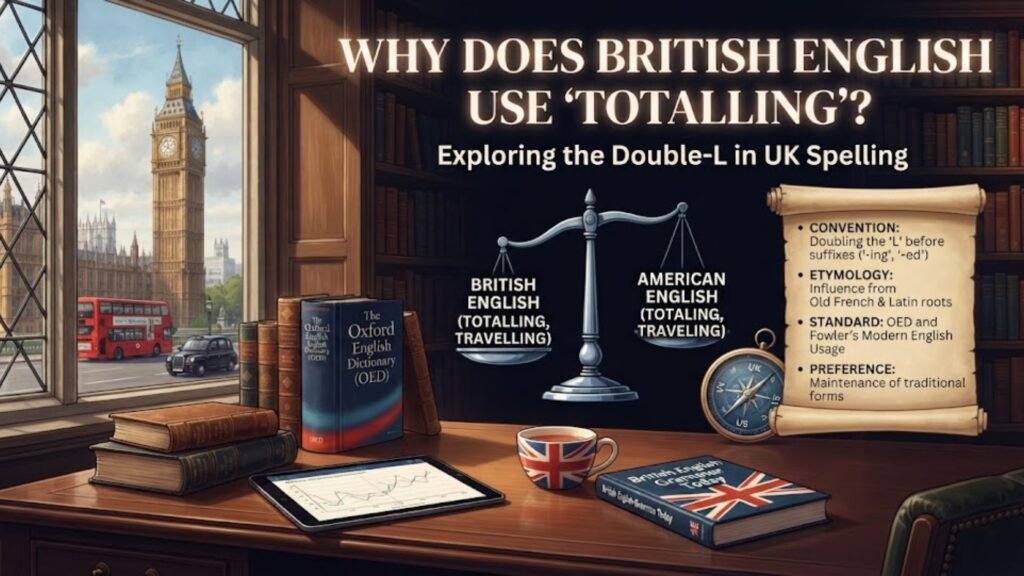
British English has a long standing habit of doubling the final consonant when adding suffixes like -ing or -ed, especially when the word ends in a single vowel followed by a single consonant. This isn’t random. It follows a fairly consistent grammar rule that’s been part of UK English for centuries.
You’ll notice this pattern pop up in tons of everyday words, not just “total.” It’s baked into how British writers learned to spell in school, and it sticks with them into adulthood.
Understanding the Rule
The rule generally applies when a word ends in a single consonant preceded by a single vowel, and the stress falls on that final syllable or the word is short enough that the doubling feels natural. “Total” ends in “l,” so British convention doubles it before tacking on “-ing.”
This might sound technical, but it’s really just muscle memory for anyone raised on traditional British spelling conventions. Once you see the pattern a few times, it clicks.
Why the Double “L”?
The double L isn’t there to confuse anyone. It actually helps preserve the pronunciation and rhythm of the word in British English. Dropping it wouldn’t change how the word sounds, but it would break away from a spelling tradition that’s stayed consistent for generations.
Think of the double L as a small nod to history. It’s a quirk that survived even as language evolved around it.
British English Examples
Beyond “totalling,” you’ll spot this same doubling trend in words like travelling, cancelling, modelling, signalling, and fuelling. If you’re used to reading British books or news sites, these spellings probably look completely normal to you.
Once you notice one, you’ll start noticing them everywhere. That’s the beauty (and occasional headache) of English varieties.
Why Does American English Use “Totaling”?
American English took a slightly different path. Back in the 1800s, lexicographer Noah Webster pushed for simplified American spelling to make written English easier and more consistent. Dropping unnecessary double letters was part of that mission.
So instead of doubling the final consonant, American writers typically leave it alone unless the stress clearly falls on that last syllable. “Total” doesn’t get the double treatment, which is why “totaling” looks lighter and shorter.
Common American Pattern
This isn’t a one-off exception. It’s a spelling pattern that shows up across dozens of similar verbs in US English. The general idea is to keep spelling as close to phonetic as possible without adding extra letters that don’t change pronunciation.
Once you understand the logic, the pattern starts to feel less like a rule you memorize and more like a shortcut that just makes sense.
Examples in American English
You’ll see the same single consonant approach in traveling, canceling, modeling, signaling, and fueling. Sound familiar? These are the exact same words we saw earlier, just spelled the American way.
If you grew up reading US textbooks or watching American shows, these spellings probably feel like second nature.
Totalling vs Totaling: Side-by-Side Comparison
| Feature | Totalling (British) | Totaling (American) |
| Region | UK, Australia, Canada, Commonwealth countries | United States |
| Consonant | Double L | Single L |
| Root Word | Total | Total |
| Meaning | Same | Same |
| Common Style Guides | Oxford Style Guide | AP Style, Chicago Manual of Style |
Both spellings are grammatically correct, so there’s no need to stress over picking the “wrong” one. It’s really about matching your writing to your reader.
Which Should You Choose?
If your audience is mostly in the UK, Australia, or another Commonwealth country, go with totalling. Writing for US audiences? Stick with totaling. Simple as that.
The Grammar Rule Behind Totalling and Totaling
Let’s zoom out for a second and look at the bigger grammar rule at play here, because this isn’t just about one word. It’s a pattern that governs adding suffixes across huge chunks of the English language.
Understanding this rule once means you’ll never second guess dozens of similar words again.
The British Rule
In British grammar rules, a final consonant gets doubled before a suffix starting with a vowel if the word ends in a single vowel plus a single consonant, regardless of where the stress falls. This is broader than the American rule, which explains why more words get doubled letters in UK English.
The American Rule
American grammar only doubles the final consonant when the stress lands directly on the last syllable. Since “total” is stressed on the first syllable, American convention drops the double letter entirely.
Why the Difference Exists
This split traces back to deliberate efforts to reform and simplify spelling in the United States during the 19th century. Language evolution happens for all sorts of reasons, but this one was intentional, practical, and honestly, pretty effective at sticking around.
Real-Life Example: A Business Reporting Mistake
Picture this. A multinational company with offices in London and New York is putting together a quarterly report. The finance team in the UK writes “totalling,” while the American editor reviewing the document flags it as an error and changes it to “totaling.”
Neither person was wrong. But without a clear style guide or agreed upon language settings, this kind of mix up creates confusion, wastes time, and can even make a business report look inconsistent to clients. It’s a small thing, but small inconsistencies add up fast in professional communications.
The fix? Companies that operate across regions usually pick one spelling convention for all official documents and stick with it. That way, everyone from the accounting team to marketing stays on the same page.
Usage Trends and Language Data (2025–2026)
Language data from search trend analyses shows some interesting patterns worth knowing if you’re writing for the web. Search volume for “totaling” consistently outpaces “totalling” globally, mostly because the US has a larger population of English speakers actively searching online.
That said, “totalling” still holds strong and steady traffic across the UK, Australia, and Canada. Neither spelling is disappearing anytime soon.
Key Findings
Recent usage trends suggest American spelling dominates overall search volume, largely thanks to sheer market size. British spelling remains the dominant spelling within Commonwealth regions, though, so it’s far from a rare spelling.
What This Means for Writers
If you’re writing for a global audience or running a website without a specific regional focus, leaning toward American spelling might capture more traffic. But if your brand or business specifically serves UK or Commonwealth customers, sticking with British spelling builds trust and feels more natural to those readers.
Authority Sources
For anyone who wants to dig deeper, Merriam-Webster Dictionary confirms “totaling” as standard American usage, while the Cambridge Dictionary lists “totalling” as the accepted British form. Google Search Central also treats both as legitimate English variants, so you won’t get penalized for using either one correctly and consistently.
How to Choose the Right Spelling
Not sure which one fits your project? Let’s break it down into simple steps you can actually follow.
Step 1: Identify Your Audience
Start by figuring out where most of your readers live. A blog aimed at UK audiences should lean British. A site built for US audiences should go American. This one decision solves most of the confusion right away.
Step 2: Follow a Style Guide
If you write professionally, chances are your company already has a preferred style guide, whether that’s AP Style, the Chicago Manual of Style, or the Oxford Style Guide. When in doubt, check what your editorial guidelines say and follow that.
Step 3: Stay Consistent
Whichever spelling you choose, stay consistent throughout the entire piece. Mixing totalling and totaling in the same article looks sloppy and can chip away at your professional credibility.
Step 4: Configure Your Writing Tools
Most spell checkers let you set your language settings to English (US), English (UK), or English (Australia). Doing this ahead of time saves you from manually catching every inconsistency later.
Common Mistakes Writers Make
Even experienced writers slip up here sometimes. Let’s look at the usual suspects.
Mixing British and American Spellings
This is by far the most common mistake. A writer starts with “totalling,” then somewhere mid article switches to “totaling” without noticing. Readers pick up on this faster than you’d think, and it makes content feel unpolished.
Ignoring Audience Expectations
Writing “totaling” for a strictly British audience, or vice versa, can feel jarring even if it’s technically correct. Matching your spelling to reader expectations shows attention to detail and respect for your audience.
Relying Solely on Spell Check
Spell check tools are helpful, but they’re not foolproof. Many won’t flag totalling as wrong even if your document is set to American English, because it’s still a real word. Always give your writing a manual once over too.
Mini Quiz: Totalling vs Totaling
Test what you’ve learned so far.
Quiz 1: Which spelling is British English?
Answer: Totalling
Quiz 2: Which sentence is correct in American English?
“She spent hours totaling the receipts.” Answer: Correct
Quiz 3: Do “totalling” and “totaling” have different meanings?
Answer: No, they share the exact same meaning.
Quiz 4: What is the root word of both spellings?
Answer: Total
Quiz 5: True or False, mixing both spellings in one article is acceptable in formal writing.
Answer: False
Quiz 6: Which English variety prefers dropping the double “l” in words like totaling?
Answer: American English
Fill in the Blanks (Totalling vs Totaling Practice)
Fill in Blank 1
The British accountant finished ______ the invoices before lunch. (totalling)
Fill in Blank 2
In the US office, employees were ______ the monthly sales figures. (totaling)
Fill in Blank 3
Her expenses kept ______ up faster than she expected. (totalling or totaling, depending on region)
Fill in Blank 4
The Canadian team followed British convention and wrote “______.” (totalling)
Fill in Blank 5
According to AP Style, American writers should use “______.” (totaling)
Fill in Blank 6
By the end of the quarter, the costs were ______ nearly ten thousand dollars. (totalling or totaling)
References
- Merriam-Webster Dictionary
- Cambridge Dictionary
- Oxford Style Guide
- Associated Press Style
- Chicago Manual of Style
- Google Search Central
FAQs
Q1: Is totalling a correct spelling?
Yes, totalling is correct and widely used across British English and other Commonwealth English varieties.
Q2: Is totaling correct in American English?
Absolutely. Totaling is the standard American spelling and appears throughout US publications, textbooks, and official documents.
Q3: Which spelling is more common worldwide?
Totaling generally shows higher search volume worldwide, mainly due to the size of the American English speaking population online.
Q4: Do totalling and totaling have different meanings?
No. Both words describe the same action, adding numbers to reach a total amount, and share an identical word meaning.
Q5: Should I use totalling or totaling for SEO?
It depends on your target audience searches. If most of your traffic comes from the US, use totaling. If it comes from the UK or Commonwealth countries, use totalling.
Q6: Does Google treat the spellings differently?
Not really. Google Search recognizes both as equivalent search terms and won’t penalize your content for choosing either, as long as you stay consistent.
Q7: Can I use both spellings in one article?
It’s best to avoid this in formal or published writing. Pick one based on your audience and maintain that spelling consistency throughout.
Conclusion
At the end of the day, totalling and totaling are simply two sides of the same coin. One belongs to British English, the other to American English, and both are perfectly acceptable depending on who’s reading your work.
The real trick isn’t memorizing which one is “more correct.” It’s understanding your audience, picking a style guide, and staying consistent from the first word to the last. Do that, and you’ll never second guess this spelling again.

Henry Parker is an English language writer with several years of experience helping learners understand grammar and improve their writing. He enjoys breaking down confusing grammar rules into simple explanations and practical examples. Through his work at HexoWaves, Henry shares useful tips on grammar, vocabulary, sentence structure, and everyday English.